Online Reading Classes vs In-Person Tutoring for Grade 3–5: Which Helps Children Improve Reading Skills Faster?
Many parents notice that their child in Grade 3, 4, or 5 can read words but still struggles to understand the meaning of a paragraph. In classrooms, teachers often observe students reading slowly, skipping difficult words, or guessing answers without real understanding. This becomes a serious concern when academic performance starts depending more on comprehension than simple reading. In early grades, students face challenges like weak vocabulary, poor sentence understanding, and lack of reading confidence, which directly affect subjects like English, science, and social studies. A structured approach such as online reading classes vs in-person tutoring for kids often becomes the key comparison for parents who want real improvement, not just practice. The most common mistake students make is focusing only on reading speed instead of understanding the meaning behind the text. With the right method, children can gradually improve fluency, comprehension, and vocabulary in a balanced way.
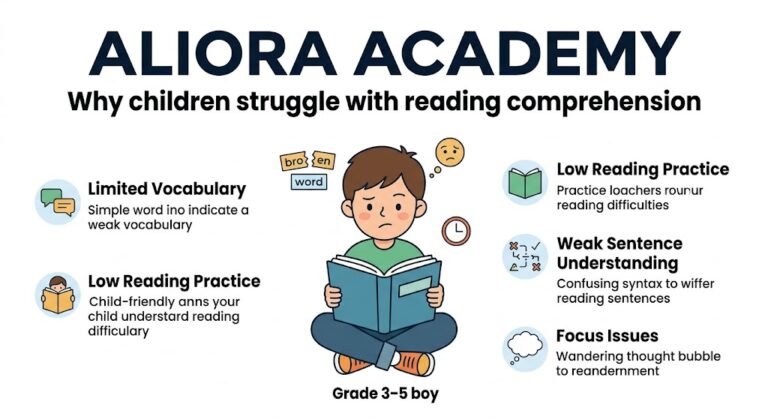
Why do students struggle with reading comprehension in Grade 3–5?
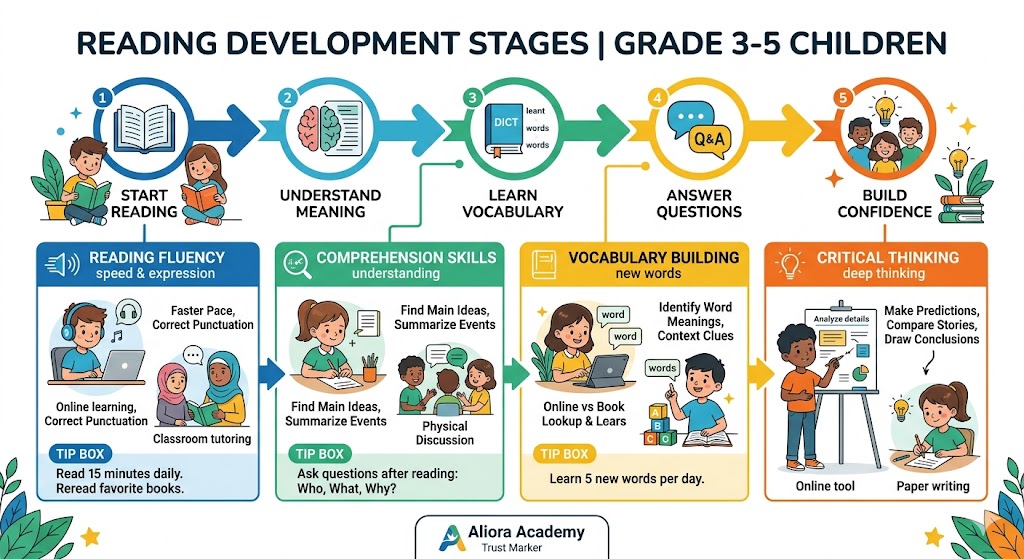
Many children in Grade 3–5 struggle because reading becomes more complex than just recognizing words. In Grade 3, students are still building basic reading fluency and word recognition. They often read sentence by sentence without understanding the full meaning. If you’re unsure whether your child’s reading habits signal a deeper issue, it can help to understand the signs your Grade 3 child needs a reading intervention.
In Grade 4, texts become longer, and students must understand paragraphs and story flow. At this stage, weak vocabulary becomes a major barrier. Children may know the words but cannot connect them in context. This is why many families look for English classes for Grade 4 that focus on structured comprehension building.
By Grade 5, students are expected to handle critical reading and inference skills, which means reading between the lines. Without proper training, they fail to identify hidden meaning or answer reasoning-based questions. Our guide on how to teach inference skills to children offers practical steps for this exact challenge.
A common classroom observation is that students:
- Pause too often while reading
- Mispronounce familiar words
- Forget what they just read
- Struggle to summarize stories
These issues show that reading problems are not only about speed but about understanding structure and meaning. A structured support system like an English learning program helps bridge this gap through guided practice and feedback.
How can children improve reading skills at home?
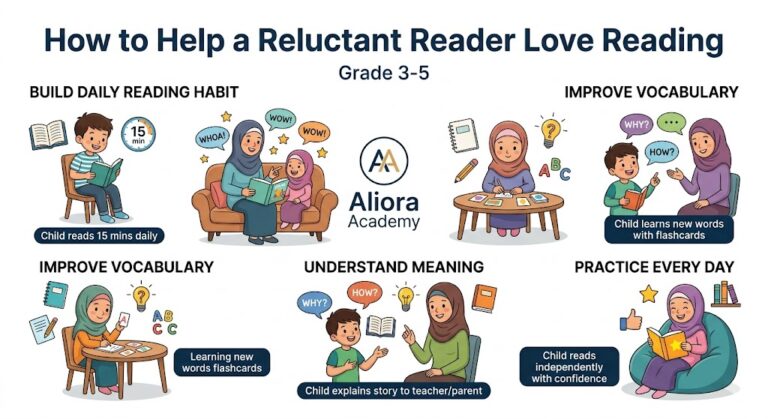
Parents play a major role in building reading habits, especially in early grades. Home practice should be simple, consistent, and interactive instead of forcing long reading hours. This approach is at the heart of how parents can support reading development in early grades.
A practical method includes:
- Reading 10–15 minutes daily
- Asking simple questions about the story
- Encouraging children to explain meanings in their own words
- Introducing new vocabulary slowly
In Grade 3, focus should be on sound recognition and sentence reading. In Grade 4, parents should encourage paragraph discussion. In Grade 5, children should be asked to predict outcomes and explain reasoning.
Parents often follow best learning method for children reading improvement at home and school without structure, which leads to slow progress. A guided system like online English classes provides structured exercises that align with school-level reading goals. To learn how to select the right program, read our guide on how to choose the right online reading program for your child.
Consistency matters more than long study sessions. Even short daily practice improves confidence and fluency over time.
What is the importance of reading fluency in early education?
Reading fluency is not just reading fast; it is reading smoothly with understanding. When children develop fluency, they naturally improve comprehension and academic performance. For a deeper look, read what reading fluency is and why it matters.
In Grade 3, fluency means reading simple sentences without hesitation. In Grade 4, it includes reading paragraphs with correct expression. In Grade 5, students must read with understanding and interpret meaning correctly.
Teachers often notice that fluent readers:
- Understand instructions quickly
- Perform better in exams
- Show stronger writing skills
- Have better vocabulary retention
A student working on Grade 4 reading comprehension and fluency practice methods showed improvement when guided through repeated reading exercises and vocabulary building tasks. Many families also find that reading accuracy matters more than speed in these grades.
Fluency also connects directly to writing and grammar understanding, because children who read well naturally learn sentence structure and language flow.
How does a reading tool improve learning outcomes?
A structured reading tool is designed to guide children step-by-step instead of random reading practice. It focuses on comprehension, vocabulary development, and fluency improvement in a balanced way.
The tool helps by:
- Breaking reading into small, understandable parts
- Teaching vocabulary in context
- Improving sentence structure awareness
- Providing guided comprehension questions
It is especially useful for children with why children struggle with understanding what they read because it identifies weak areas and builds them gradually. To further boost vocabulary, check out vocabulary building techniques for elementary school children.
Students using structured support systems show better results compared to unplanned reading because they follow a clear learning path. For a closer look at how tutoring can accelerate progress, see how online reading tutoring helps struggling readers catch up.
Parents often choose between tutoring methods, but tools combined with an English classes for Grade 3 program provide a more consistent learning structure than occasional practice sessions.
What mistakes do students make in reading practice?
Many students try to read faster instead of reading correctly. This creates confusion and weak comprehension over time.
Common mistakes include:
- Ignoring punctuation
- Skipping difficult words
- Not revising new vocabulary
- Reading without understanding meaning
In Grade 3, students often guess words instead of learning them. In Grade 4, they struggle to connect ideas between paragraphs. In Grade 5, they fail to analyze deeper meaning in stories. If your child avoids reading altogether, you may find helpful ideas in our post on how to help a reluctant reader fall in love with books.
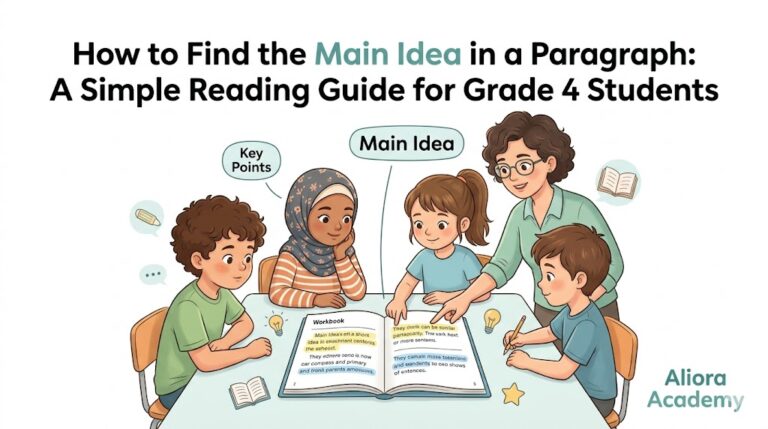
Teachers recommend slow, meaningful reading instead of rushed practice. A structured English classes for Grade 4 program helps correct these habits through guided correction and feedback. Another crucial skill is learning to find the main idea of a paragraph, which directly addresses comprehension gaps.
The key is not more reading but smarter reading with proper understanding techniques.
Real-Life Learning Examples
Example 1: Slow Reader in Grade 3
A Grade 3 student reads very slowly and avoids long sentences. After joining structured practice through English classes for Grade 3, the child practiced short daily reading tasks. Outcome: Improved fluency and reduced hesitation within 4 weeks.
Example 2: Poor Comprehension in Grade 4
A Grade 4 learner could read but failed to answer questions. Using guided paragraph breakdown and discussion-based learning through English classes for Grade 4, comprehension improved. Outcome: Better understanding of story meaning and improved test scores. For more support, see our guide on what to do when a child struggles with comprehension.
Example 3: Weak Vocabulary in Grade 5
A Grade 5 student struggled with academic words in science and English. Vocabulary-focused exercises through English classes for Grade 5 helped build word knowledge. Outcome: Stronger academic understanding and improved writing ability.
How does structured learning compare to random reading practice?
Structured learning provides a clear path, while random reading often leads to uneven progress.
A structured system:
- Builds skills step by step
- Tracks improvement
- Focuses on weak areas
- Ensures balanced growth in reading skills
Random reading may improve exposure but does not guarantee comprehension improvement. That is why guided learning is more effective for Grade 3–5 students. To explore more reading resources, visit the Aliora Academy blog or browse our reading category for additional tips.
FAQ
How can my child improve reading at home?
Daily short reading sessions with discussion questions and vocabulary practice help build strong reading habits.
What is the best way to build reading habits daily?
Consistency is key. 10–20 minutes of focused reading with understanding questions works better than long, irregular sessions.
How do reading tools improve comprehension skills?
They break reading into structured steps, teach vocabulary in context, and guide students through understanding meaning instead of just reading words.
Conclusion
Reading is the foundation of all academic learning. In Grade 3–5, children must move beyond word reading to real understanding. Regular practice, vocabulary growth, and guided learning play a major role in building strong reading skills. Structured support systems and consistent daily practice help students develop confidence, fluency, and comprehension. With the right learning approach, children not only read better but also think better and perform stronger in all subjects.