Why Does My Child Struggles With Reading Comprehension?
Why Does My Child Struggles With Reading Comprehension?
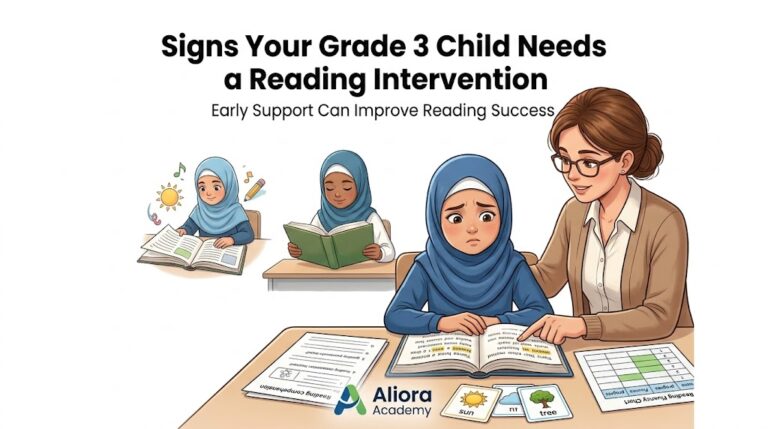
Child Struggles With Reading Comprehension is one of the most common concerns parents face when a child can read words but cannot understand the meaning behind them. For example, a Grade 3 student may read a paragraph fluently but still fail to answer simple questions, or a Grade 5 student may take too long to understand exam passages. This creates frustration, low confidence, and poor academic performance.
Reading comprehension is not just about reading words; it is about understanding ideas, connecting sentences, and thinking critically about what is being read. When children struggle in this area, it often affects every subject, including English, Science, and Social Studies. The good news is that this skill can be improved with the right guidance, practice, and structured learning approach.
Many children face difficulties due to weak vocabulary, poor reading habits, lack of focus, or gaps in language understanding. In some cases, students simply need better reading strategies and consistent practice to improve their comprehension skills.
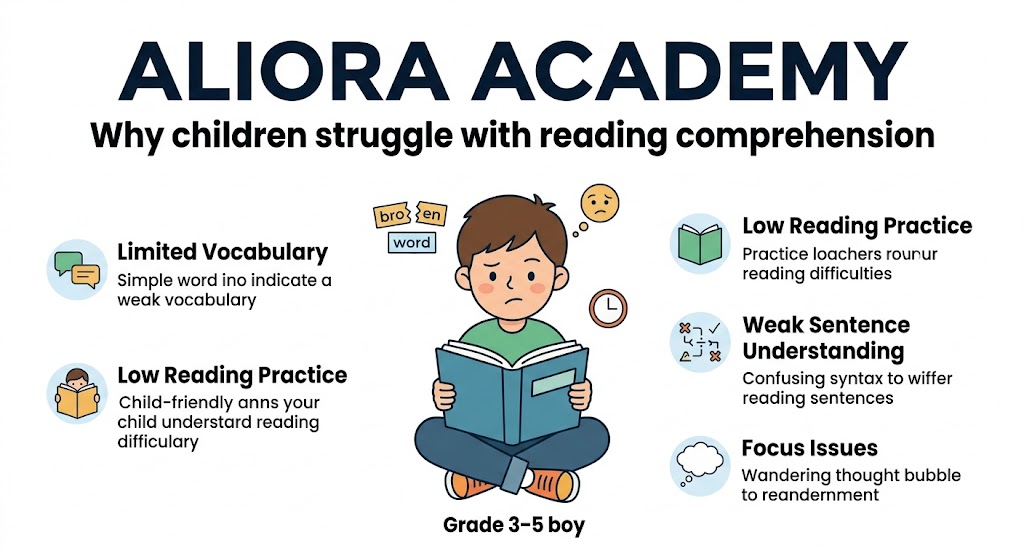
Why do children struggle with reading comprehension?
Children struggle with reading comprehension for several interconnected reasons that often go unnoticed in early learning stages. One major reason is weak decoding ability, where a child spends too much effort reading words and has little energy left to understand meaning.
Another common issue is limited vocabulary development. When students do not understand key words in a passage, they cannot grasp the full idea of the text. For example, a Grade 4 student reading a science paragraph may understand some sentences but miss the main concept due to unfamiliar words.
Other important factors include:
- Lack of daily reading practice
- Weak sentence structure understanding
- Difficulty connecting ideas across paragraphs
- Low attention span during reading tasks
A Grade 3 student often struggles with short passages because they are still building basic English reading skills. In Grade 4, the challenge shifts to understanding structured paragraphs. By Grade 5, students are expected to analyze and interpret text, which requires stronger cognitive skills.
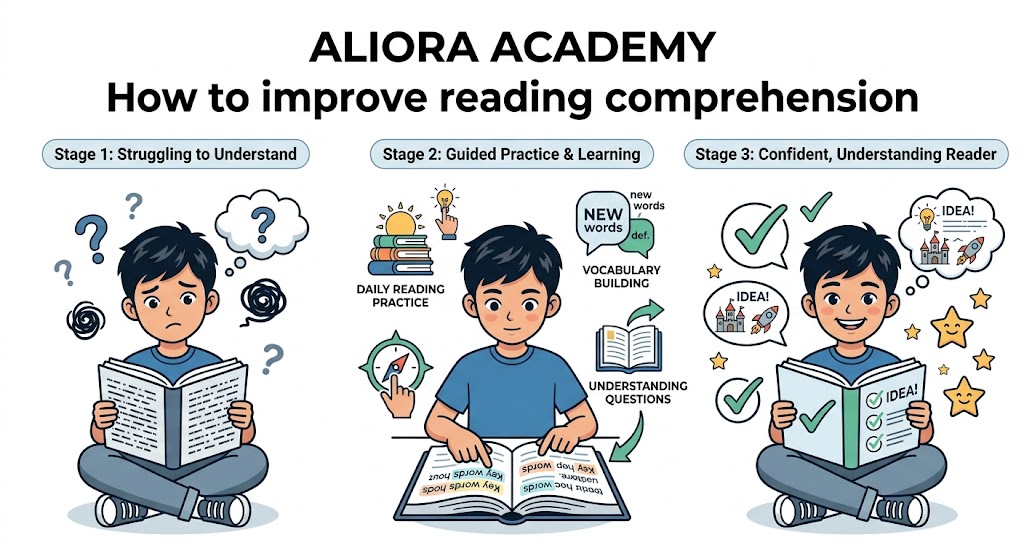
At Aliora Academy, structured programs like reading classes for Grade 3 help students build foundational comprehension skills step by step through guided practice and interactive reading.
How can students improve reading skills at home?
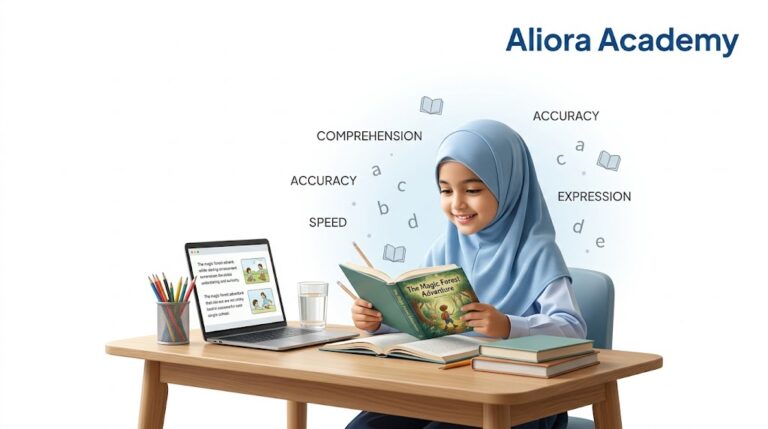
Improving reading comprehension at home requires consistency and the right approach rather than long study hours. Children learn best when reading becomes part of their daily routine, not a forced task.
Parents can support improvement through simple steps:
- Encourage 15–20 minutes of daily reading
- Ask questions like “What happened in this story?”
- Let children summarize what they read in their own words
- Focus on understanding, not speed
- Discuss new words after reading
A Grade 4 student, for example, may improve significantly when they are guided to break down paragraphs and identify main ideas. This builds strong comprehension skills and improves confidence in exams.
Structured support such as online reading classes helps children follow a guided system where reading, vocabulary, and understanding are taught together in a balanced way.
What role does vocabulary play in reading success?
Vocabulary is the foundation of strong reading comprehension. Without understanding words, a child cannot fully understand sentences or ideas. This is one of the most important reasons behind reading struggles.
When vocabulary is weak:
- Students guess meanings incorrectly
- Sentences lose clarity
- Reading becomes slow and confusing
- Interest in reading decreases
For Grade 3 learners, vocabulary helps them recognize basic words and build sentence understanding. In Grade 4, it supports paragraph comprehension and structured answers. By Grade 5, vocabulary becomes essential for academic reading and inference-based questions.
A strong language learning foundation improves not only reading but also writing and speaking. Programs like reading classes for Grade 4 focus on vocabulary building through context-based learning instead of memorization, which improves long-term retention.
Why does reading improve academic performance?
Reading is directly connected to overall academic success because it strengthens multiple learning areas at the same time. Students who read well understand textbooks faster, answer questions correctly, and perform better in exams.
Strong reading skills improve:
- Critical thinking
- Writing structure and clarity
- Listening comprehension
- Subject understanding in Science and Social Studies
For example, a Grade 5 student who practices daily reading can easily analyze long exam passages and answer inference-based questions. This is because strong reading builds the ability to connect ideas logically.
When children develop consistent reading habits, they naturally improve literacy development and academic confidence. Structured learning like reading classes for Grade 5 helps students master advanced comprehension and analytical reading skills needed for higher grades.
How can parents support reading at home?
Parents play a critical role in building strong reading habits in children. Support at home can make a significant difference in how quickly a child improves.
Effective strategies include:
- Reading together with the child daily
- Asking open-ended questions about stories
- Encouraging children to explain meanings
- Providing age-appropriate books
- Creating a quiet reading environment
Many children improve faster when parents show interest in their reading journey. For instance, discussing a story during dinner or asking about new words helps strengthen memory and understanding.
When combined with structured support like a reading improvement program, children receive both home guidance and professional instruction, which accelerates progress in comprehension skills.
Real-Life Examples
Example 1: Grade 3 Student Struggling with Reading Words
A young Grade 3 student could read slowly but did not understand simple sentences.
Problem: Weak vocabulary and slow word recognition
Solution: Daily phonics practice and guided reading sessions
Outcome: Improved word recognition and basic sentence understanding within weeks
Example 2: Grade 4 Student Improving Comprehension Skills
A Grade 4 student could read but struggled to answer paragraph questions.
Problem: Difficulty identifying main ideas
Solution: Practice summarizing each paragraph in one sentence
Outcome: Improved confidence in structured reading questions
Example 3: Grade 5 Student Preparing for Exams
A Grade 5 student struggled with long exam passages.
Problem: Weak inference and slow comprehension
Solution: Timed reading practice and question analysis training
Outcome: Better exam performance and faster understanding of texts
FAQs
How can my child improve reading comprehension skills?
Regular reading practice, vocabulary building, and guided questioning help improve comprehension. Structured learning and daily reading routines create the strongest results over time.
What is the best age to improve reading ability?
Early elementary years, especially Grade 3 to Grade 5, are the most important stages. Skills built at this age create long-term academic success.
Do online reading classes really help students?
Yes, when designed properly. Online classes provide structured lessons, vocabulary support, and guided comprehension practice that improve reading performance step by step.
Conclusion
Reading is the foundation of all learning. When a child builds strong vocabulary development, regular reading habits, and proper comprehension skills, academic performance improves naturally. Most reading challenges can be solved with consistent practice and the right guidance.
Parents who support daily reading at home and combine it with structured learning see steady improvement in confidence and understanding. With proper support, every child can become a strong and independent reader.