Parent Guide to Building Strong Math Foundations in Elementary School
A strong math foundation in elementary school decides how well a child performs in higher grades. Many children struggle later because their basic concepts were never properly built. Parents play a key role in shaping these early skills by supporting daily practice, understanding learning gaps, and encouraging consistent learning habits. With the right guidance, math can become simple, logical, and enjoyable for children instead of a subject they fear.
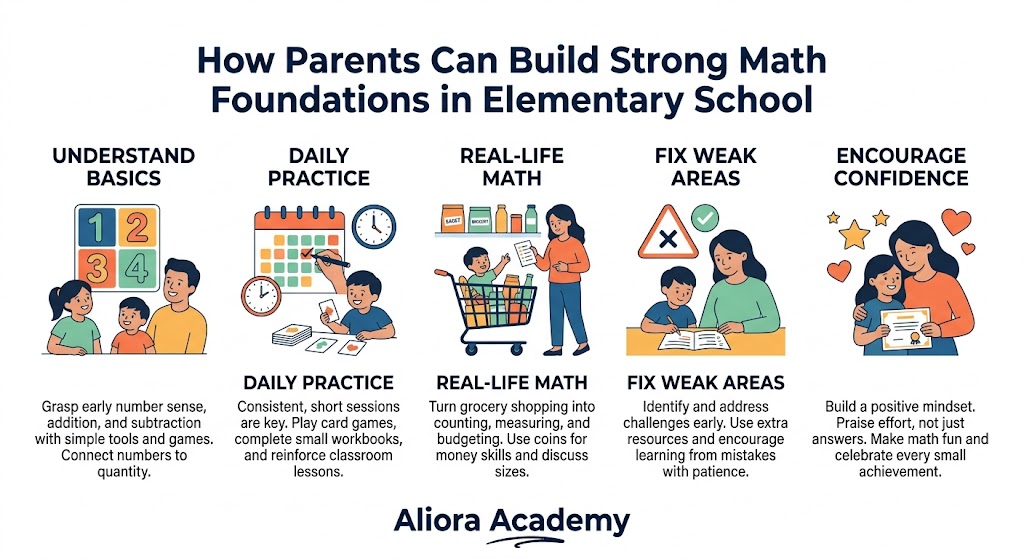
Parent Guide to Building Strong Math Foundations in Elementary School
The early elementary school years represent a critical window for neurological development, particularly regarding how young minds organize, process, and execute analytical reasoning tasks. Mathematics is not merely an isolated academic discipline comprised of rigid equations; it is a highly integrated linguistic framework. When children are introduced to foundational mathematics with an emphasis on systematic logical relationships, they develop cognitive structures that extend far beyond elementary school testing standards.
Many parents mistakenly assume that proficiency in early mathematics is determined by innate talent or a natural disposition toward numbers. However, contemporary cognitive science confirms that mathematical fluency is an acquired capability rooted directly in high-quality conceptual exposure. By establishing a structurally sound and emotionally secure learning environment, parents can guide their children past early computational hurdles and toward genuine cognitive independence.
To explore how these core academic pathways scale systematically across different early developmental thresholds, parents can review our centralized blueprint inside the Aliora Mathematics Portal, which serves as the anchor point for our structured curriculum frameworks.
1. The Systemic Impact of Early Math Foundations
Early childhood mathematics instruction sets the baseline for all subsequent analytical pathways. When a young student masters basic spatial properties, numerical values, and operations, they are not just passing a grade-level benchmark; they are wiring their working memory to successfully handle layered abstract logic later in life.
Neurological research highlights that numerical proficiency in early childhood serves as a strong predictor of long-term academic success across both STEM subjects and language arts. This predictive strength stems from the unique structural demands of mathematics, which require simultaneous working memory storage, strategic planning, and rapid rule execution.
When a child engages with mathematical frameworks between kindergarten and fifth grade, they move through distinct cognitive transitions:
- Numerical Object Permanence: Moving from counting individual concrete physical objects to understanding abstract numbers as symbolic variables.
- Operational Scalability: Recognizing that addition and subtraction scale directly into advanced multiplicative groups and fractional proportions.
- Structural Pattern Recognition: Identifying underlying algebraic properties hidden within simple geometric and arithmetic groupings.
2. How Parents Act as Cognitive Translators
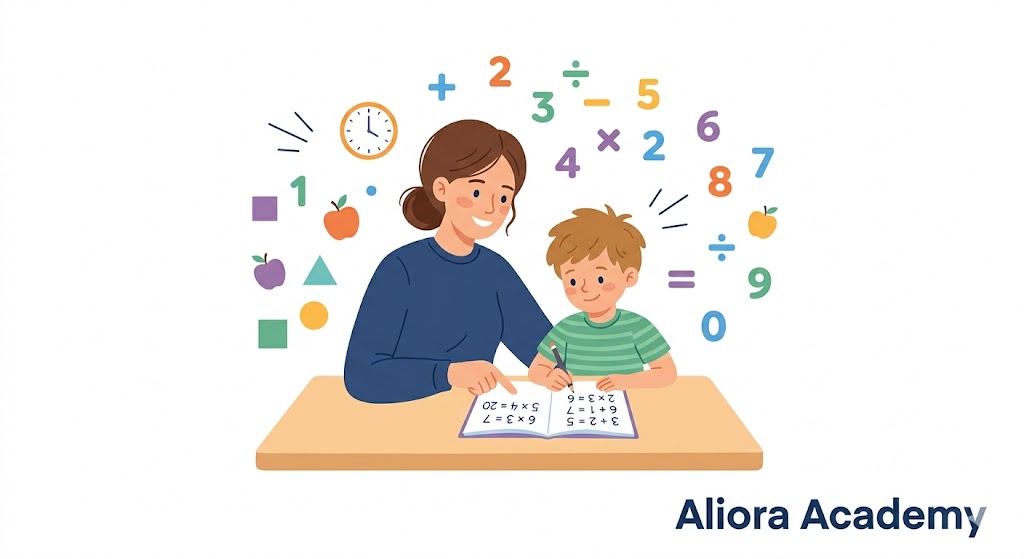
Parents do not need an advanced engineering or statistics background to foster an exceptionally high degree of mathematical confidence in their children. Instead, the parental role is best understood as that of a cognitive translator. A classroom teacher must deliver structured group instruction, but a parent has the unique opportunity to personalize these concepts within daily life.
When parents deliberately weave computational tasks into routine conversations, they strip math of its cold, academic isolation. For instance, cooking transforms a flat textbook page on fractions into an active lesson on ratios and volume distribution. Scaling a baking recipe requires real-time fractional addition and multiplication.
Similarly, tracking real-world metrics like grocery store unit pricing or gas mileage encourages children to calculate proportional variations naturally. This continuous exposure proves to young minds that math is not a punitive set of rules designed for testing, but a practical survival tool used to understand the modern world.
3. Identifying and Reversing Common Parental Pitfalls
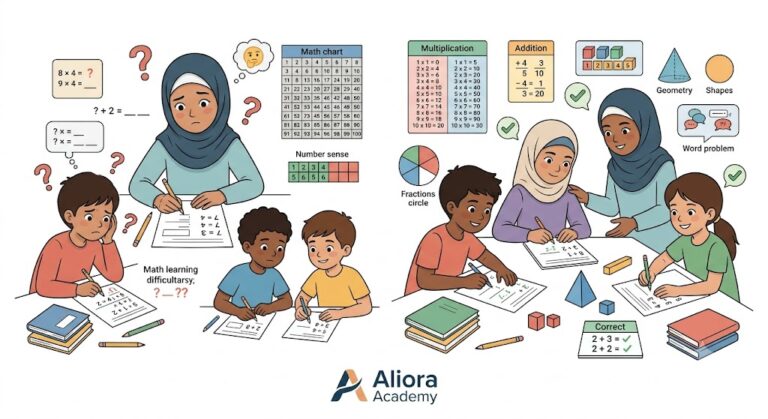
Despite the best intentions, parents often fall into traditional teaching traps that can inadvertently spark long-lasting math anxiety. Recognizing these subtle behavioral pitfalls is the first step toward building a healthier, more productive learning environment at home.
Critical Danger Zone: The Speed Premium Trap
Demanding that a child solve calculation sheets instantly creates a high-stress environment that triggers the brain's threat-response centers. When anxiety takes over, the prefrontal cortex—the exact zone needed for mathematical reasoning—is temporarily disabled. Always prioritize conceptual depth over rapid responses.
Another common mistake is treating minor calculation errors as absolute conceptual failures. When a child miscalculates a multi-step problem, pointing out the incorrect final answer without acknowledging their correct logical setup destroys their confidence. Instead, praise their structural approach and gently guide them to find the minor calculation slip on their own. This changes mistakes from a source of shame into a natural, constructive part of problem-solving.
4. Tackling Multiplication and Complex Word Problems
As students progress into mid-elementary school, the curriculum moves away from simple arithmetic and into multi-layered operations. This shift is where many young learners experience their first major drop in academic confidence, particularly when confronting multiplication tables and text-heavy word problems.
Multiplication should never be taught through raw, rote memorization. Memorizing numbers without understanding their underlying meaning leaves students ill-prepared for advanced algebraic groupings. Instead, parents should focus on array modeling—showing that $4 \times 6$ is a structured grid containing four rows of six distinct units.
Once a child visualizes these mathematical areas, they can seamlessly transition into the curated lessons within our Grade 3 Mathematics Program, which focuses heavily on transitioning young minds into advanced operational fluency.
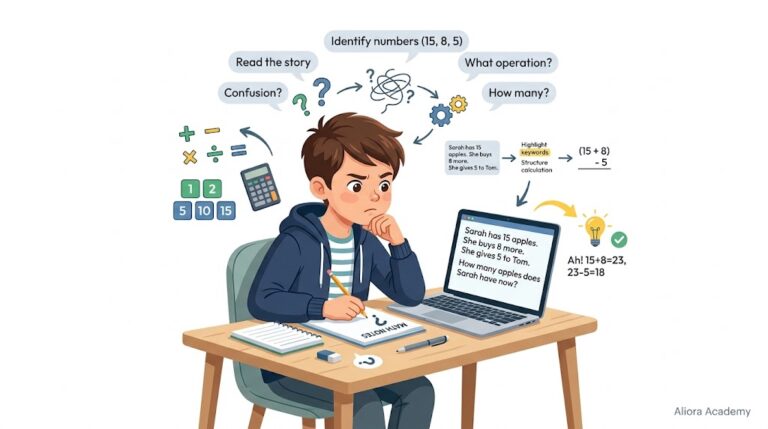
Word problems introduce an entirely new layer of difficulty by combining reading comprehension with mathematical translation. Children often struggle not because they cannot perform the calculation, but because they cannot extract the math from the paragraph. Parents can help by breaking the problem down into a systematic code-breaking exercise.
If your child is currently facing roadblocks with multi-step written scenarios, you can access specialized diagnostic toolkits and structural breakdowns within our comprehensive guide on what to do when a child struggles with math word problems.
5. Designing Micro-Practice Routines for Long-Term Memory
Cognitive durability is built through frequent, low-stakes practice rather than high-pressure cramming sessions. Forcing a child into grueling multi-hour weekend study sessions is highly inefficient; it exhausts their working memory and builds resentment toward the subject.
Instead, the most successful home learning strategies rely on structured micro-sessions lasting just 15 to 20 minutes each day. These short sessions keep the brain active without hitting cognitive burnout thresholds.
| Target Session Phase | Operational Activity Model | Primary Neurological Benefit |
|---|---|---|
| Phase 1: Warm-up (3-5 Mins) | Rapid, low-stakes numerical patterns or mental reviews. | Activates math pathways and clears mental lethargy. |
| Phase 2: Core Focus (10 Mins) | Working through 3 to 5 conceptual challenge tasks. | Builds new synaptic pathways without causing mental fatigue. |
| Phase 3: Connection (5 Mins) | Explaining the "why" behind the solutions aloud. | Locks the day's lessons into long-term memory reserves. |
As students progress into mid-elementary coursework, these daily practice routines must be paired with clear, age-appropriate learning goals. Parents looking for targeted learning plans to guide these micro-sessions can explore the benchmarks in our Grade 4 Structural Framework, which outlines the exact operational standards required at that level.
6. Shifting From Rote Memorization to Deep Conceptual Logic
Rote memorization creates a fragile illusion of math mastery. A child might memorize a specific pattern well enough to get a perfect score on a predictable Friday pop quiz, but if they do not understand the underlying logic, that knowledge vanishes the moment a problem is framed slightly differently.
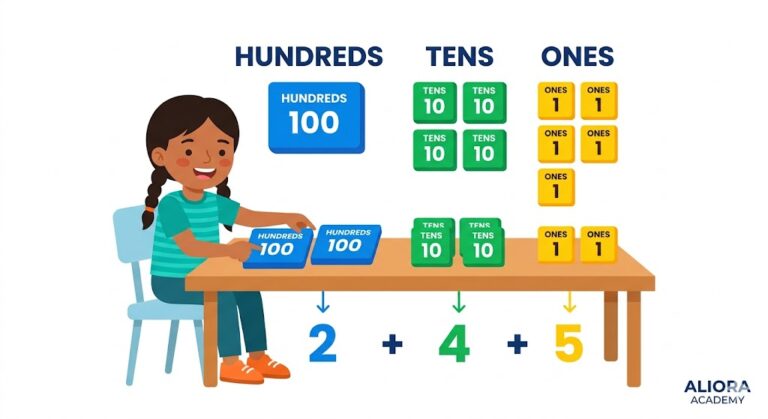
Concept-based learning, by contrast, focuses entirely on teaching children the structural logic behind why algorithms work. For example, instead of simply teaching a child to "borrow a one" during long subtraction, show them how they are actually decomposing a base-10 block into ten individual units.
When a child truly understands this process of structural decomposition, they can effortlessly apply it to decimals, currency conversions, and algebraic variables. This deep logical foundation ensures they never find themselves lost as the curriculum grows more complex.
As your child nears the transition into middle school, maintaining this conceptual clarity becomes absolutely essential for survival. To ensure your student is fully prepared to handle complex numerical systems and multi-layered variables, you can reference our advanced milestone guide within the Grade 5 Mathematics Curriculum.
7. Maximizing Growth with Professional Online Math Instruction
While home support provides an invaluable foundation, many parents eventually run into limitations in time, scheduling, or teaching experience as their child moves into complex upper-elementary school topics. This is where partnering with a structured online math program can completely transform a child's academic trajectory.
Professional online math platforms do not just hand children digital worksheets. They combine expert instruction, dynamic visual aids, and real-time adaptivity to pinpoint and close specific learning gaps instantly.
A certified educator can provide neutral, patient guidance that helps prevent the emotional tension that sometimes surfaces when parents tutor their own children. By blending structured home reinforcement with expert digital pedagogy, parents can ensure their child receives a remarkably well-rounded, stress-free math education.
For families searching for highly effective, structured learning environments tailored specifically to these mid-elementary development goals, read our full analysis of the Best Online Math Classes for Grade 4 Students.
8. The Long-Term Return on Early Mathematical Literacy
The time and energy parents invest in building early math skills yield incredible long-term rewards. When an elementary student learns to face complex problems with patience, logic, and curiosity, they are developing a resilient mindset that will serve them for life.
Deep conceptual clarity protects children from math anxiety, sparks their creative problem-solving abilities, and opens the door to future success in a technology-driven world. By eliminating high-pressure speed drills, adopting smart daily practice routines, and using professional learning resources when needed, parents give their children the ultimate academic gift: the confidence to look at any complex problem and know they have the tools to solve it.