Why Does My Child Struggles With Word Problems in Math?
Why Does My Child Struggle With Word Problems in Math?
Many parents become concerned when their child struggles with word problems, even though they can solve basic calculations correctly. A student may know how to add, subtract, multiply, or divide, but suddenly feel confused when those same skills appear inside a written story problem.
Imagine a Grade 4 student who can solve multiplication questions on a worksheet with ease. However, when asked to calculate how many apples are needed for several baskets in a word problem, they do not know where to begin. This situation is very common and often leaves both students and parents frustrated.
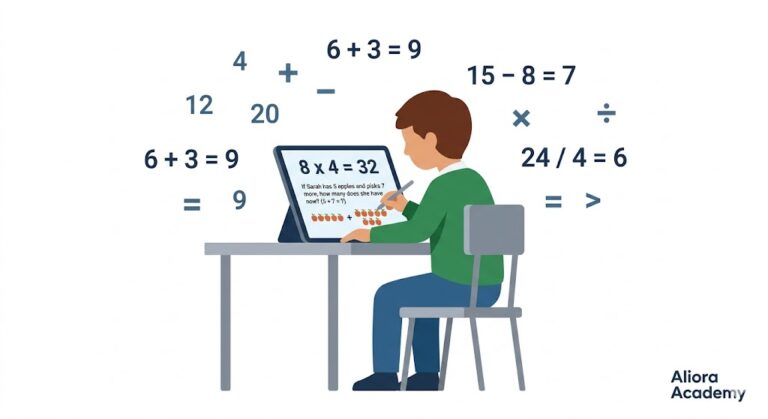
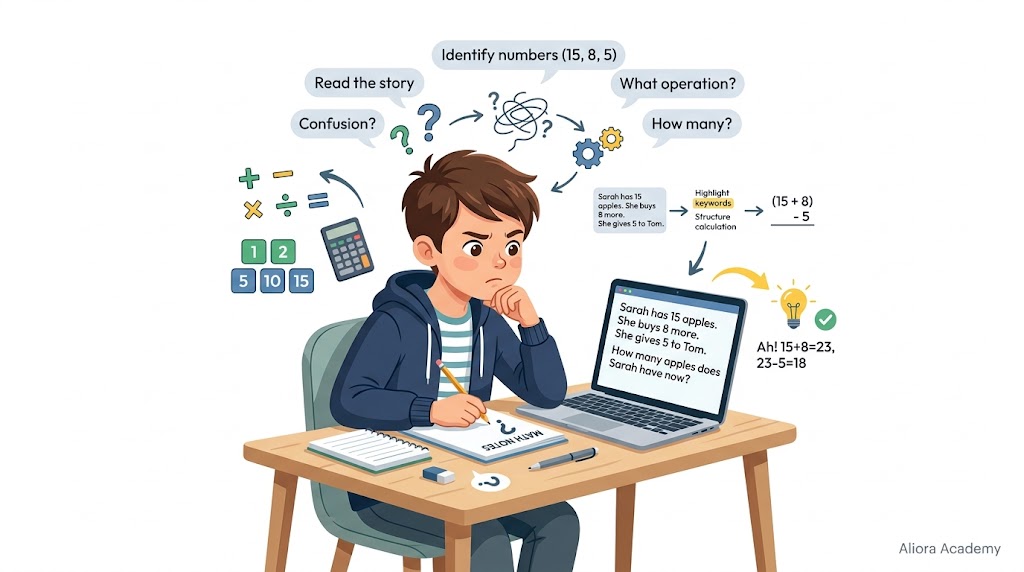
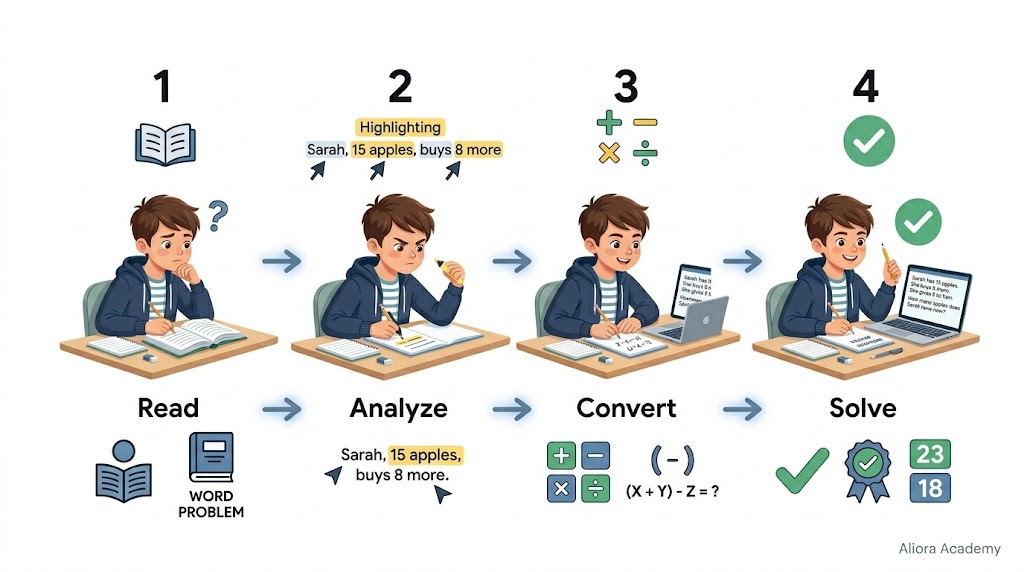
Word problems require much more than arithmetic. Students must read carefully, understand the situation, identify important information, choose the correct operation, and then solve the problem accurately. When one of these steps becomes difficult, overall performance can suffer.
The good news is that most challenges can be improved through targeted practice, strong learning strategies, and consistent support. Understanding the reasons behind the difficulty is the first step toward helping students become confident problem solvers.
Why Do Children Struggle With Math Word Problems?
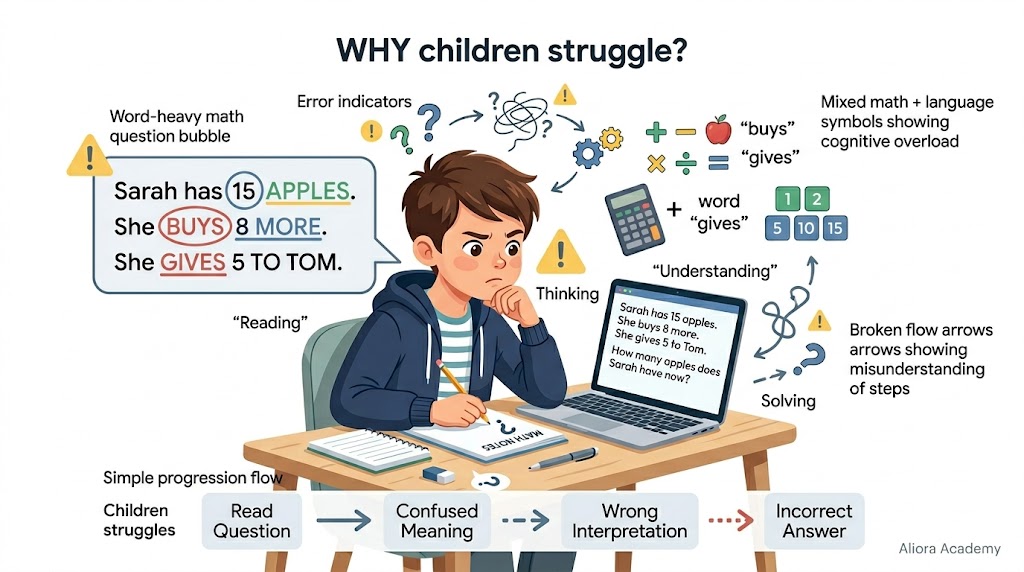
Word problems combine reading comprehension and mathematics. Many students understand numbers but have trouble understanding the language used in questions.
A common issue is limited understanding of mathematical vocabulary. Words such as “difference,” “total,” “product,” and “quotient” can confuse younger learners if they are unfamiliar with their meanings.
Some students also rush through the question without identifying important details. They may focus on numbers only and ignore the context, leading to incorrect answers.
Other students struggle because they have gaps in basic arithmetic skills. If addition, subtraction, multiplication, or division are not automatic, solving a complex word problem becomes much harder.
Additional factors include:
- Weak reading comprehension
- Difficulty identifying key information
- Lack of confidence in mathematics
- Poor problem-solving strategies
- Limited practice with real-world math situations
Students enrolled in structured math learning programs often develop stronger analytical skills because they learn how to break problems into manageable steps.
For families looking for additional support, Aliora Academy’s math learning program can help students strengthen foundational concepts through guided instruction.
Why Is Number Sense Important for Solving Word Problems?
Number sense is the ability to understand how numbers work and relate to one another. It helps students estimate answers, recognize patterns, and select appropriate operations.
Without strong number sense, students often guess which operation to use. They may add when multiplication is required or subtract when division makes more sense.
Strong number sense allows students to:
- Recognize reasonable answers
- Compare quantities
- Estimate outcomes
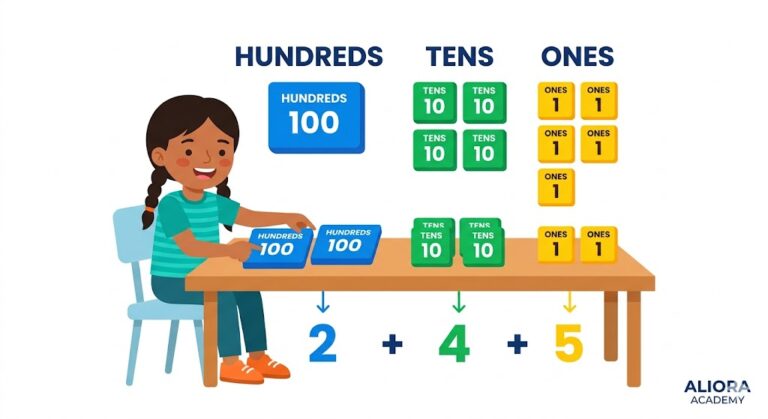
- Understand place value
- Apply arithmetic skills effectively
In Grade 3, students begin developing these abilities through place value, addition, subtraction, and multiplication concepts. Strong foundations make future problem-solving easier.
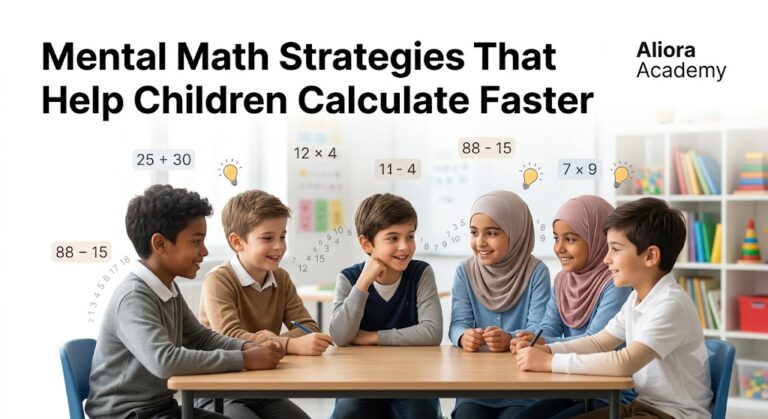
Students who regularly practice mental math activities often become faster and more accurate when solving word problems because they spend less time calculating and more time thinking critically.
Number sense also supports long-term academic success in fractions, decimals, measurement, and geometry.
Why Are Reading Skills Connected to Mathematics Success?
Many parents are surprised to learn that reading skills play a major role in mathematics performance.
Word problems require students to read carefully, understand instructions, and interpret information correctly. Even when the math is simple, poor reading comprehension can create confusion.
Students often struggle with:
- Understanding question wording
- Identifying important information
- Ignoring irrelevant details
- Following multi-step instructions
For example, a student may correctly multiply numbers but misunderstand what the question is actually asking.
Teachers frequently encourage students to:
- Read the problem twice.
- Highlight key information.
- Identify the question being asked.
- Create a plan before solving.
These habits improve both reading comprehension and mathematical reasoning.
How Do Grade-Level Math Expectations Affect Word Problem Performance?
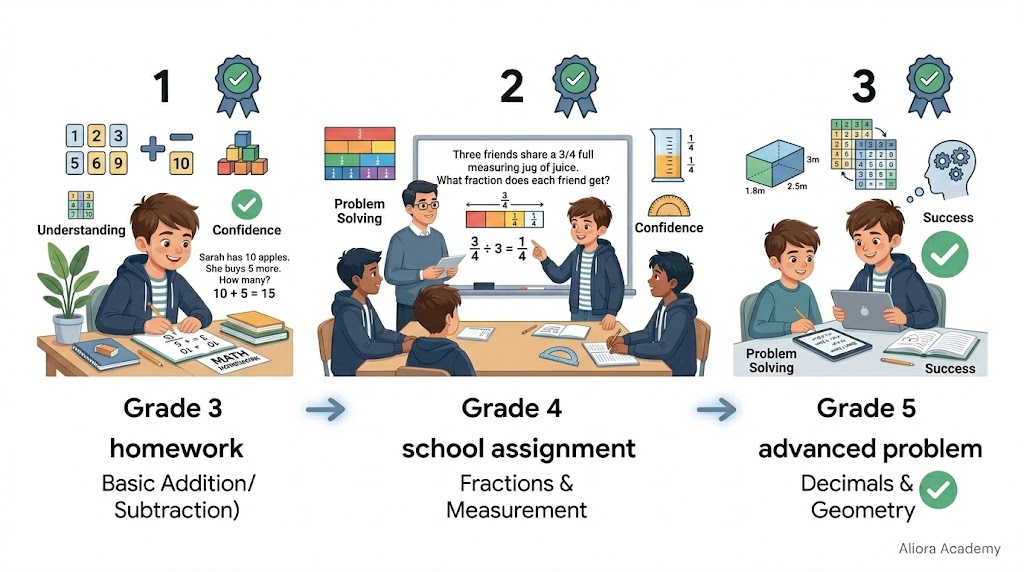
Word problem complexity increases significantly from Grade 3 through Grade 5.
Grade 3 Expectations
Students begin working with:
- Addition and subtraction word problems
- Multiplication basics
- Place value concepts
- Number patterns
Students who need additional support may benefit from dedicated math classes for Grade 3.
Grade 4 Expectations
Students encounter:
- Multi-digit operations
- Fractions
- Measurement
- Geometry basics
- More advanced problem solving
Structured math classes for Grade 4 can help students build confidence in these new concepts.
Grade 5 Expectations
Students face:
- Advanced fractions
- Decimals
- Multi-step word problems
- Geometry concepts
- Critical mathematical thinking
Students often succeed when they receive consistent guidance through math classes for Grade 5.
As expectations grow, foundational gaps become more noticeable. Addressing weaknesses early prevents future learning difficulties.
What Real-Life Examples Show How Students Improve Their Problem-Solving Skills?
Example 1: Grade 3 Student Improving Multiplication Skills
A Grade 3 student understood addition but struggled with multiplication word problems.
The challenge was slow recall of multiplication facts. The solution involved daily multiplication practice using visual arrays and short exercises. Within several weeks, the student solved word problems more quickly and accurately because multiplication became automatic. Parents can explore practical multiplication strategies here.
Example 2: Grade 4 Student Learning Fractions
A Grade 4 student struggled with fraction word problems because fractions felt abstract.
The solution involved visual fraction models, fraction circles, and real-life examples involving food portions. As understanding improved, the student became more comfortable solving fraction-based questions and measurement problems.
Example 3: Grade 5 Student Solving Multi-Step Problems
A Grade 5 student became overwhelmed by multi-step questions.
The challenge was organizing information correctly.
The student learned to:
- Underline key information
- Break problems into smaller steps
- Check answers carefully
After consistent practice, confidence increased and test performance improved significantly.
How Can Parents Support Math Learning at Home?
Parents play an important role in helping children develop strong mathematics skills.
The goal is not to provide answers but to guide thinking.
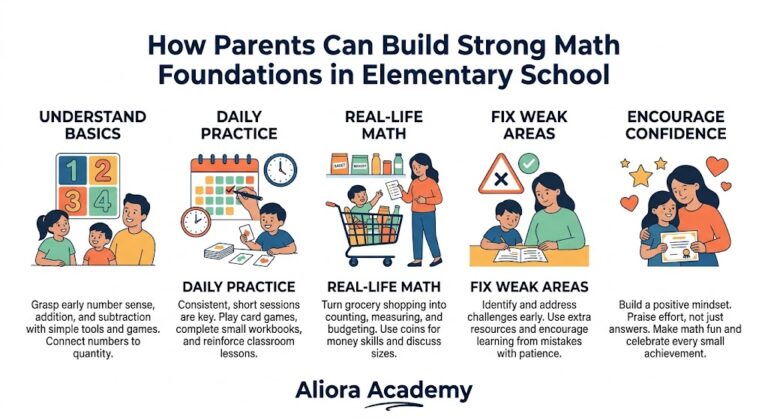
Helpful strategies include:
- Encourage daily math practice
- Discuss math in everyday situations
- Use shopping and budgeting activities
- Ask students to explain their reasoning
- Praise effort and persistence
For example, while grocery shopping, parents can ask children to estimate totals, compare prices, or calculate discounts.
Simple conversations about numbers strengthen logical thinking and practical problem-solving abilities.
Families can also explore additional math resources and learning support through Aliora Academy’s Mathematics.
How Can Students Build Math Confidence?
Confidence grows when students experience consistent success.
Many students believe they are “bad at math” after making mistakes. In reality, mistakes are part of learning and often reveal where improvement is needed.
Students can build confidence by:
- Practicing regularly.
- Breaking large tasks into smaller steps.
- Reviewing mistakes carefully.
- Celebrating small improvements.
- Asking questions when confused.
Strong study habits, effective homework routines, and supportive instruction help students become independent learners.
Many students gain additional confidence through guided online math classes, where they receive personalized support and immediate feedback.
When students begin solving problems independently, their motivation often increases naturally.
FAQs
How can my child improve math skills at home?
Encourage daily practice, use real-life math activities, review mistakes together, and focus on understanding concepts rather than memorizing answers.
What is the best way to learn multiplication tables?
Regular practice, visual models, skip counting, games, and repeated exposure help students remember multiplication facts more effectively.
How do online math classes help students succeed?
Online classes provide structured lessons, personalized guidance, consistent feedback, and opportunities to strengthen mathematics skills at an appropriate pace.
Conclusion
When a child struggles with math word problems, the issue is often linked to reading comprehension, number sense, problem-solving strategies, or foundational arithmetic skills rather than mathematics alone.
Students become successful problem solvers when they develop strong math confidence, improve their number sense, strengthen critical thinking, and practice consistently. Whether they are working on Grade 3 multiplication, Grade 4 fractions, or Grade 5 multi-step problems, steady progress is possible with the right support.
Parents can make a meaningful difference by encouraging positive learning habits, creating opportunities for real-world math practice, and helping students approach challenges with patience and persistence. Over time, these small efforts can lead to stronger problem-solving skills, greater independence, and long-term academic success.