Best Online Math Classes for Grade 4 Students
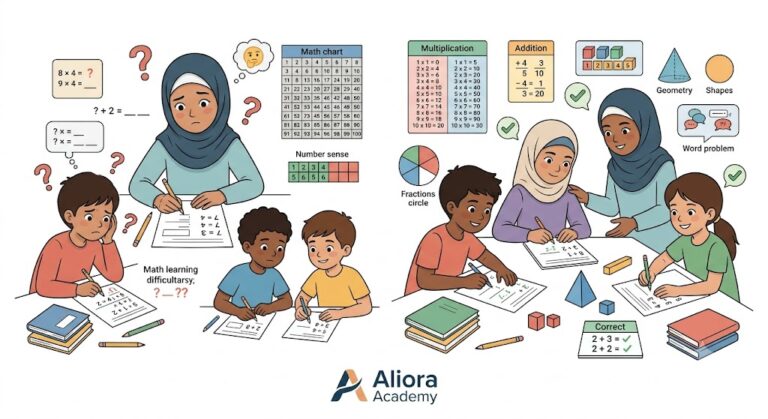
Grade 4 is a critical stage where math becomes more advanced with multiplication, division, fractions, and word problems. Many children struggle when concepts are not clearly explained in school. Best online math classes for Grade 4 students provide structured learning, step-by-step explanations, and practice that helps children understand math in a simple and stress-free way. These classes build confidence and improve problem-solving ability through guided learning.
Secure immediate slot placement inside our dedicated Grade 4 Math Hub. Explore our comprehensive structural framework on the primary Math Classes Portal, or return home to evaluate alternative academic programs via our Aliora Academy Main Gateway.
Why Grade 4 Students Need Structured Online Math Learning
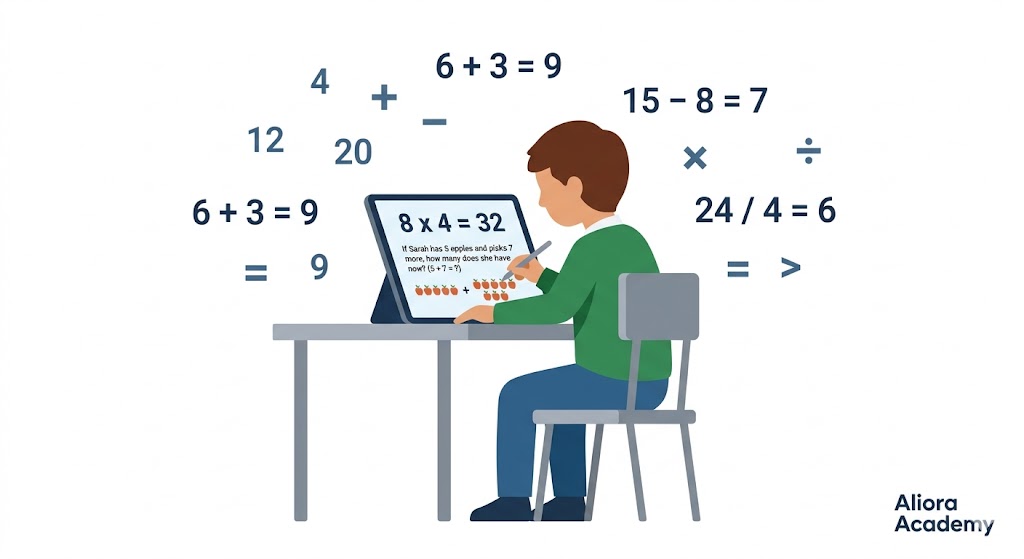
Math in Grade 4 is not just about memorization; it is about understanding logic and solving problems. Many students lose confidence when they cannot follow classroom speed. Online math classes solve this problem by allowing children to learn at their own pace with clear explanations and repeated practice. This improves understanding and reduces fear of math.
Explore our core methodology within the comprehensive Online Math Portal, or register your child directly for specialized curriculum maps inside the dedicated Grade 4 Class Tracking Hub.
Is your child falling behind on complex multi-step math tasks?
Word problems and situational math challenges often cause hidden learning bottlenecks for young students during elementary transitions.
Read Our Structural Resolution GuideCommon Problems Grade 4 Students Face in Math
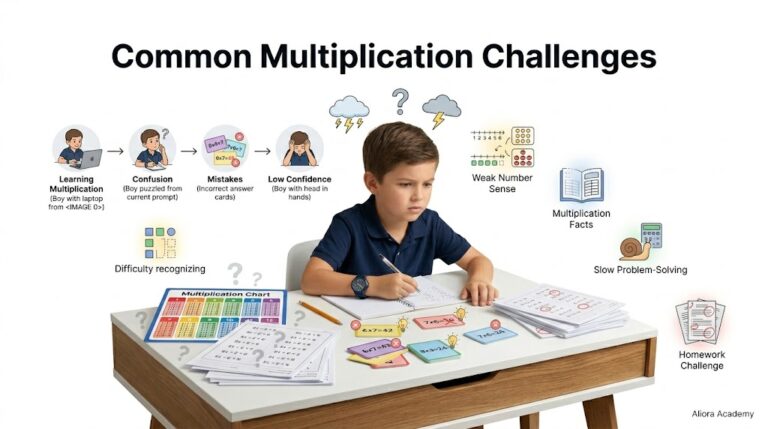
Many Grade 4 students face difficulties in understanding multiplication tables, solving word problems, and managing time-based math exercises. Weak foundational skills from Grade 3 often continue into Grade 4, making concepts harder. Some children also struggle with attention, which affects their accuracy in solving problems.
If hidden academic gaps stem from previous terms, explore our structural remedies for Grade 3 Foundational Math Review or review targeted tactics to improve multiplication skills early.
Core Pain Points
Select a learning bottleneck below to review its primary warning indicator:
The student gets confused when parsing multi-step scenarios, leading to computational paralysis or random number guessing.
View Solution ArchitectureWhat Makes Online Math Classes Effective for Grade 4
Step-by-Step Concept Explanation
Breaking down advanced operations like long division and multi-step equations into clear, manageable logical phases.
Interactive Problem-Solving Practice
Engaging exercises that provide immediate feedback to transform abstract theories into practical, independent mastery.
Daily Homework Support
Constructive real-time assistance to guide students through challenging school assignments without creating academic stress.
Visual Learning for Difficult Topics
Utilizing visual models, dynamic charts, and fraction bars to simplify complex geometric and fractional ideas.
Regular Performance Tracking
Continuous structural reporting and milestones that keep parents clearly informed of practical skill improvements.
Review available curricula inside the Grade 4 Classroom Framework, discover our general pedagogical blueprints via the Core Mathematics Portal, or explore general educational insights across the Aliora Mathematics Resource Category.
Benefits of Online Math Learning for Grade 4 Students
Adaptive structural learning shifts metrics from anxious rote memorization to real mathematical reasoning.
Online math learning helps students improve accuracy, speed, and confidence. It allows children to revisit difficult topics and practice until they understand. This method also reduces exam stress and builds long-term mathematical thinking skills that are useful in higher grades.
Targeted Mastery Loops
Children can immediately isolate, break down, and revisit demanding topics repeatedly until the concept is crystal clear.
Exam Stress Minimization
Continuous progress evaluation removes the fear of high-stakes testing, transforming exams into a standard showcase of built abilities.
Advanced Preparation Strategy
Constructing core mental agility and algorithmic tracking frameworks ensures an easy transition into subsequent analytical stages.
Review the current Grade 4 Structural Agenda, prepare for upcoming milestones via our Grade 5 Curriculum Matrix, or trace our overarching educational methodology across the Aliora Mathematics Resource Center.
How Regular Practice Improves Math Performance
Math skills improve with consistent practice. Even 20 minutes of daily problem solving can significantly improve understanding. Online classes provide structured worksheets and exercises that help children strengthen weak areas and build confidence step by step.
Track ongoing milestones via the Grade 4 Analytical Dashboard, scale advanced baseline logic inside our main Mathematics Suite, or review critical precursors to improve multiplication skills early.
Daily Drill Impact Matrix
Isolates syntax friction and misaligned arithmetic carries.
Builds fluid response speeds for long division and complex fractions.
Transforms multi-step word strings into clear equations safely.
How Parents Can Support Grade 4 Math Learning
Integrating quick mathematical reasoning checks during family routines transforms abstract school standards into fluid, instinctive real-world skills.
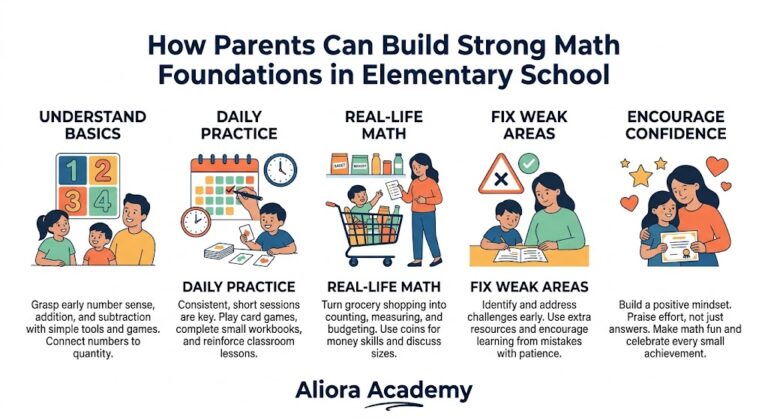
Parents can support children by encouraging daily practice, reviewing homework, and helping them stay consistent. Simple discussions about math in daily life, like shopping or time calculation, make learning more practical and interesting.
Consistency Frameworks
Establishing daily problem-solving habits reinforces cognitive loops, reducing long-term testing anxiety and friction.
Real-World Math Syncs
Using shopping trips, metric estimation, or scheduling calculations brings mathematical thinking to life outside the workbook.
Guided Reinforcement
Reviewing daily structural homework ensures micro-gaps are caught early before they impacts progressive milestones.
If your child struggles with word problems, read our intervention blueprint, explore general learning paths on our homepage at Aliora Academy, or select customized assets from the Core Mathematics Portal.
Why Online Math Classes Are Better Than Traditional Learning
Online classes offer flexibility, personal attention, and visual explanations that traditional classrooms often lack. Students can replay lessons, practice more, and learn without pressure. This improves long-term understanding and academic performance.
By pulling down physical walls, your child accesses custom-paced modules designed specifically to eliminate conceptual gaps before they form bad learning blocks.
Secure placement directly inside the Grade 4 Specialized Track, assess alternative mathematical strategies at the Core Math Hub, or explore general educational insights inside the Aliora Math Resource Portal.
Best Online Math Classes for Grade 4 Students
1. The Crucial Pivot: Why Grade 4 Math Dictates Future STEM Capability
Fourth grade marks a structural realignment in an elementary student's cognitive relationship with numeric systems. In earlier grades, mathematics focuses heavily on physical counting, simple additive pooling, and immediate calculation sequences. However, as students cross into the fourth-grade framework, numbers expand into abstract multi-dimensional tools. The conceptual weight shifts rapidly from basic operations to complex systems, requiring deep logical analysis rather than simple memorization.
Educational psychology routinely singles out this specific term as a defining milestone for long-term STEM performance. It is here that students are first introduced to sophisticated operational hierarchies, challenging fractional transformations, and advanced dimensional measurement rules. If a student relies solely on rote compliance without understanding the underlying numbers, they will face significant academic hurdles as problems scale in difficulty.
Pedagogical Insight: Success at this level depends entirely on conceptual readiness. Students must be able to break down a numeric problem into its component logical parts before choosing a calculation path.
When foundational mechanics are weak, the classroom pace can quickly leave a student behind. Developing early proficiency in advanced problem decomposition ensures your child can navigate these changes with confidence. To analyze how these foundational frameworks are structured, explore the complete Aliora Core Mathematics Portal.
2. Deconstructing the Friction Points: Common Learning Bottlenecks
The challenges fourth-graders face are rarely caused by a sudden drop in academic ability. Instead, they usually stem from a mismatch between a student's current skill level and the rapid pace of traditional school curricula. In a standard classroom, an instructor must move through topics on a rigid schedule to meet year-end testing milestones. This environment often prevents teachers from stopping to correct individual micro-gaps, creating a compounding learning deficit.
Consider the typical progression: a student who hasn't fully mastered multi-digit subtraction is suddenly asked to learn multi-step long division. Because long division relies heavily on fast, accurate subtraction, the student faces a double cognitive burden. They spend so much mental energy on the subtraction steps that they lose track of the broader division algorithm. This constant overload leads to fatigue, a high rate of simple mistakes, and a growing fear of math.
Furthermore, classroom social dynamics often keep struggling students from asking for help. No child wants to raise their hand and admit they're lost when their peers seem to be moving forward. This silence hides learning gaps until they show up on major exams. If these challenges look familiar, it's often helpful to look back and strengthen previous milestone skills. You can review these foundational requirements through our dedicated Grade 3 Foundational Math Review Matrix.
3. The Structural Paradigm Shift: Online Environments & Concept Clarity
Modern online math platforms offer structural advantages that traditional physical classrooms simply cannot match. The most important of these is the ability to decouple learning from a rigid group timeline. Every student's brain processes abstract data differently. An online format gives students the freedom to pause a lesson, revisit a complex explanation, or practice a specific type of problem until it clicks, all without the pressure of keeping up with classmates.
In addition, online learning uses dynamic visual tools that bring abstract math concepts to life. While a textbook can only show static numbers on a page, digital tools can use interactive models—like moving fraction bars, animated arrays, and color-coded geometric shifts. These elements help bridge the gap between concrete numbers and abstract formulas, allowing students to see the logic behind the math in real time.
| Learning Dimension | Traditional Brick-and-Mortar Classrooms | Engineered Online Learning Frameworks |
|---|---|---|
| Pacing Control | Driven by collective timelines and rigid group curriculum targets. | Adaptive pacing matches the student's personal processing speed. |
| Visual Tools | Limited to standard whiteboards and static textbook illustrations. | Features dynamic, interactive visual models built directly into the interface. |
| Tracking Accuracy | Evaluations are delayed, relying on periodic tests and quizzes. | Provides instant tracking data to pinpoint and fix micro-gaps immediately. |
By replacing high-stakes pressure with structured, step-by-step progress, digital spaces shift a student's perspective from stressful memorization to genuine problem-solving. This targeted approach forms the core of our fourth-grade strategy. You can view the details of this framework on our specialized Grade 4 Classroom Tracking Hub.
4. Triad Core Mastery: Multiplication, Division, and Complex Word Problems
Fourth-grade math competency is anchored by three major pillars: advanced multi-digit multiplication, systematic long division, and complex multi-step word problems. Each of these pillars demands a distinct set of analytical skills. They require a student to manage multiple rows of data, maintain neat columns, and accurately track remainder distributions across several steps of a problem.
Word problems represent the peak of this analytical challenge. Unlike straightforward calculation drills, a word problem requires a student to read a short narrative, isolate the relevant math data, ignore any distracting details, and build an accurate step-by-step equation. This process is a common sticking point for many young learners, who often struggle to translate written sentences into actionable mathematical operations.
To help students master these challenges, our curriculum breaks down word problems into clear, repeatable steps. We teach children to look for key context clues, draw visual models to map out the problem, and verify their logic before diving into calculations. If your child struggles with these types of questions, you can read our complete behavioral assessment and strategy breakdown in our guide: Resolving Learning Bottlenecks in Student Word Problems.
5. Algorithmic Automation: The Cognitive Science of Practice-Based Progress
Cognitive architecture research consistently confirms that permanent mathematical proficiency requires a transition from conscious calculation to automatic retrieval. When a student first encounters a new mathematical rule, their working memory must work overtime to process each individual step. If a child has to use valuable mental energy just to recall basic multiplication facts while trying to solve a complex multi-step problem, their brain can quickly experience cognitive overload.
Consistent, short practice sessions help automate these baseline arithmetic steps. Spending just twenty minutes a day on structured practice transforms these rules into deeply ingrained habits. This routine frees up cognitive energy, allowing students to focus on high-level logic, question translation, and structural cross-checks.
Our platform supports this cognitive development through smart, targeted exercises. Rather than assigning long, repetitive worksheets that cause student burnout, our systems dynamically adjust problem sets based on real-time performance. If a student shows they struggle with a specific type of remainder split, the system gently loops back to provide tailored exercises for that exact skill gap. This approach ensures every minute of practice goes toward building real capability and confidence.
6. Co-Centric Academic Architecture: Orchestrating Home Support Structures
While structured digital tutoring provides the framework for academic progress, the home environment remains a critical pillar of long-term student success. Parent involvement doesn't require teaching advanced mathematical theory or spending hours grading workbooks after a long day. Instead, the most impactful support comes from establishing reliable practice routines and connecting math to everyday family life.
When parents bring math into casual conversations, abstract classroom concepts become practical real-world tools. Simple activities like calculating grocery discounts, scaling ingredient measurements for a recipe, or tracking travel times turn math into an engaging, real-world puzzle. These casual interactions demystify numbers and show children that math isn't just an arbitrary school subject—it's a vital life skill.
Additionally, parents play a vital role by setting up a quiet, organized study space free from digital distractions. A calm environment allows students to focus fully on their work, which directly improves accuracy and reduces homework frustration. By matching your home routine with structured online learning tools, you create a supportive environment that helps your child thrive.
7. Metrics of Modern Instruction: The Benefits of Structured Online Tutoring
Our online math programs are built from the ground up to provide clear benefits that help students succeed. Every class utilizes a careful mix of experienced educators, data-driven tracking systems, and positive reinforcement to build an engaging and effective learning environment. This approach removes the guesswork from tutoring, giving parents a clear view of their child's progress.
- Precision Progress Metrics: Our platforms track every response down to the second, allowing us to pinpoint the exact moment a student encounters friction. This data lets us address small misunderstandings before they turn into major hurdles.
- Safe, Low-Stakes Learning Spaces: By moving out of a public classroom, students learn in a private, supportive environment where they can make mistakes and learn from them without any social anxiety.
- Targeted Skill Building: Our curriculum targets specific learning needs instead of generic age-based milestones. This ensures advanced students can move ahead quickly, while those who need extra support can take the time to build absolute mastery.
This organized approach to tutoring replaces standard classroom stress with systematic, predictable progress. By addressing individual learning needs and building confidence from the very first lesson, we help students develop a lifelong appreciation for mathematics.
8. Long-Term Horizons: Securing Mathematical Fluidity Beyond Elementary Gates
The skills built during the fourth grade lay the vital foundation for all future mathematics courses. The logical reasoning and step-by-step problem-solving habits developed today will directly impact a student's performance as they transition into fifth grade and prepare for secondary-level STEM challenges.
When a child completes fourth grade with a deep, conceptual understanding of mathematical systems, future topics like algebraic variables, complex ratios, and spatial coordinate planes become natural next steps rather than overwhelming obstacles. Investing in a structured, custom-paced learning program today gives your child the tools, confidence, and strategy they need to excel across all future academic stages.
To explore how our curriculum prepares students for these upcoming academic transitions, look through our forward-looking course designs on the Grade 5 Curriculum Matrix Portal.
Help Your Child Improve Math Skills Today
Strong math skills in Grade 4 create a foundation for future academic success. Aliora Academy provides structured online math classes designed to improve understanding, problem-solving ability, and confidence in students through guided learning.
Explore our curriculum via the Grade 4 Specialized Hub, compare cross-academic targets at the Core Mathematics Portal, or preview next year's operational standards in the Grade 5 Preparatory Track.
Frequently Asked Questions
The best online math classes are those that move away from rigid, one-size-fits-all schedules and instead use adaptive, conceptual frameworks. Effective programs combine live, expert guidance with interactive visual models that help students see the logic behind numbers. Look for curricula that focus heavily on core fourth-grade milestones—like multi-digit operations and fractions—while providing real-time progress data to catch individual learning gaps early.
Improvement starts with setting up a short, structured daily practice routine in a calm environment free from digital distractions. Beyond formal study sheets, you can bring mathematical thinking into regular family routines. Talking casually about numbers during everyday activities—like calculating change when shopping, scaling recipe ingredients, or tracking time intervals—helps transform abstract classroom rules into natural, practical problem-solving habits.
Fourth grade is a major turning point because the curriculum shifts rapidly from concrete math (like basic counting and simple addition) to abstract operations. Students are suddenly introduced to complex, multi-step systems like long division, multi-digit multiplication, and multi-layered word problems. These topics require strong working memory, clean workspace organization, and deep logical analysis, which can easily overwhelm a child if their basic foundational skills are weak.
Yes, structured online math programs significantly boost performance by giving students a safe, low-stakes space to learn at their own pace. Unlike crowded classrooms where the lesson keeps moving regardless of individual confusion, online formats allow children to review difficult explanations and practice concepts until they make complete sense. This custom-paced support eliminates hidden learning gaps and replaces test anxiety with predictable academic progress.
Consistency is much more important than long, exhausting study marathons. For most fourth-grade students, spending 15 to 20 minutes of focused, high-quality practice each day is ideal. Short, targeted sessions prevent cognitive overload and mental fatigue while helping shift basic calculations into permanent memory. This regular routine frees up valuable mental energy, allowing students to tackle complex logic and advanced word problems with confidence.
Absolutely. Effectively supporting your child doesn't mean you need to teach advanced mathematical theory yourself. Parents can make a huge impact simply by helping establish a reliable study schedule, reviewing daily homework assignments to catch mistakes early, and showing a positive, stress-free attitude toward math problems. Combining a encouraging home environment with structured online tools gives children a reliable path to long-term success.