Online Math Tutoring For Grade 5 Students: What Parents Should Know
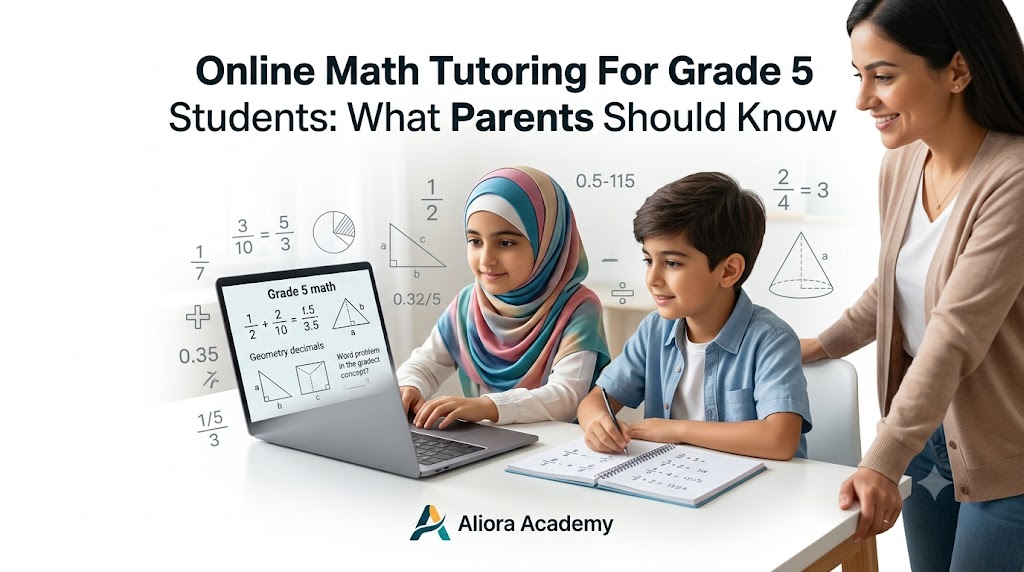
Online Math Tutoring For Grade 5 Students has become an important learning solution for parents whose children are struggling with school mathematics or need extra academic support. Many Grade 5 students understand basic concepts but begin facing difficulties when lessons become more advanced. Topics such as fractions, decimals, geometry, and multi-step word problems often require deeper thinking and stronger problem-solving skills.
Imagine a student who performed well in earlier grades but suddenly starts bringing home lower math test scores. The child may understand classroom lessons but struggles to apply concepts independently. Over time, frustration grows, confidence decreases, and homework becomes stressful for both parents and students.
Several factors contribute to these challenges. Some students have gaps in foundational skills from previous grades. Others learn at a different pace than the classroom environment allows. Limited practice, weak number sense, and difficulty understanding mathematical language can also affect performance.
The good news is that students can improve significantly with structured guidance, consistent practice, and personalized support. Quality online tutoring helps children strengthen concepts, develop confidence, and build the skills needed for long-term academic success.
How Does Grade 5 Math Become More Challenging for Students?
Grade 5 serves as an important transition year in mathematics. Students move beyond basic calculations and begin applying mathematical thinking to more complex situations.
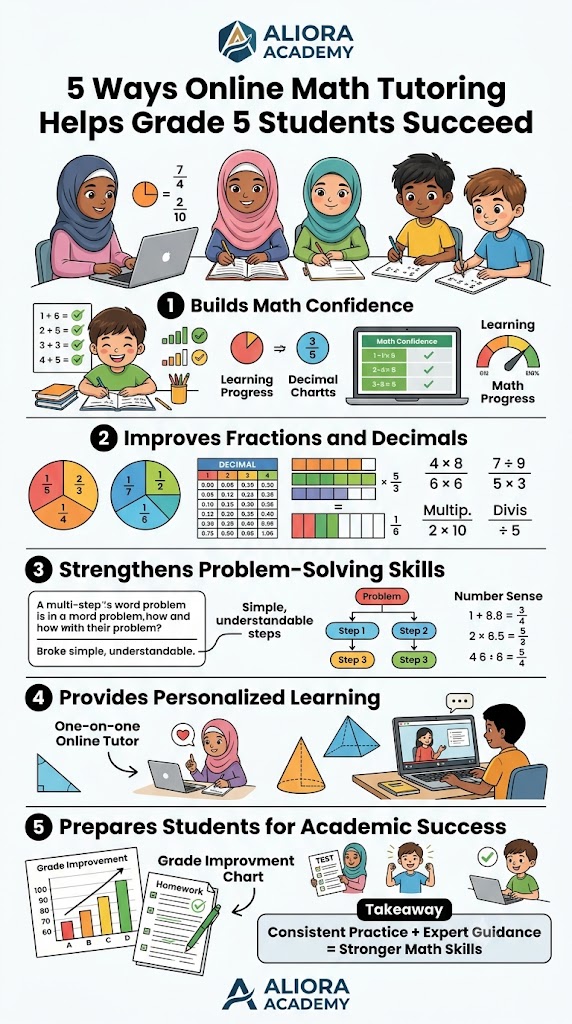
They are expected to solve advanced fraction problems, work confidently with decimals, understand measurement conversions, and tackle multi-step word problems. These topics require both computational accuracy and logical reasoning.
Many children can perform calculations but struggle when asked to explain their thinking. Modern mathematics places a strong emphasis on reasoning and problem-solving rather than memorization alone.
Common Grade 5 math concepts include:
- Advanced fractions
- Decimal operations
- Geometry concepts
- Measurement and conversions
- Data interpretation
- Multi-step problem solving
- Mental math strategies
Students who receive support through a structured math learning program can often strengthen these skills before learning gaps become larger.
As expectations increase, children also need stronger study habits and independent learning skills. Building these habits early helps prepare them for middle school mathematics.
Why Do Many Grade 5 Students Struggle With Mathematics?
Math difficulties rarely happen because a child lacks ability. In most cases, there are specific learning barriers that can be identified and addressed.
One common reason is weak foundational knowledge. A student who has not mastered multiplication facts may find fractions and decimals much more difficult.
Another challenge is limited number sense. Students who do not fully understand how numbers relate to one another often struggle with estimation, mental calculations, and problem-solving tasks.
Word problems can also create difficulties. Children must read carefully, identify important information, and choose the correct mathematical operation before solving the problem.
Parents may notice warning signs such as avoiding math homework, frequent calculation mistakes, low test scores, lack of confidence, difficulty explaining answers, and increased frustration during math activities.
Families concerned about learning gaps can review guidance from Aliora Academy's article on signs your child is falling behind in math through the page available on the academy website.
Early intervention often prevents small challenges from becoming larger academic obstacles.
Why Is Number Sense So Important in Grade 5 Mathematics?
Number sense forms the foundation of mathematical understanding. It helps students recognize patterns, estimate answers, and solve problems efficiently.
Children with strong number sense understand that mathematics is more than following formulas. They can think flexibly and select efficient strategies when solving questions.
For example, a student asked to calculate 198 + 202 may quickly recognize that the answer is close to 200 + 200 rather than performing lengthy calculations.
Strong number sense supports:
- Mental math
- Estimation
- Fraction understanding
- Decimal operations
- Problem solving
- Logical reasoning
When students improve number sense, they often become faster and more confident in everyday mathematics tasks.
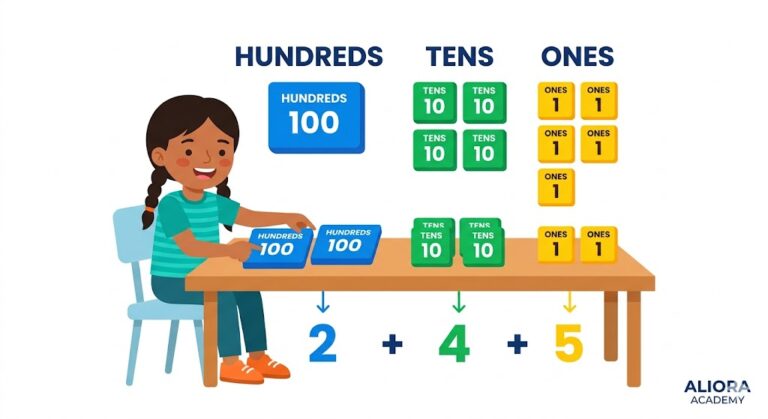
Many successful tutors use visual models, manipulatives, and real-world examples to strengthen these skills.
As students progress from concepts taught in math classes for Grade 4, number sense becomes increasingly important for mastering Grade 5 content.
How Can Online Math Tutoring Help Grade 5 Students Learn More Effectively?
Online tutoring provides individualized instruction that many students cannot receive in a traditional classroom.
A tutor can identify learning gaps, explain concepts using different methods, and adjust lessons based on the student's needs. This personalized approach often improves understanding and engagement.
Benefits of online tutoring include flexible scheduling, one-on-one attention, immediate feedback, customized learning plans, progress tracking, and increased confidence.
Students can revisit difficult topics without feeling rushed. Tutors can spend additional time on fractions, decimals, or geometry until understanding becomes secure.
Quality online math classes also provide structured practice opportunities that reinforce classroom learning.
For parents, online learning offers visibility into academic progress and helps ensure consistent support throughout the school year.
Why Are Word Problems Challenging for Many Children?
Word problems combine reading comprehension with mathematical reasoning. Students must understand the language before they can solve the mathematics.
Many children know how to perform calculations but become confused when information is presented within a story or real-life scenario.
Common challenges include:
- Misunderstanding keywords
- Choosing incorrect operations
- Missing important details
- Difficulty organizing information
- Rushing through questions
A useful strategy involves teaching students to follow these steps:
- Read carefully.
- Identify important information.
- Determine what the question asks.
- Choose a solving strategy.
- Check the answer.
For example, if a student needs to calculate the total cost of several items and then apply a discount, multiple operations may be required.
Regular practice with real-life situations helps children become more comfortable solving these problems independently.
How Can Parents Support Math Learning at Home?
Parents play a significant role in a child's mathematical development, even without advanced math knowledge.
The most effective approach is creating a positive learning environment where mistakes are viewed as part of the learning process.
Practical strategies include:
- Encouraging daily math practice
- Reviewing homework together
- Using math during shopping activities
- Practicing multiplication facts
- Discussing problem-solving strategies
- Celebrating progress
Consistency matters more than lengthy study sessions. Fifteen to twenty minutes of focused practice each day can produce meaningful improvement.
Parents can also explore structured educational resources such as Aliora Academy's math classes for Grade 5 to support classroom learning.
Maintaining open communication with teachers and tutors helps ensure students receive consistent guidance.
What Real-Life Examples Show the Benefits of Structured Math Support?
Example 1: Grade 3 Student Improving Multiplication Skills
A Grade 3 student struggled to remember multiplication facts and often completed assignments slowly. The solution involved daily multiplication practice, visual arrays, and short review sessions through targeted support similar to concepts taught in math classes for Grade 3. After several weeks, the student recalled facts more quickly and completed assignments with greater accuracy.
Example 2: Grade 4 Student Mastering Fractions
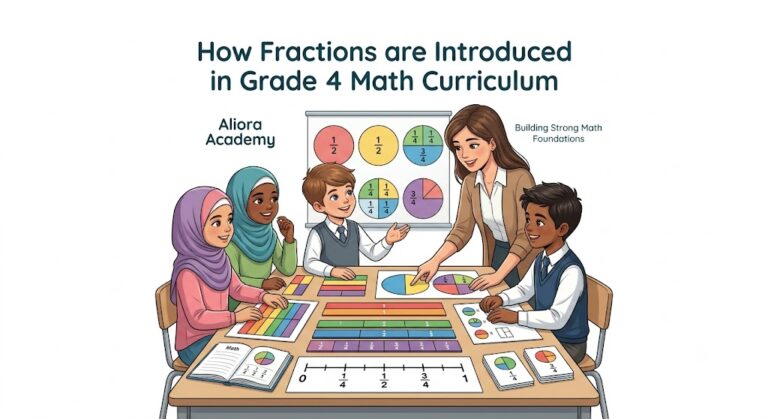
A Grade 4 student found fractions confusing because they seemed abstract. Using visual fraction models, diagrams, and hands-on examples commonly emphasized in math classes for Grade 4, the student developed a clearer understanding. As a result, fraction comparison and equivalent fraction problems became much easier.
Example 3: Grade 5 Student Building Confidence
A Grade 5 student struggled with multi-step word problems and often left questions unanswered during tests. The solution focused on breaking problems into smaller steps, strengthening reasoning skills, and providing personalized feedback through a Grade 5 tutoring program. Over time, the student developed stronger critical thinking skills and became more confident during assessments.
How Can Students Build Math Confidence and Independent Learning Skills?
Confidence grows when students experience consistent success and understand that improvement comes through practice.
Children should focus on learning strategies rather than worrying about mistakes. Every error provides information about what needs additional practice.
Students can strengthen confidence by:
- Setting small learning goals
- Practicing regularly
- Reviewing mistakes carefully
- Using mental math strategies
- Asking questions when confused
- Tracking progress over time
Independent learning skills are equally important. Students who take responsibility for reviewing concepts and completing practice activities often achieve stronger academic outcomes.
A structured Grade 5 online math tutor can help students develop these habits while providing accountability and guidance.
Over time, confidence, persistence, and stronger mathematical understanding work together to support long-term success. Explore our math learning resources for additional tips and structured guidance.
FAQs
How can my child improve math skills at home?
Encourage daily practice, review homework regularly, use real-life math activities, and focus on understanding concepts rather than memorizing procedures. Consistent practice builds stronger mathematics skills over time.
What is the best way to learn multiplication tables?
Short daily practice sessions, visual models, skip counting, multiplication games, and repeated review are effective methods. Students learn faster when multiplication facts are connected to real-world examples.
How do online math classes help students succeed?
Online classes provide personalized instruction, flexible scheduling, targeted practice, immediate feedback, and structured support. These benefits help students strengthen problem solving, build confidence, and improve academic performance.
Conclusion
Grade 5 mathematics introduces important concepts that prepare students for future academic success. Topics such as fractions, decimals, geometry, measurement, and multi-step problem solving require strong foundations and consistent practice.
Parents should pay close attention to signs of difficulty and provide support before learning gaps become larger. Building math confidence, strengthening number sense, improving problem solving, and developing logical thinking skills can significantly improve a student's learning experience.
Whether support comes from home practice, school resources, or professional tutoring, consistent effort remains the key to success. With the right guidance, students can become confident, capable learners who approach mathematics with greater understanding and independence.