How to Teach Long Division to Grade 4 Students Step by Step

Long division is one of the most important math skills Grade 4 students learn. It helps children solve larger division problems by breaking them into smaller, manageable steps. Many students find long division difficult at first, but with the right teaching approach and regular practice, it becomes much easier. Understanding long division also strengthens multiplication, problem-solving, and overall number sense.
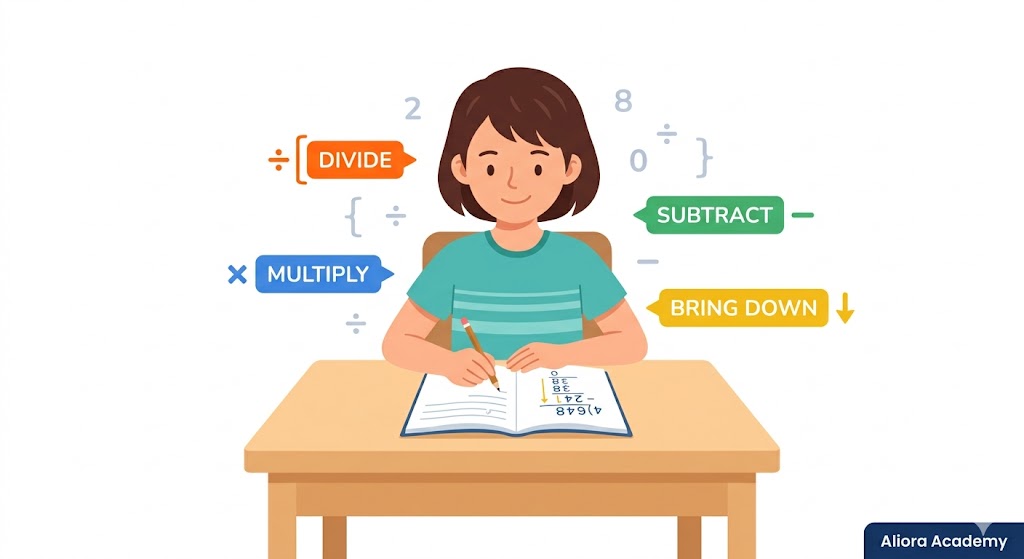
Step-by-step guide for teaching long division to Grade 4 students

What Is Long Division in Grade 4 Math?

Long division is a method used to divide larger numbers into smaller groups. Instead of solving everything at once, students follow a series of simple steps to find the answer. This method is commonly introduced in Grade 4 because students already have a basic understanding of multiplication and division facts.

Master the sequential progression: explore the Grade 4 Long Division Module, solidify prerequisite concepts in our Grade 3 Foundation Track, or browse the complete Aliora Mathematics Category.

🧩

Algorithmic Breaking

Transforms intimidating multi-digit problems into manageable, sequential steps, ensuring that high-level calculation becomes intuitive.

📈

Mathematical Maturity

Serves as the vital bridge between elementary division facts and complex algebraic problem-solving in later years.

Why Many Grade 4 Students Struggle with Long Division

Long division combines several math skills at the same time. Students must divide, multiply, subtract, and bring down numbers correctly. If multiplication facts are weak, long division becomes much harder. Lack of practice and confusion about the sequence of steps are also common reasons for mistakes.

Address common barriers early: reinforce core proficiency to improve Grade 3 multiplication fluency, find targeted solutions if your child struggles with word problems, or review the Grade 4 Math Foundation Framework.

Multitasking Complexity

Long division requires cognitive load balancing—simultaneously managing division, multiplication, and subtraction processes within a single problem.

⛓️

Sequential Dependency

Because each step relies on the accuracy of the previous one, a small calculation error early on can compound into an incorrect final answer.

The Simple Long Division Steps Every Child Should Learn

01

Divide

Determine how many times the divisor fits into the first digit or group of digits.

02

Multiply

Multiply the divisor by the number you just wrote above the division bracket.

03

Subtract

Subtract that result from the current section of the dividend to find the remainder.

04

Bring Down

Bring down the next digit from the dividend and repeat the cycle.

Why Multiplication Skills Are Essential for Long Division

Strong multiplication knowledge makes long division significantly easier. Children who know multiplication tables can quickly determine how many times a number fits into another number. This reduces errors and improves speed.

Think of multiplication as the engine of division. When a student doesn't have to pause to calculate basic facts, they can dedicate their full cognitive attention to the complex steps of the long division process.

Best Practice Methods for Long Division Success

Consistent Intervals

Children learn long division faster through consistent practice. Small, frequent sessions prevent frustration and keep concepts fresh.

Structured Progression

Start with simple one-digit divisors before moving to larger, multi-digit numbers to build logical comfort.

Visual Engagement

Use worksheets, color-coded steps, and real-life examples to make learning interactive and less intimidating.

Common Long Division Mistakes Students Make

01

Skipping Subtraction

Students often try to calculate the remainder mentally, leading to avoidable errors in complex problems.

02

Incorrect Multiplication

Weakness in basic times tables causes the entire long division process to collapse early.

03

Missing "Bring Down"

Forgetting to bring down the next digit is a frequent oversight that halts the progression of the calculation.

04

Placement Errors

Writing quotient digits in the wrong column often leads to confusion when dealing with zeros as placeholders.

How Online Math Classes Help Students Master Long Division

🎥

Guided Visuals

Interactive demonstrations break down long division steps into clear, dynamic visuals that static textbooks simply cannot provide.

Immediate Feedback

Students receive instant correction and guidance, preventing the formation of bad habits or recurring calculation errors.

♾️

Unlimited Practice

The ability to revisit lessons and practice repeatedly at their own pace fosters mastery and builds lasting student confidence.

How to Teach Long Division to Grade 4 Students Step by Step

Mastering long division is a significant milestone in a child's mathematical development. Learn the proven strategies to guide your Grade 4 student toward numerical confidence.

What is long division?

Long division is a structured algorithm used to divide large multi-digit numbers by a single or double-digit divisor. Unlike basic division facts, long division breaks complex numbers into smaller, manageable parts. It teaches students to process numbers column by column, a skill essential for higher-level mathematics.

For a foundational understanding, you can visit our Aliora Math Portal to see how this fits into the broader numeracy framework.

Why long division is taught in Grade 4

Grade 4 is the pivotal year where students shift from concrete counting to abstract operational thinking. Long division is introduced here because students have typically mastered multiplication tables and foundational division, making them cognitively ready for the multi-step nature of the long division algorithm.

If your student is transitioning into this phase, our Grade 4 Math Resources provide the necessary scaffolding for this leap.

Understanding the division process

The essence of the process is "fair sharing." When we divide, we are partitioning a larger quantity into equal-sized groups. In the long division algorithm, we do this by systematically breaking the dividend down by its place value, starting from the highest digit.
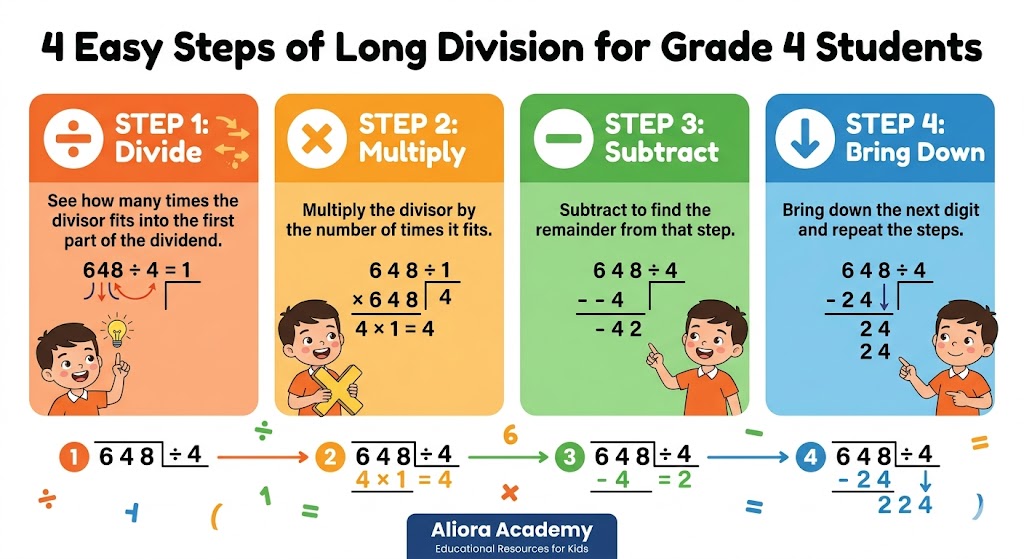
Step-by-step long division visual guide for Grade 4

Understanding this process requires moving away from guessing and toward a rigid, logical sequence. Students who struggle here often benefit from reviewing Grade 3 Math foundations to ensure there are no gaps in their understanding of place value.

The Divide, Multiply, Subtract, Bring Down method

The acronym "DMSB" (Divide, Multiply, Subtract, Bring Down) is the gold standard for teaching long division. Each step must be completed in order:

  • Divide: How many times does the divisor fit?
  • Multiply: Find the value of that fit.
  • Subtract: Determine what is left over.
  • Bring Down: Prepare the next digit for the cycle.

Importance of multiplication skills

You cannot have successful long division without strong multiplication skills. If a child has to spend time counting on their fingers to solve basic products, they will lose track of the division sequence. We highly recommend utilizing resources to improve multiplication skills as a prerequisite to mastering long division.

Common long division mistakes

Common errors include skipping the subtraction step (doing it mentally, which leads to error), incorrectly aligned digits, or mismanaging zeros in the quotient. If your child struggles with word problems, it may be because they are getting lost in the algorithm itself, preventing them from applying the concept to real-world scenarios.

Practical teaching activities

Use base-ten blocks or money to make the process concrete. When students physically partition a stack of "tens" and "ones," the abstract numbers on paper suddenly make logical sense. This physical interaction is often the "aha!" moment for struggling students.

Online learning support for division skills

Digital platforms offer immediate feedback loops that allow students to practice hundreds of problems without the risk of cementing bad habits. Whether moving into Grade 5 curriculum or reinforcing current concepts, online support is vital for tailored pacing.

Parent involvement in math learning

Parents play a vital role as "coaches" rather than "answers-providers." Ask your child to explain *why* they chose a step. For structured guidance on this, our Parent Guide to Building Strong Math Foundations is an essential resource for keeping your involvement productive and positive.

Building confidence in mathematics

Confidence is a byproduct of competence. When students see themselves successfully navigating the DMSB algorithm, their anxiety decreases, and their mathematical agility increases. Celebrate the process, not just the final result, to ensure they remain engaged and resilient learners.

Help Your Child Master Long Division with Confidence

Long division becomes much easier when students learn each step carefully and practice regularly. Building strong multiplication skills and following a structured learning approach helps children solve division problems accurately and confidently. Give your child the tools to thrive at Aliora Academy.

Frequently Asked Questions

What is long division in Grade 4 math?

Long division is a structured algorithm that breaks complex division problems into a sequence of smaller, manageable steps, allowing students to divide large multi-digit numbers systematically.

Why do students struggle with long division?

Students often struggle because the process requires multitasking—performing division, multiplication, and subtraction simultaneously—while keeping track of the correct sequence of steps.

How can I teach long division step by step?

Focus on the "DMSB" pattern: Divide, Multiply, Subtract, and Bring Down. Using concrete manipulatives like base-ten blocks can also help make the abstract process visible and intuitive.

How important are multiplication tables for division?

They are critical. If a student has to pause to calculate basic multiplication facts, they lose focus on the division algorithm itself, making the entire process significantly harder and prone to error.

How much long division practice is needed daily?

Consistency is more important than volume. Short, focused practice sessions of 15–20 minutes daily are much more effective for long-term retention than infrequent, hour-long study sessions.

Do online math classes help with division skills?

Yes. Online platforms provide interactive visualizations, instant feedback, and the ability to re-watch lessons, which are powerful tools for mastering the sequential nature of long division.

Similar Posts