Understanding Decimals: A Complete Guide for Grade 4 and Grade 5 Students
Understanding Decimals for Grade 4 and Grade 5 Students becomes important when a child starts dealing with money, measurements, and real-world math problems. Many parents notice that their child can easily solve whole number sums but gets confused when numbers include a dot, like 3.5 or 12.75. For example, a Grade 5 student may know multiplication well but struggle when calculating prices during shopping or understanding place value after the decimal point.
This confusion usually happens because decimals are introduced too quickly without strong number sense and place value understanding. Students often memorize steps without truly understanding what the numbers represent. As a result, they lose confidence in math and start avoiding it.
The good news is that decimals can become simple when taught using visual methods, real-life examples, and structured practice. With the right guidance, students build strong mathematics skills, improve problem solving, and develop lasting math confidence that supports advanced topics like fractions and percentages.
How do students understand decimals through real-life examples?
Decimals become easier when children see them in real life instead of just in textbooks. A child may not understand 0.5 on paper, but they quickly understand it when they see half a chocolate bar or half a liter of milk. This connection helps build strong number sense. This is the best way to learn decimal numbers for Grade 5 learners and younger students alike.
In Grade 4 and Grade 5 classrooms, teachers often use money to explain decimals. For example, 10.50 means 10 rupees and 50 paise. This makes the concept practical and meaningful.
Parents can also support learning at home through simple activities like:
- Reading prices at grocery stores
- Measuring ingredients while cooking
- Comparing distances in kilometers and meters
These small daily practices improve math learning without pressure.
At Aliora Academy, structured lessons under the math learning program help students connect decimals with everyday life in a clear and logical way.
Why do children struggle with decimal place value?
One major reason children struggle is misunderstanding place value. They often think the number after the decimal is just another whole number. For example, they may read 2.5 as "two and five" instead of "two and five-tenths."
This confusion happens because:
- They have weak foundation in whole number place value
- They do not understand tenths, hundredths, and thousandths
- Teaching is often memorization-based instead of visual
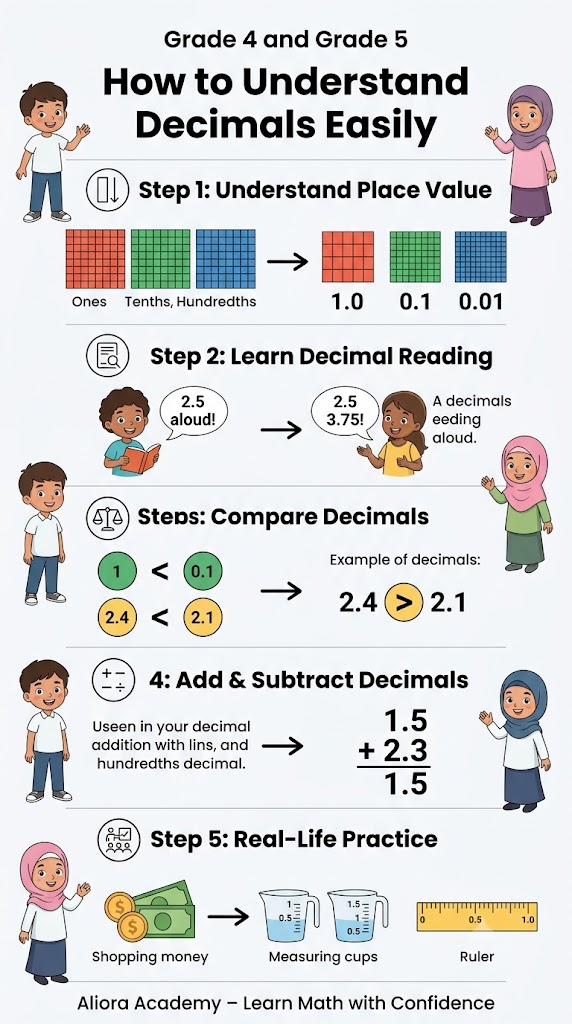
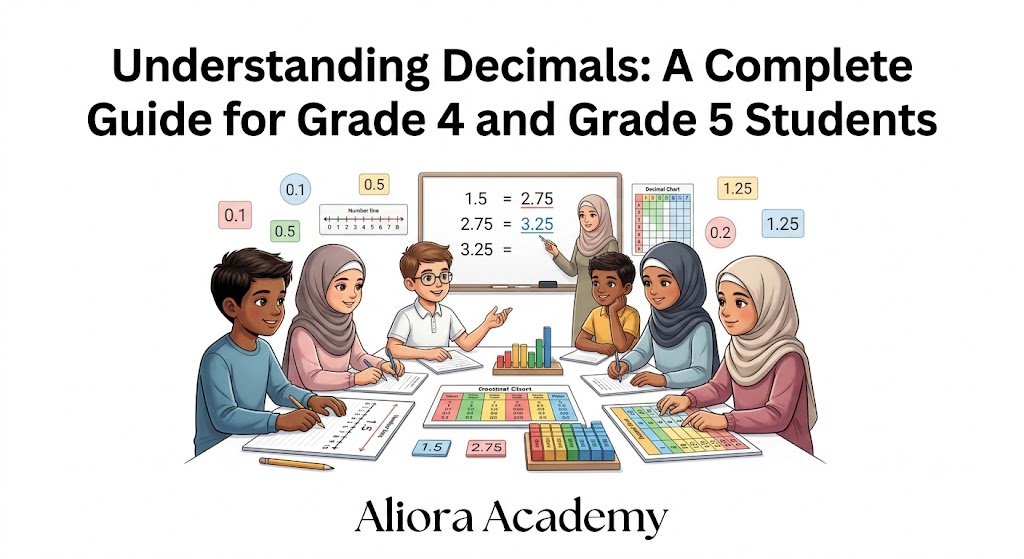
To solve this, educators use grids, blocks, and charts. When a child sees that 0.1 is one small part of a whole, understanding becomes easier. This is essential for teaching decimals step-by-step for primary students.
For Grade 4 students, strengthening this foundation through math classes for Grade 4 improves overall mathematical thinking and prepares them for advanced topics in Grade 5.
How can students master decimal operations step by step?
Once the concept is clear, students move toward operations like addition, subtraction, multiplication, and division with decimals. This is where many learners lose confidence if steps are not clear.
A simple learning sequence works best:
- Understand place value of decimals
- Learn to compare decimal numbers
- Practice addition and subtraction
- Move to multiplication and division
For example, adding 3.2 + 1.5 becomes easy when students align decimal points correctly. Without this understanding, they often make alignment mistakes.
Regular practice in math classes for Grade 5 helps students build accuracy and speed in multi-step calculations and improves critical thinking in math. For personalized guidance, online math tutoring for Grade 5 offers additional support.
How does decimal learning improve problem-solving skills?
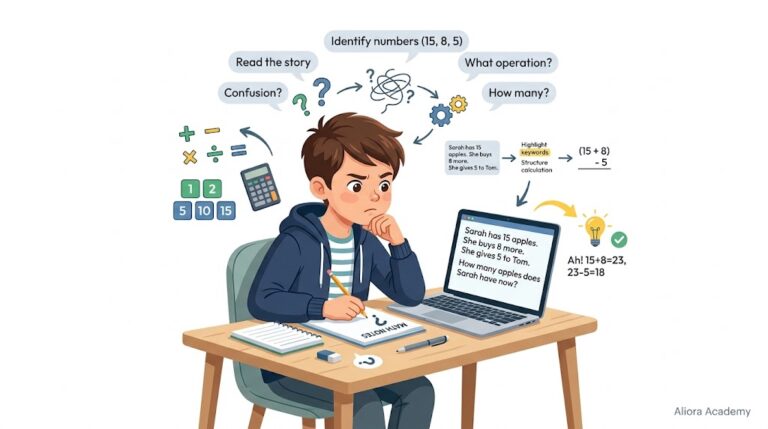
Decimals are not just numbers; they are part of real problem-solving in daily life. When students understand decimals, their ability to solve word problems improves significantly.
A Grade 5 student might face a question like calculating total cost after buying multiple items. Without decimal understanding, the problem becomes confusing.
With proper training, students learn:
- Breaking problems into smaller steps
- Identifying important numbers
- Applying correct operations
This improves logical thinking and math confidence. It also prepares students for higher-level topics like percentages and ratios.
What are the best ways to build math confidence in decimals?
Many students fear decimals because they think they are "difficult." This fear reduces performance even when the concept is simple. This is part of understanding how children understand decimals in elementary math.
To build confidence:
- Start with easy real-life examples
- Avoid rushing into complex problems
- Use visual tools like charts and number lines
- Practice regularly in small sessions
Parents play a major role here by encouraging effort instead of perfection. When students feel supported, they naturally improve in mathematics skills.
If a child is struggling deeply, structured guidance through online math classes can provide step-by-step clarity and personalized learning support. Building strong mental math strategies also accelerates decimal comprehension.
Why is number sense important in decimal learning?
Strong number sense helps students understand what numbers actually represent instead of just memorizing them. Without it, decimals feel random and confusing. This is the foundation of decimal learning for kids Grade 4 and Grade 5.
Number sense helps children:
- Estimate values quickly
- Compare decimal numbers easily
- Understand real-world math situations
For example, a child with good number sense will immediately understand that 4.75 is greater than 4.5 without needing long calculations.
This skill is essential not only for decimals but also for fractions, percentages, and advanced arithmetic. If your child shows persistent gaps, review the signs your child is falling behind in math to catch issues early.
Real-Life Learning Examples
Example 1: Grade 4 student learning decimals through measurement
A student struggled with decimal numbers in class. The challenge was understanding tenths and hundredths. The solution involved using measuring cups during cooking activities. The outcome was improved understanding of 0.5 and 0.25 in practical situations.
Example 2: Grade 5 student improving problem solving with money
The student had difficulty calculating shopping bills. The teacher used real price tags and mock shopping exercises. After practice, the student confidently solved multi-step decimal problems.
Example 3: Grade 3 foundation strengthening for future decimals
A younger student practiced place value using blocks and charts. This early support helped later when transitioning to decimals in Grade 4, making learning smoother and faster. Early learners benefit from math classes for Grade 3 that build these foundations.
Why do children struggle with math in general?
Children often struggle because foundational skills like number sense, place value, and mental math are weak. When basics are unclear, advanced topics become difficult.
Another reason is lack of consistent practice. Math is a skill that improves with repetition, not memorization alone. Students also struggle when they do not see real-life connections. For strategies to rebuild confidence, see how to help a child who hates math develop confidence.
How can parents support decimal learning at home?
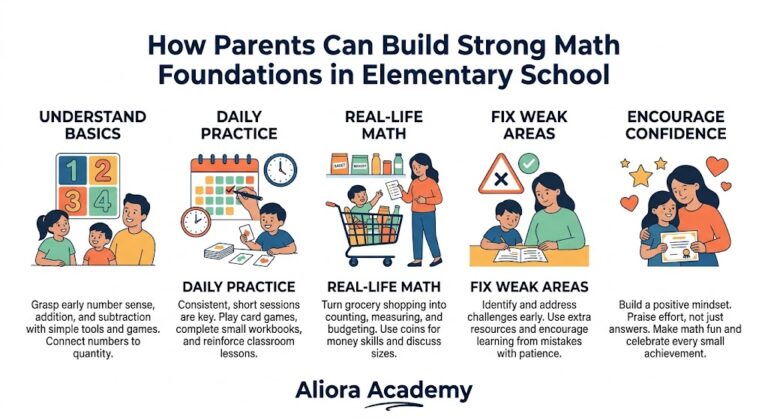
Parents can support learning by:
- Practicing small math activities daily
- Using real-life examples like shopping and cooking
- Encouraging mistakes as part of learning
- Avoiding pressure and comparison
Consistent support builds long-term math confidence and reduces fear. Explore our math learning resources for more tips and structured guidance.
FAQs
How can my child improve decimal skills at home?
Daily practice using money, measurements, and simple number comparisons helps children understand decimals naturally.
What is the best way to learn decimals for Grade 5 students?
The best method is step-by-step learning: place value first, then comparison, followed by operations and word problems.
How do online math classes help with decimals?
They provide structured lessons, visual explanations, and guided practice that help students understand decimals clearly and confidently.
Conclusion
Decimals become simple when children build strong number sense, understand place value, and practice regularly with real-life examples. For Grade 4 and Grade 5 students, mastering decimals is not just about school exams but about building strong problem solving and logical thinking skills for life.
With consistent practice, supportive teaching, and guided learning, students develop confidence in math and perform better in advanced topics like fractions and percentages. Aliora Academy continues to support learners with structured math learning designed to make concepts clear, practical, and easy to understand.