What are Multi Step Word Problems and How Do Children Solve Them?
multi-step word problems for kids often become the point where many children start to feel stuck in math. A parent may notice this when a child can easily solve simple addition or multiplication questions but struggles when the problem is written in a story format. For example, a Grade 4 student might understand 6 × 4 but gets confused when the question says, “Ali has 6 boxes with 4 pencils in each, then he gives away 5 pencils. How many are left?” The child knows the operations but cannot decide the order.
This difficulty usually happens because word problems require more than calculation. They need reading comprehension, logical thinking, and step-by-step decision making. Many students miss key information, choose the wrong operation, or try to solve everything in one step.
The good news is that students can improve this skill with structured practice, number sense development, and guided strategies used in programs like structured math learning pathways such as those offered through Aliora Academy’s math resources available at Aliora Academy's math program.

Why do children struggle with multi-step word problems in math?
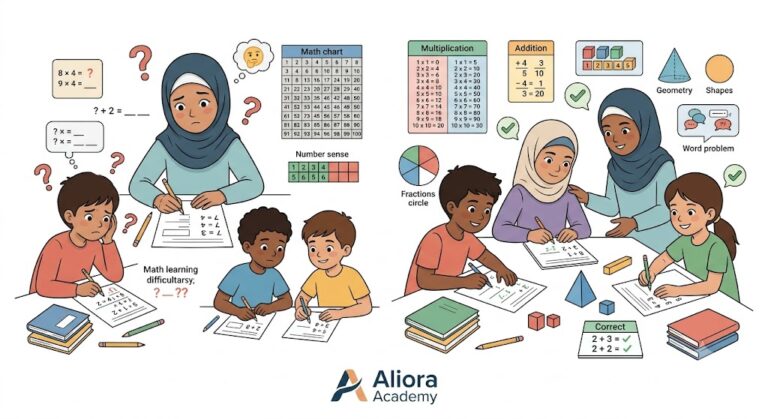
Many children struggle with math word problems because they treat them like simple calculation exercises instead of reading-based logic tasks. When a problem includes multiple steps, students must first understand the situation before deciding what to calculate.
One major reason is weak number sense. If a child does not understand how numbers relate to each other, they cannot decide whether to add, subtract, multiply, or divide. This is common in Grade 3 and Grade 4 learners who are still building foundational arithmetic skills.
Another issue is reading difficulty. A long sentence can confuse students, causing them to miss important clues. For example, words like “left,” “total,” or “shared equally” directly indicate operations, but students often overlook them.
Common challenges include:
- Skipping important details in the question
- Trying to solve everything in one step
- Not understanding keywords in word problems
- Weak multiplication and division fluency
- Poor connection between reading and math logic
At this stage, structured support such as guided practice in math classes for Grade 3 can help children break problems into manageable steps and build confidence gradually.
How do children actually solve multi-step word problems step by step?
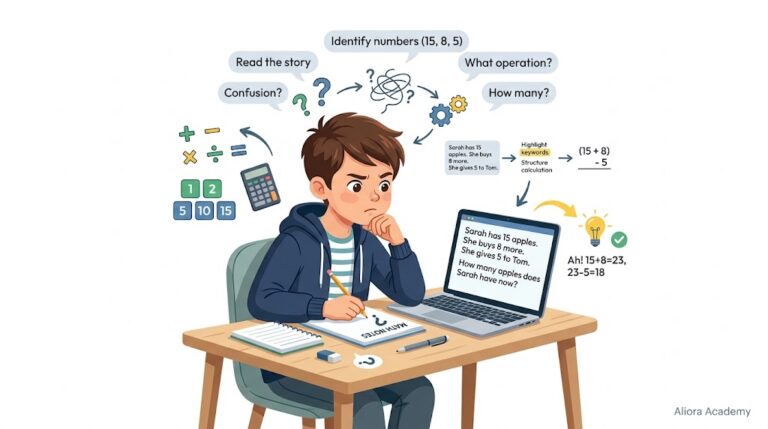
To understand multi-step word problems for kids, it is important to see how successful students approach them. They do not rush into solving; instead, they follow a structured thinking process. This is the essence of word problem solving strategies for Grade 3, 4, and 5.
The first step is reading carefully. Students are trained to read the question at least twice. The first reading is for understanding the story, and the second is for identifying numbers and operations.
The second step is breaking the problem into parts. Instead of solving everything at once, children divide the problem into smaller steps. For example:
- Find the total quantity
- Perform subtraction or distribution
- Arrive at final answer
The third step is choosing the correct operation. Students learn to connect keywords with operations:
- “Total” → addition
- “Left” → subtraction
- “Each” → multiplication or division
Finally, students check their answer for logic. Does it make sense in real life? This habit improves critical thinking and reduces careless mistakes.
With consistent practice through structured learning like math classes for Grade 4, children gradually develop independent problem-solving ability. For a strong foundation in the operations needed, mastering addition and subtraction with regrouping is essential.
How can parents help children master multi-step math word problems at home?
Parents play a major role in helping children understand complex math problems. The goal is not to give answers but to build thinking habits. This is a key part of math word problem practice for kids at home.
One effective method is using real-life situations. For example, during shopping, a parent can ask, “We bought 3 packets of biscuits and each has 5 biscuits. If we eat 4, how many are left?” This builds natural problem-solving skills.
Another approach is step-by-step questioning:
- What is the problem asking?
- What information is given?
- What should we do first?
- What comes next?
Parents should also encourage drawing diagrams. Visual learning helps children in Grades 3–5 understand abstract problems more clearly.
Simple home strategies include:
- Daily 10-minute word problem practice
- Using objects like coins or toys for explanation
- Encouraging explanation instead of memorized answers
- Praising effort, not just correct answers
For deeper structured learning, many parents use guided programs such as math classes for Grade 5 to build long-term confidence in critical mathematical thinking. Building strong mental math strategies also supports quicker problem solving.

What real-life examples show how students improve multi-step word problem skills?
These examples demonstrate how children solve multi-step arithmetic problems when given the right support.
Example 1: Grade 3 Student Learning Multiplication Logic
A Grade 3 student struggled with basic word problems involving multiplication. The challenge was understanding when to multiply instead of add. The solution involved daily practice with small story problems like grouping objects. After two weeks, the student could identify multiplication situations correctly and improved overall number sense.
Example 2: Grade 4 Student Understanding Fractions in Problems
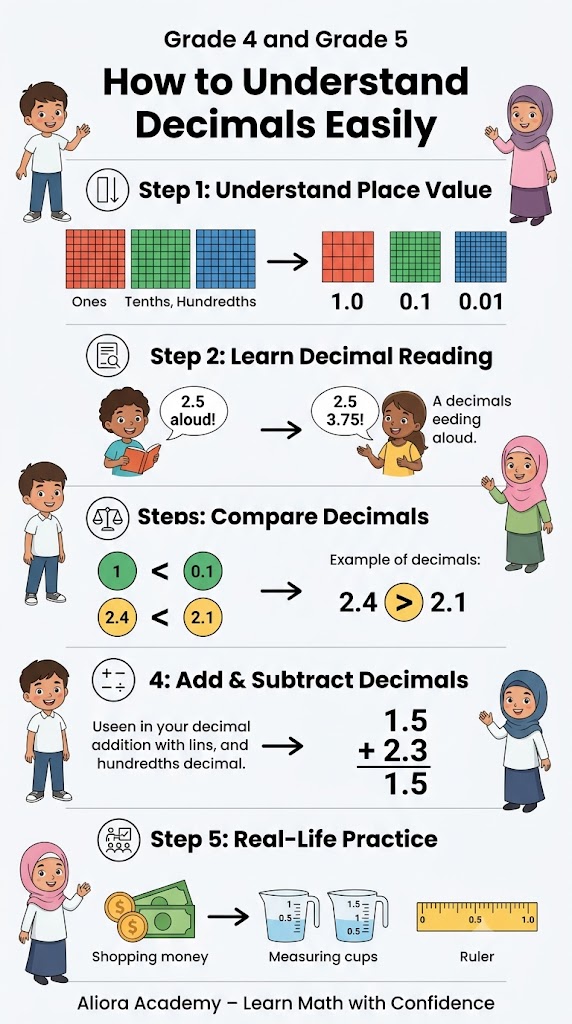
A Grade 4 student found fraction-based word problems confusing, especially when combined with subtraction. Using visual diagrams (like cutting shapes into parts), the student learned to break problems step by step. The outcome was improved confidence in fractions help and better accuracy in classroom tests. For more on this topic, see understanding decimals for Grade 4 and 5.
Example 3: Grade 5 Student Solving Multi-Step Problems
A Grade 5 student struggled with long word problems involving multiple operations. The solution was teaching a checklist method: underline keywords, break steps, and solve one part at a time. Within a month, the student improved significantly in multi-step reasoning and started solving problems independently. For additional support, online math tutoring for Grade 5 can provide personalized guidance.
Why is number sense important for solving word problems effectively?
Number sense is the foundation of all math problem-solving. Without it, children cannot understand how numbers behave in real-life situations.
Students with strong number sense can:
- Estimate answers before solving
- Choose correct operations quickly
- Understand relationships between numbers
- Avoid unnecessary calculation errors
Weak number sense leads to confusion even in simple problems. For example, a child may not realize that 50 is greater than 5 times 8 unless they understand multiplication deeply.
Improving number sense requires:
- Daily mental math practice
- Real-world math activities
- Repeated exposure to word problems
- Gradual progression from simple to complex tasks
Programs like homeschool math programs help students build these skills in a step-by-step manner. If your child has developed math anxiety, our guide on helping a child who hates math offers practical strategies to rebuild confidence.
FAQs
How can my child improve multi-step word problems for kids at home?
Start with small, daily practice. Encourage your child to read problems twice, underline keywords, and solve step by step instead of rushing.
What is the best way to teach children word problem solving?
Use real-life examples and visual aids. Let children explain their thinking instead of just writing answers. This builds long-term understanding.
Do online math classes really help with word problems?
Yes, structured online math classes provide guided practice, step-by-step strategies, and consistent feedback, which improves problem-solving skills over time.
Conclusion
Understanding multi-step word problems for kids is not about memorizing formulas but developing logical thinking, reading clarity, and step-by-step problem-solving skills. When children build strong number sense and practice regularly, they become more confident in handling complex math situations.
Parents and teachers should focus on consistent practice, real-life examples, and structured learning support. Over time, students develop independence in math, better academic performance, and stronger confidence in solving problems. Explore our math learning resources for more tips and structured guidance.