How Fractions are Introduced in Grade 4 Math Curriculum
How Fractions are Introduced in Grade 4 Math Curriculum is a common question many parents ask when their child begins learning more advanced math concepts. A student who performed well with multiplication and division in Grade 3 may suddenly feel confused when fractions appear in homework, quizzes, and classroom activities.
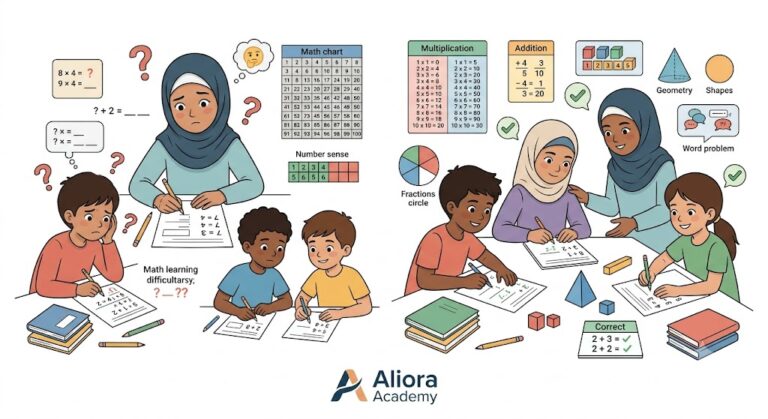
Many children struggle because fractions are different from whole numbers. They must learn that numbers can represent parts of a whole rather than complete quantities. This shift requires strong number sense, visual understanding, and consistent practice.
Parents often notice challenges such as:
- Difficulty comparing fractions
- Confusion about numerators and denominators
- Mistakes in word problems
- Reduced confidence during math lessons
The good news is that fractions are introduced gradually. A well-structured curriculum helps students connect previous arithmetic knowledge with new mathematical ideas. Through visual models, hands-on activities, and guided practice, children develop the foundation needed for future topics such as decimals, ratios, and algebra.
At Aliora Academy, experienced educators understand that mastering fractions requires patience, clear explanations, and regular practice that builds long-term mathematical confidence.
What Do Students Learn Before Fractions in Grade 4?
Before students begin working with fractions, they spend several years developing foundational mathematics skills.
In Grade 3, students focus heavily on addition, subtraction, multiplication basics, place value, and number patterns. These skills create the foundation needed for fraction learning.
For example, children learn that multiplication represents equal groups. This understanding later helps them recognize equivalent fractions and fraction relationships.
Students also develop stronger problem-solving abilities through daily practice with word problems. These experiences teach children how to interpret mathematical situations and apply appropriate strategies.
Important Grade 3 foundations include:
- Multi-digit addition and subtraction
- Multiplication practice
- Basic division concepts
- Number patterns
- Place value understanding
- Mathematical reasoning
Parents interested in strengthening these skills can explore math classes through Aliora Academy's Grade 3 mathematics program.
A strong foundation makes the transition into fractions much smoother and less intimidating.
How Fractions are Introduced in Grade 4 Math Curriculum?
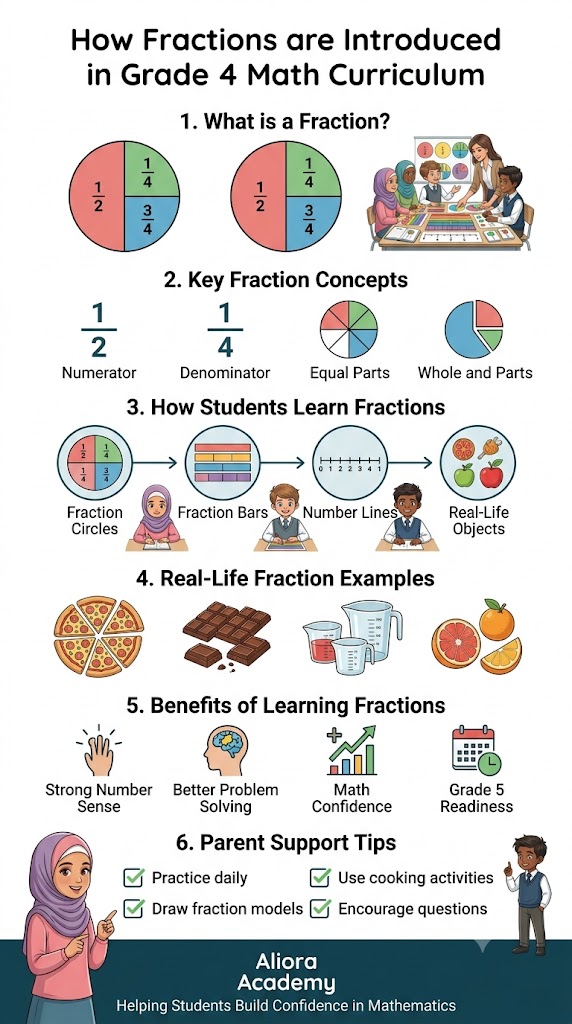
The introduction of fractions begins with visual and concrete learning experiences rather than complex calculations.
Teachers often start by showing familiar objects such as:
- Pizza slices
- Chocolate bars
- Apples
- Paper shapes
- Measuring cups
Students learn that a fraction represents equal parts of a whole. They discover that in the fraction 3/4:
- 3 is the numerator
- 4 is the denominator
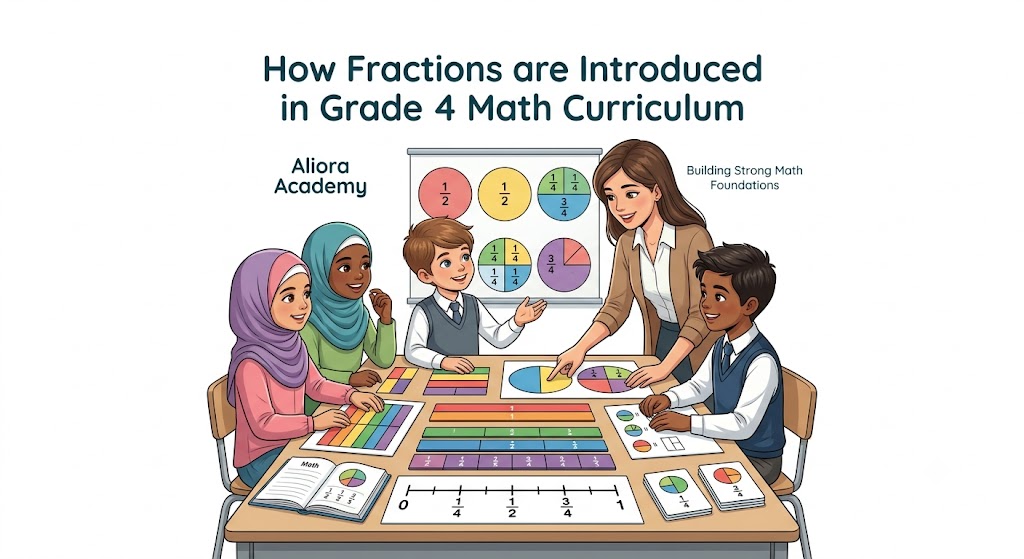
Visual models play a critical role during this stage. Children shade parts of shapes, divide objects into equal sections, and identify fractional amounts.
Teachers emphasize concepts such as:
- Understanding fractions as parts of a whole
- Identifying numerators and denominators
- Comparing simple fractions
- Recognizing equivalent fractions
- Representing fractions on number lines
This gradual approach helps children develop conceptual understanding before moving toward more advanced fraction operations.
Why Do Many Children Struggle to Understand Fractions?
Fractions are often considered one of the first major conceptual challenges in elementary mathematics.
Unlike whole numbers, fractions require students to think about relationships between quantities rather than individual numbers.
Several factors contribute to difficulty:
- Weak number sense
- Limited visual understanding
- Memorization without comprehension
- Math anxiety
- Lack of practice at home
A common misunderstanding occurs when students believe 1/8 is larger than 1/4 because 8 is greater than 4. This shows why helping children understand fractions in Grade 4 requires repeated visual reinforcement.
Children need repeated opportunities to see and manipulate fraction models before abstract symbols make sense.
Another challenge is transferring knowledge from one context to another. A student may recognize fractions in a picture but struggle to solve a word problem involving fractions.
Consistent instruction, visual learning tools, and supportive feedback significantly improve understanding. For more on this topic, see Grade 4 fractions lessons which provide step-by-step guidance for students.
Why Is Number Sense Important When Learning Fractions?
Strong number sense helps students estimate, compare, and reason about mathematical quantities.
When children understand the size of fractions, they can make better decisions while solving problems.
For example, a student should recognize that:
- 1/2 is larger than 1/4
- 3/4 is close to one whole
- 2/8 equals 1/4
These insights support logical thinking and reduce calculation errors.
Teachers encourage number sense development through activities such as:
- Fraction number lines
- Visual fraction models
- Estimation exercises
- Real-world measurement activities
Students who develop strong number sense generally perform better in later topics such as decimals, percentages, and algebraic reasoning. This is a key part of fractions in elementary math education.
This foundation becomes increasingly important in Grade 5 when fraction concepts become more advanced, as covered in our Grade 5 math program.
How Can Parents Support Fraction Learning at Home?
Parents do not need advanced mathematics knowledge to help their children succeed.
Everyday activities provide excellent opportunities for learning.
Cooking Activities
Measuring ingredients helps children see fractions in action. Examples: 1/2 cup of milk, 1/4 teaspoon of salt, 3/4 cup of flour.
Food Sharing
Cutting a pizza into equal pieces creates a natural discussion about fractions. Children can compare one-half, one-fourth, and three-fourths.
Shopping Activities
Parents can ask questions such as: Which fraction of the basket contains fruit? What fraction of items are vegetables?
Homework Support
Helpful strategies include asking guiding questions, using drawings, encouraging explanations, and practicing consistently.
Families seeking additional support may benefit from structured online math classes that provide guided instruction and personalized feedback. This is especially helpful for how fourth graders learn fractions effectively.
How Do Real Students Improve Their Fraction Skills?
Real learning progress often comes from consistent practice and targeted support.
Example 1: Grade 3 Student Building Multiplication Skills
A Grade 3 student struggled with multiplication facts and frequently made calculation errors. The solution involved ten minutes of daily multiplication practice using visual arrays and skip-counting strategies. Within a few months, the student's arithmetic skills improved significantly, creating a stronger foundation for future fraction learning.
Example 2: Grade 4 Student Mastering Fractions
A Grade 4 student found fractions confusing and often mixed up numerators and denominators. Teachers introduced visual fraction bars, number lines, and interactive exercises. The student gradually developed confidence and began solving fraction comparison problems independently. This demonstrates how fractions help students most when concepts are presented visually.
Example 3: Grade 5 Student Solving Multi-Step Problems
A Grade 5 student struggled with multi-step word problems involving fractions and decimals. Through structured problem-solving strategies and guided practice, the student learned to break problems into smaller steps. As confidence increased, academic performance improved across mathematics assessments. For more on supporting older students, see online math tutoring for Grade 5 students.
How Does Fraction Learning Prepare Students for Grade 5 Math?
Fraction learning in Grade 4 is not an isolated topic. It prepares students for future mathematical concepts, including:
- Advanced fractions
- Decimal operations
- Ratios
- Percentages
- Geometry concepts
- Multi-step problem solving
Grade 5 students frequently work with equivalent fractions, fraction operations, and decimal relationships. Without a strong fraction foundation, these topics become much more difficult.
Students who master fractions early often demonstrate stronger critical thinking, better problem-solving abilities, and greater confidence in mathematics. If you're concerned about your child's readiness, review the signs your child is falling behind in math to catch issues early.
Why Are Word Problems Often Difficult for Fraction Learners?
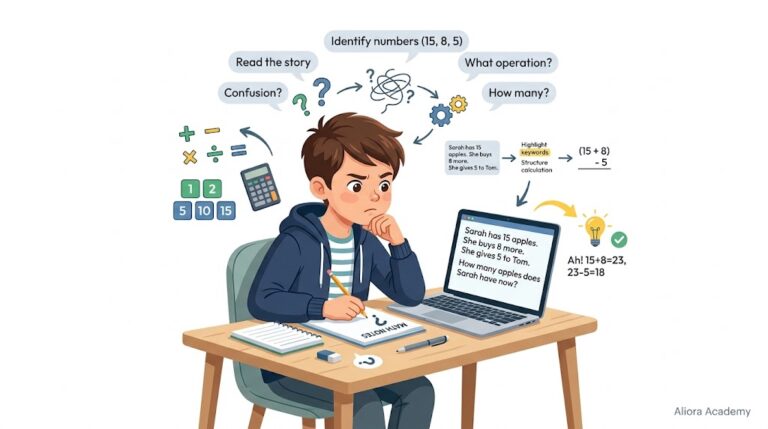
Word problems require students to combine reading comprehension with mathematical reasoning. Many students understand fractions in isolation but struggle when they appear within a story problem.
Common challenges include:
- Identifying important information
- Choosing the correct operation
- Understanding mathematical language
- Organizing multiple steps
Effective strategies include: reading the problem twice, highlighting key details, drawing visual models, estimating answers, and checking solutions. These approaches strengthen both logical thinking and independent learning skills.
How Can Students Build Confidence While Learning Fractions?
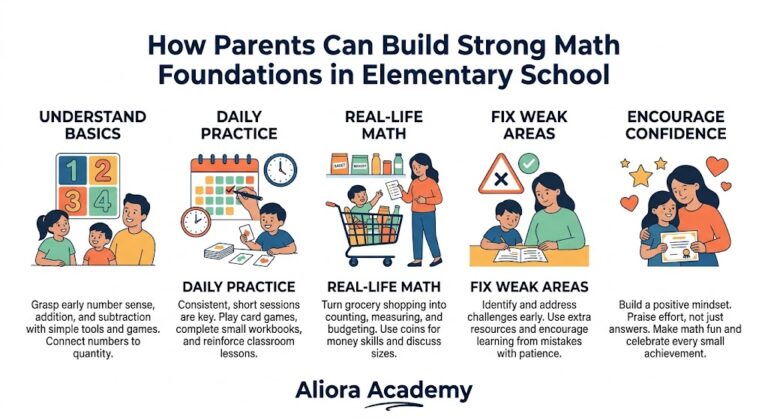
Math confidence develops through small successes over time. Students should focus on understanding concepts rather than memorizing procedures.
Helpful habits include:
- Practicing a little every day
- Using visual models
- Asking questions
- Reviewing mistakes
- Celebrating progress
Confidence grows when children see that challenging problems can be solved through persistence and careful thinking. Supportive learning environments help students view mistakes as opportunities to learn rather than signs of failure.
For children showing signs of frustration or falling behind, early intervention and targeted math tutoring can make a significant difference. Explore our math learning resources for additional guidance.
FAQs
How can my child improve fraction skills at home?
Use everyday activities such as cooking, measuring, sharing food, and drawing fraction models. Short daily practice sessions are usually more effective than occasional long study periods.
What is the most important fraction concept in Grade 4?
Understanding that fractions represent equal parts of a whole is the most important concept. Once students understand this idea, comparing and working with fractions becomes easier.
How do online math classes help students learn fractions?
Online lessons provide structured instruction, visual demonstrations, guided practice, personalized feedback, and additional support for challenging concepts.
Conclusion
Understanding How Fractions are Introduced in Grade 4 Math Curriculum helps parents support their children's learning journey more effectively. Fractions represent a major step forward in elementary mathematics and serve as the foundation for many future concepts.
Students succeed when they build strong number sense, practice problem solving regularly, and receive consistent support from teachers and parents. Visual learning methods, real-world applications, and steady practice help transform fractions from a confusing topic into a manageable and meaningful part of math learning.
By developing confidence, logical thinking, and strong study habits, students become better prepared for Grade 5 mathematics and long-term academic success.