How to Help Your Child Write Better Sentences in Grade 3
Writing better sentences is one of the most important skills a Grade 3 child can develop. At this stage, children often know words but struggle to arrange them in a clear, meaningful way. With the right guidance, they can learn to form correct grammar, express ideas simply, and build confidence in writing. Sentence writing improves not only English skills but also thinking ability and communication in everyday life.
Explore our focused English Classes gateway, prepare early for advanced steps via the Grade 4 Program, or return directly to our primary educational dashboard at Aliora Academy Home.
Step-by-Step Skill Building
Systematic compound syntax tracking metrics.
Academic Improvement Focus
Targeted development loops for higher marks.
Why Sentence Writing Skills Matter in Grade 3
Sentence writing is the foundation of all English learning. When children learn to form correct sentences, they can express their thoughts clearly in school and daily life. It also improves reading comprehension, grammar understanding, and overall academic performance. A child who writes well can answer exam questions better and explain ideas without confusion.
Explore our target proficiency paths inside our core English Classes portal. Learn how to address core structural errors when your Child Struggles with English Grammar, or read new elementary training guides inside our Blog Section.
Clear Idea Expression
Enables young minds to systematically map abstract thoughts into structurally logical written arguments.
Comprehension Link
Deconstructing and forming sentences builds a stronger grasp of complex reading passages.
Exam Performance
Eliminates response confusion, ensuring children write accurate answers to score higher marks.
Common Problems Children Face in Sentence Writing
Many Grade 3 students face similar writing challenges. They often know words but cannot arrange them properly into sentences. Common issues include grammar mistakes, missing punctuation, weak vocabulary, and confusion about sentence structure. Some children also repeat words or write very short and unclear sentences.
If syntax barriers persist, read our structural optimization guide for when a Child Struggles with English Grammar. For targeted lexical support, implement the methodologies on our Grade 3 Vocabulary Page, or discover fresh home-learning strategies inside our curated Blog Section.
Grammar & Syntax Errors
Missing Punctuation
Weak Lexical Selection
Structural Confusion
Redundant Word Repetition
Short & Unclear Output
Simple Steps to Improve Sentence Writing Skills
Developing clear writing habits requires a systematic, layered approach. By breaking down compound thoughts into simple mechanical steps, Grade 3 children can easily master text construction without feeling overwhelmed by complex rules.
Review our live skill development pipelines in How Online Classes Work. To expand the essential terminology needed for syntax construction, access our Grade 3 Vocabulary Page, or secure direct curriculum enrollment via our primary English Classes gateway.
Start with Short Sentences Daily Practice
Focus heavily on simple sentence completion loops before introducing conjunctions or long paragraphs.
Teach Basic Grammar Structure
Train the brain to anchor ideas inside a clear structural core: Subject + Verb + Object.
Improve Vocabulary Through Reading
Expose children to high-quality storybooks to help them absorb correct word pairings naturally.
Practice Writing 5–10 Sentences Daily
Build physical and mental typing or writing stamina through small, manageable daily text outputs.
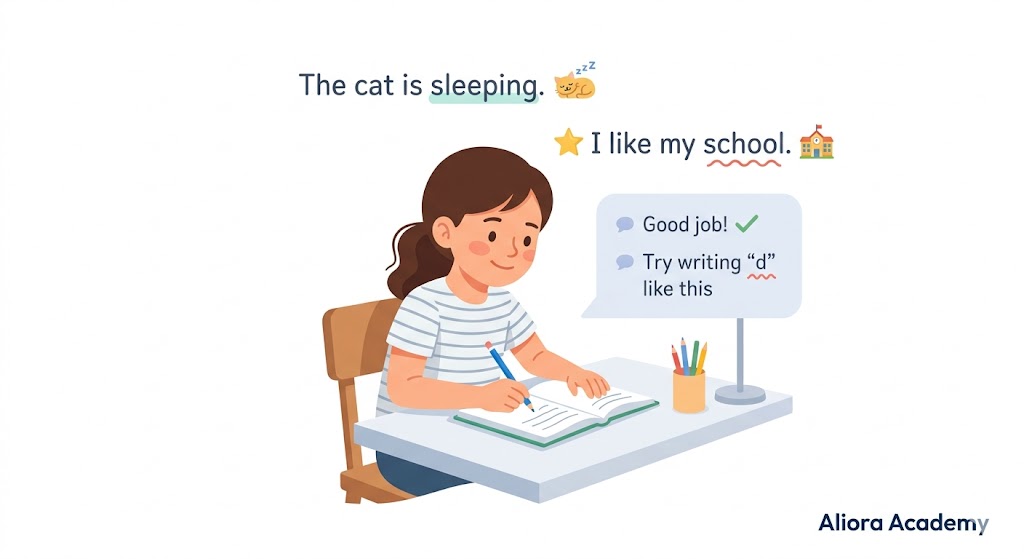
Correct Mistakes Gently and Repeatedly
Use encouraging feedback loops to explain grammatical slips without dampening creative writing confidence.
How Vocabulary Improves Sentence Writing
Vocabulary plays a direct role in writing better sentences. When children learn more words, they can express ideas more clearly and creatively. A strong vocabulary helps them avoid repetition and build more meaningful sentences. It also improves grammar accuracy because children understand how words function in a sentence.
Implement immediate, practical word-building exercises using our Grade 3 Vocabulary Page. Secure live interactive mentoring slots through our core English Classes portal, or discover professional literacy tips inside our primary Blog Section.
Clear & Creative Expression
Prevents Monotonous Repetition
Improves Grammatical Accuracy
Strong Contextual Understanding
How Parents Can Help Improve Sentence Writing
Parents play a key role in building writing habits. Simple daily activities like asking children to describe their day in sentences, reading short stories together, and correcting mistakes gently can make a big difference. Encouragement is more powerful than pressure at this stage.
Access our detailed roadmap in the Parent Guide Article. To back your home activities with structured professional training, review our interactive English Classes, or read alternative home learning hacks inside our Blog Section.
Daily Verbal Prompts
Ask open-ended questions that require full, complete sentence explanations instead of brief, one-word replies.
Shared Reading Routine
Read high-quality literary blocks side-by-side to notice and analyze clean paragraph patterns together.
Gentle Feedback Loops
Prioritize constructive guidance and direct support over strict performance rules to keep motivation high.
How Online English Classes Help Sentence Writing
Online English classes provide structured learning for sentence writing. Children get guided practice, grammar explanations, and writing exercises designed for their level. Teachers correct mistakes in real time and help students build confidence step by step. This structured support helps children improve faster than self-learning alone.
Discover our practical methodology details inside How Online Classes Work. Prepare your learner for critical upcoming academic growth loops with our dedicated Grade 4 Program, or secure a foundational evaluation pass today through our core English Classes hub.
Structured Learning Paths
Guided Syntax Practice
Clear Grammar Explanations
Targeted Writing Drills
Real-Time Error Correction
Step-by-Step Confidence
Daily Habits to Build Strong Writing Skills
Daily practice is the key to improving sentence writing. Even 10–15 minutes of writing each day can show big improvement. Children should practice writing simple sentences about daily life, objects around them, or short stories. Repetition builds confidence and reduces mistakes over time.
Explore deeper educational strategies inside our expert-guided Blog Section. Build stable syntax core foundations through structured English Classes, or enrich their daily word choices via our Grade 3 Vocabulary Page.
10–15 Minute Micro-Sessions
Keeps daily learning highly focused and manageable without exhausting your child's mental stamina.
Real-World Object Descriptions
Encourages children to look around their immediate environment and frame physical sights into structured syntax.
Confident Syntax Repetition
Revisiting identical sentence frames builds deep muscle memory and gradually eliminates structure errors.
How to Help Your Child Write Better Sentences in Grade 3
An exhaustive, technical pedagogical breakdown for educators and parents looking to systematically optimize syntax construction, eliminate foundational grammar blind spots, and expand lexical processing speeds in elementary learners.
Importance of Sentence Writing Skills
Developing robust sentence writing skills for kids at the elementary level acts as the ultimate catalyst for long-term academic excellence. In Grade 3, cognitive linguistic development shifts from basic word recognition to complex organizational expression. When a child masters the mechanics of linking subjects with corresponding predicates, they are not merely performing an English syntax drill—they are building structural logic circuits in their brain.
Clear sentence design directly amplifies reading comprehension. As children understand how clauses are assembled, they read with greater speed and contextual accuracy. This structural comfort forms the absolute academic writing foundation that preserves a student's confidence when they face multi-sentence essay responses in subsequent grade levels.
Common Writing Mistakes in Children
Identifying structural errors early prevents bad habits from crystallizing into permanent writing blocks. Many young learners experience a notable drop in writing fluency improvement because they rely heavily on run-on phrases joined repeatedly by simple conjunctions like "and" or "but." Conversely, some children output fragments—choppy, broken textual blocks lacking a clear structural verb anchor.
Frequent systematic slip-ups also manifest as tense misalignment or general subject-verb disagreement. These issues typically occur because the child’s vocalized thought speed outpaces their physical text-generation mechanics. Recognizing these patterns allows for targeted diagnostic intervention rather than generalized, unhelpful red-pen corrections.
Grammar Basics for Grade 3
Demystifying basic grammar for children requires a clean breakdown of mechanical sentence architecture. Students must learn to reliably isolate the Subject (the performer of the action) from the Predicate (the action and its accompanying modifiers).
To implement successful sentence structure practice at home or online, introduce simple color-coded structural visualizers:
- Nouns & Pronouns: The essential foundational actors within the text string.
- Action Verbs: The operational engines driving the timeline of the clause forward.
- Modifiers (Adjectives/Adverbs): The descriptive elements providing clarity and spatial depth.
Mastering these simple component rules protects children from structural confusion, allowing them to formulate pristine English sentence formation for children across any school assignment.
Vocabulary Building Strategies
An accurate sentence demands a precise vocabulary. Without structured vocabulary development for kids, young writers repeat empty, generic target descriptors like "good," "bad," "big," or "mad" over and over. To unlock sophisticated expression, parents must deliberately feed specific synonyms into the child's daily speech paths.
Encourage active semantic tracking during reading routines. When an unfamiliar word shows up in a book, don't just skip past it—analyze its exact structural role inside the paragraph. Showing a child how an energetic adjective replaces a dull phrase directly teaches them how to improve grammar for kids through sharp, deliberate vocabulary choice.
Daily Writing Practice Methods
Consistent, structured routines outperform sporadic marathon writing sessions every single time. High-impact writing practice for elementary students works best when broken down into low-stakes 15-minute daily challenges. This steady repetition builds strong motor control and cognitive memory loops without overwhelming the student.
Transform standard writing practice by utilizing real-life sensory triggers:
| Practice Trigger | Target Strategy Focus | Linguistic Benefit |
|---|---|---|
| Object Isolation | Describe a physical item using 3 precise adjectives. | Elaborates core noun phrases safely. |
| Sequential Recount | Map out a daily event using clear order markers. | Builds transition logic between clauses. |
| Emotion Mapping | Explain an internal feeling without using basic keywords. | Drives deeper semantic word selection. |
Using this balanced layout turns daily practice into an engaging routine, showing parents exactly how to improve writing in Grade 3 without unnecessary friction.
Role of Parents in Writing Development
The home environment serves as the primary incubator for early literacy habits. While professional instructors provide strategic blueprints, parents reinforce these skills through consistent daily encouragement. Instead of focusing heavily on spelling mistakes right away, prioritize the structural completeness of your child's thoughts first.
Encourage regular conversational check-ins that require descriptive answers. When a child explains an idea out loud using full sentences, they are mentally drafting clean text before their pencil even touches paper. This constant vocal practice is highly effective for building natural, fluid communication habits.
Benefits of Online English Classes
While home practice forms a wonderful foundation, enrolling your child in a specialized English learning for Grade 3 program provides the specialized structure needed for advanced fluency. Professional online classes pair kids with experienced educators who can instantly spot subtle structural errors right as they happen.
Digital learning hubs leverage interactive web boards, visual syntax puzzles, and customized real-time writing exercises designed explicitly for elementary performance brackets. This professional guidance takes the guesswork out of writing instruction, helping children correct deep-seated mistakes far faster than unguided home study alone.
Long-Term Academic Improvement
Mastering early sentence structure triggers a powerful chain reaction across a student's entire educational journey. A child who writes with structural clarity can confidently break down complex word problems in mathematics, craft precise laboratory observations in science, and synthesize historical timelines cleanly.
As these young learners advance into middle school and beyond, their early mastery of core grammar keeps them from struggling with complex paragraphs. By investing heavily in foundational training today, you ensure your child steps forward with the critical communication tools required for lifelong academic success.
Start Improving Your Child’s Writing Skills Today
Strong sentence writing skills build the foundation for better communication, academic success, and confidence in English. Aliora Academy helps children improve writing, grammar, and vocabulary through structured online English programs designed for Grade 3 students.
Explore immediate curriculum entry points via our primary English Classes gateway. Track upcoming skill benchmarks in our Grade 4 Matrix, or download additional home learning frameworks through our comprehensive Parent Guide.
Frequently Asked Questions
Find quick, actionable solutions to common roadblocks parents face when trying to support elementary writing development at home.
How can I improve my child’s sentence writing in Grade 3?
Focus on daily high-impact practice loops starting with short, simple structures. Introduce a clean structural core framework (Subject + Verb + Object) using color-coded cards or interactive worksheets before introducing complex clauses or long paragraphs.
What causes weak sentence writing skills in children?
Weak skills typically stem from a combination of low reading exposure, lack of core grammar breakdown rules, and limited vocabulary. When children don't understand how words function as blocks within a clause, they output choppy run-on strings or fragmented lines.
How much daily writing practice is needed?
Consistency is far more critical than long, intense sessions. Keeping target practice between 10 to 15 minutes daily ensures your child remains focused, builds muscular and cognitive writing stamina, and finishes without experiencing learning fatigue.
Does vocabulary improve sentence writing?
Yes, vocabulary acts as the physical building block for syntax. Expanding a student's lexical range prevents them from repeating generic, monotonous descriptors, helps them frame creative assertions with precision, and improves sentence variety.
Are online classes effective for writing skills?
Structured online English programs provide professional scaffolding that accelerates progress beyond solo home-study. Dedicated instructors spot structural errors in real time, explaining proper grammar context through engaging visual tools that build confidence step by step.
What is the best age to start writing practice?
Basic sentence training should start around ages 6 to 7 (Grade 1 and 2) through simple trace and layout actions. By age 8 (Grade 3), cognitive shifts require an explicit emphasis on syntax development, logic sequencing, and accurate punctuation routines.