Why Speaking Practice Is Essential for English Learners in Elementary Grades
Reading and writing get most of the attention in elementary English — but speaking is the skill that holds the other three together. A child who speaks English regularly builds vocabulary faster, reads with more understanding, and writes with more confidence. Here is why it matters and how to build the habit.
Speaking Is the Skill That Connects All the Others
Elementary English is usually taught as four skills: listening, speaking, reading and writing. In practice, speaking is the one that gets squeezed. Class time goes to worksheets and comprehension passages, and speaking gets a few minutes at the end — or none at all.
That is backwards. Speaking is the skill that turns passive knowledge into active knowledge. A word a child has only read is a word they recognise. A word a child has said out loud several times is a word they own — and can use in their writing without hesitation.
This guide explains four reasons speaking practice matters so much in elementary grades, what it looks like in practice, and how to build it at home without turning it into a chore.
- Vocabulary Retention
- Reading Comprehension
- Writing Fluency
- Confidence
- Listening Accuracy
- Pronunciation
Four Reasons Speaking Practice Cannot Be Skipped
Each of these works on its own, but together they explain why a child who speaks English regularly pulls ahead in every other area too.
Reason 1: Speaking Builds Vocabulary That Sticks
RetentionA word a child has only read is stored passively — they recognise it when they see it, but cannot produce it. A word they have said out loud is stored actively. Producing a word forces the brain to retrieve it, and retrieval is what makes memory durable.
- Words move from recognition to active use
- Retrieval practice strengthens long-term memory
- New words transfer into writing more easily
- Vocabulary grows through real conversation
Reason 2: Speaking Supports Reading Comprehension
ReadingReading comprehension depends on hearing the sentence correctly in your head. Children who read aloud regularly — and who speak English often — process written sentences far more smoothly, because the rhythm and structure are already familiar to their ear.
- Speech rhythm transfers to silent reading
- Spoken sentences become easier to parse on the page
- Oral discussion builds background knowledge for texts
- Retelling aloud strengthens comprehension
Reason 3: Speaking Makes Writing Easier
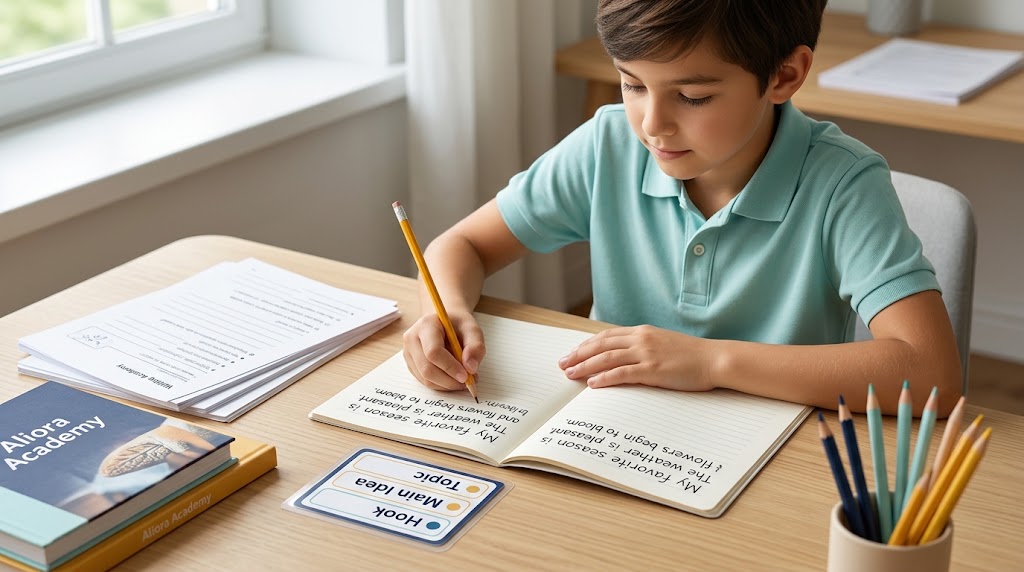
WritingWriting is essentially speech slowed down and polished. A child who cannot say a sentence clearly will struggle to write it clearly. Oral rehearsal — saying the sentence before writing it — is one of the most effective supports for early writing.
- Oral rehearsal before writing improves structure
- Spoken sentences are usually clearer than written drafts
- Grammar absorbed through speech transfers to writing
- Vocabulary available in speech appears in writing
Reason 4: Speaking Builds Confidence and Fluency
ConfidenceFluency is not about speed — it is about not freezing. Children who speak English regularly learn to keep going through a mistake, which is the single most important habit for later fluency. Confidence comes from practice, not from waiting until it is perfect.
- Mistakes become survivable rather than stopping
- Speaking becomes automatic instead of effortful
- Children volunteer answers in class more often
- Willingness to speak supports all later learning
Four Habits That Build Speaking at Home
None of these need extra lessons or materials. They need a few minutes and consistency — and a willingness to let your child make mistakes.
Talk in Full Sentences
Ask a question and expect a full sentence back. "What did you do at school?" — "I learned about volcanoes."
Get Question PromptsRetell What They Read
After any story, ask them to tell you what happened in their own words. Speaking about a text cements understanding.
Get Retelling PromptsSpeak Before Writing
Ask your child to say the sentence aloud before they write it. Spoken sentences are cleaner than written drafts.
Get Writing PromptsPlay Speaking Games
Twenty questions, describe-the-picture, tell-me-a-story. Games make speaking regular without making it feel like practice.
Get Game IdeasWhat Speaking Practice Changes
A practical comparison showing how consistent speaking practice affects each area of English over a term.
| Area | Without Speaking Practice | With Speaking Practice | Ask |
|---|---|---|---|
| Vocabulary Word Recall | Recognises words on a page but does not use them in speech. | Uses new words in conversation within a week of learning them. | |
| Pronunciation Sound Accuracy | Mispronounces words that have only been read, never heard. | Pronunciation corrected through real speech and repetition. | |
| Reading Fluency Sentence Processing | Reads word-by-word because sentences do not yet sound familiar. | Reads in phrases because spoken English rhythm is already familiar. | |
| Comprehension Understanding | Reads a passage but cannot explain it in their own words. | Retells the passage confidently after discussing it aloud. | |
| Writing Sentence Construction | Struggles to form sentences because they have not said them first. | Sentences flow because they were spoken aloud before writing. | |
| Grammar Sentence Structure | Knows the rule but does not apply it in speech or writing. | Applies the rule automatically because it was practised in speech. | |
| Listening Understanding Speech | Struggles to follow fast spoken English, even familiar words. | Follows spoken English more easily because speech patterns are known. | |
| Confidence Willingness | Avoids speaking in class and stays silent even when they know the answer. | Volunteers answers and joins discussion without prompting. |
Not Sure How Much Your Child Actually Speaks?
Share your child's age, school grade and how they respond to English at home. You will get a clear picture of where speaking practice will help most — and a simple routine to build it.
Describe What You Notice at Home
Answers in single words, avoids English, waits for you to translate — these details tell us a lot.
Send DetailsShare a Writing Sample
Speaking gaps show up in writing too — in short sentences and repeated word choices.
Send a SamplePlan a Speaking Routine
Tell us how much time you have each week, and we will suggest a realistic routine for home.
Discuss RoutineSix Signs a Child Is Not Getting Enough Speaking Practice
None of these on their own is alarming. But two or three together usually mean speaking is being skipped at school or at home.
Answers Only in Single Words
A child who understands English but replies in one-word answers is often unsure how to build a full sentence out loud — even when they can write one.
Reading Well but Not Speaking
A child who reads fluently but will not speak is usually strong on the visual channel and weak on the oral one — speaking practice closes that gap.
Mispronouncing Words They Can Read
Mispronouncing common words is a clear sign the child has learned them by sight, not by ear — speaking practice corrects this naturally.
Writing That Sounds Awkward
Sentences that read oddly often simply have not been said aloud. Reading the sentence out loud usually reveals the problem immediately.
Avoiding English Outside Class
Using the home language for everything is natural but slows English. Ten minutes of spoken English a day makes a real difference.
Freezing Mid-Sentence
Stopping mid-sentence and starting over often means the child is translating from their first language instead of thinking in English.
How to Build Speaking Practice in Four Steps
A practical sequence you can start this week, without changing much else.
Start Small and Daily
Ten minutes of English conversation every day beats an hour once a week. Consistency is what builds the habit.
Expect Full Sentences
Gently push for full sentences even when a one-word answer is enough. This is where fluency is built.
Let Mistakes Pass
Correct only one thing at a time and never mid-sentence. Confidence matters more than accuracy at this stage.
Link Speaking to Reading and Writing
Retell stories aloud, and say sentences before writing them. Speaking should connect to everything else.
Speaking Practice Checklist
- Your child speaks English for at least ten minutes a day.
- Answers are given in full sentences, not single words.
- Your child retells stories or videos in their own words.
- New vocabulary is used in speech within a week of learning it.
- Sentences are said aloud before being written down.
- Mistakes are corrected gently and only one at a time.
- Your child is not afraid to be wrong in front of you.
- Speaking activities are enjoyable, not treated as tests.
- Your child hears fluent English read aloud regularly.
- Reading comprehension is checked by talking about the text.
- English is spoken in ordinary conversation, not just lessons.
- Your child volunteers to speak English without being prompted.
Frequently Asked Questions
Common questions parents ask about speaking practice in elementary grades.
Why does speaking matter more than reading or writing at this age?
All four skills matter, but speaking does something the others cannot: it turns passive vocabulary into active vocabulary. A word a child has only read is a word they recognise. A word they have said out loud several times is a word they own — and can produce without hesitation in speech or writing. Speaking also trains the ear for sentence rhythm, which makes reading smoother and writing more natural. It is not that speaking matters more — it is that speaking quietly supports the other three.
How much speaking practice does a child need each day?
Ten minutes a day of genuine English conversation is enough, and far more effective than a long session at the weekend. The key word is genuine — a real conversation, not a drill. Asking about their day, discussing a story they read, or playing a speaking game all count. Over a term, ten minutes a day adds up to roughly twenty hours of spoken practice, which is enough to make a visible difference in fluency and confidence.
My child refuses to speak English at home. What should I do?
Refusal is almost always about confidence, not ability. Two things help most. First, remove the audience — speak English one-to-one, never in front of siblings or relatives who might laugh. Second, make the stakes low — talk about something enjoyable rather than testing them. Some children do better speaking to a pet, a toy or a recording than to an adult. If your child is comfortable in their home language, they may simply need to hear that mistakes in English are normal and expected.
Should I correct my child's mistakes while they are speaking?
Not mid-sentence. Correcting while a child is speaking interrupts the flow and teaches them that speaking is risky. Instead, let them finish, then respond naturally using the correct form — for example, if they say "I goed to the park", reply "Oh, you went to the park? What did you do there?" This models the correction without stopping them. Save one or two specific corrections for later, when they are not mid-flow.
Does reading aloud count as speaking practice?
It helps, but it is not the same thing. Reading aloud develops pronunciation and fluency with the text, but it does not require the child to construct their own sentences. Real speaking practice — the kind that builds confidence and active vocabulary — involves forming original sentences in response to a question or a situation. Reading aloud is a useful supplement; it should not replace speaking practice.
What if my child understands English but only replies in one or two words?
This is a very common stage, and the fix is gentle persistence. When your child answers in one word, respond by modelling the full sentence back — "Yes, and where did you go?" — and expect a full answer. Ask questions that cannot be answered in one word: "What was the best part of your day?" rather than "Did you have a good day?" Over a few weeks, the habit of answering in full sentences builds naturally.
Can speaking practice help with writing?
Yes, and this is one of the most underused supports for early writing. Writing is essentially speech slowed down and polished. A child who can say a sentence clearly will usually write it clearly. Getting your child to say the sentence aloud before writing it is one of the fastest ways to improve the quality of their written work. For more on writing specifically, see how to help your Grade 4 child write a strong introduction paragraph.
How can I get help building speaking practice for my child?
You can reach out directly on WhatsApp at +92 300 123 4567. Share your child's age, school grade and how they respond to English at home — whether they answer in single words, avoid speaking, or freeze mid-sentence. That is enough to suggest a realistic routine and, if needed, the right kind of structured lesson support.
Give Your Child the Skill That Lifts Everything Else
Share your child's age, school grade and how they respond to English at home. You will get a clear picture of where speaking practice will help most — and a realistic routine to build it.
Why Speaking Practice Is Essential for English Learners in Elementary Grades
Elementary English is usually taught as four skills: listening, speaking, reading and writing. In practice, speaking is the one that gets squeezed. Class time goes to worksheets and comprehension passages, and speaking gets a few minutes at the end — or none at all. That is backwards. Speaking is the skill that turns passive knowledge into active knowledge. A word a child has only read is a word they recognise. A word a child has said out loud several times is a word they own — and can use in their writing without hesitation. This guide explains four reasons speaking practice matters so much, and how to build it at home.
Reason 1: speaking builds vocabulary that sticks
A word a child has only read is stored passively — they recognise it when they see it, but cannot produce it. A word they have said out loud is stored actively. Producing a word forces the brain to retrieve it, and retrieval is what makes memory durable. This is why children who speak English regularly tend to have noticeably larger active vocabularies than children who only read. For strategies that build vocabulary properly, see best vocabulary-building strategies for Grade 5 students.
Reason 2: speaking supports reading comprehension
Reading comprehension depends on hearing the sentence correctly in your head. Children who speak English often process written sentences far more smoothly, because the rhythm and structure are already familiar to their ear. Oral discussion before reading also builds background knowledge, which is one of the strongest predictors of comprehension. Retelling a passage aloud is one of the fastest ways to check whether it was actually understood. For a fuller picture, see how to support a child who struggles with reading comprehension.
Reason 3: speaking makes writing easier
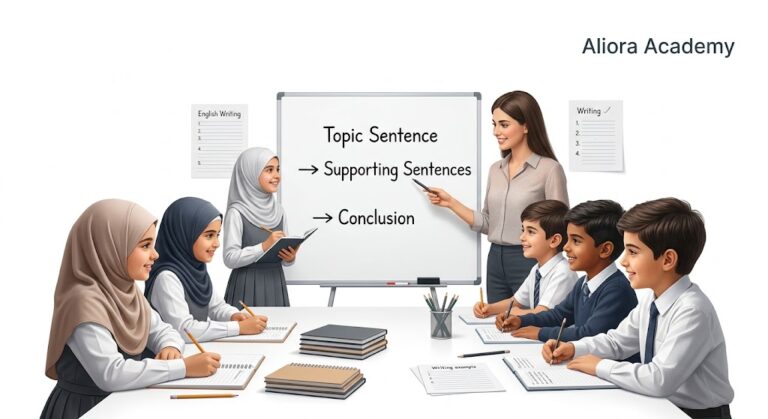
Writing is essentially speech slowed down and polished. A child who cannot say a sentence clearly will struggle to write it clearly. Oral rehearsal — saying the sentence before writing it — is one of the most effective supports for early writing, and it works at every level from single sentences to full paragraphs. Grammar and vocabulary absorbed through speech transfer naturally into written work. For how this plays out in practice, see how to help your Grade 4 child write a strong introduction paragraph.
Reason 4: speaking builds confidence and fluency
Fluency is not about speed — it is about not freezing. Children who speak English regularly learn to keep going through a mistake, which is the single most important habit for later fluency. Confidence comes from practice, not from waiting until it is perfect. A child who is willing to speak imperfectly will keep learning. A child who stays silent to avoid mistakes stops improving. For a closer look at the confidence side, see how to build English speaking confidence in children.
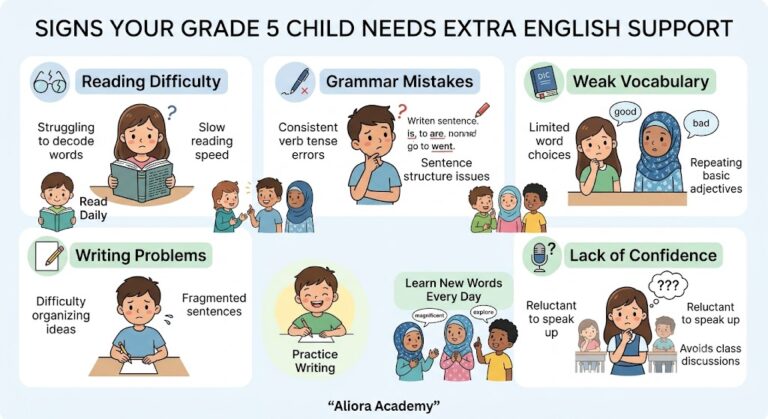
Signs a child is not getting enough speaking practice
Watch for a cluster of signs rather than a single one:
- Answers only in single words — unsure how to build a full sentence aloud.
- Reads well but does not speak — strong on the visual channel, weak on the oral one.
- Mispronounces words they can read — learned by sight, not by ear.
- Writing that sounds awkward — sentences that have never been said aloud.
- Avoiding English outside class — using the home language for everything.
- Freezing mid-sentence — often translating from the first language instead of thinking in English.
How much speaking practice is enough
Ten minutes a day of genuine English conversation is enough, and far more effective than a long session at the weekend. Over a term, that adds up to roughly twenty hours of spoken practice — enough to produce visible change in fluency and confidence. The key is that the conversation must be real, not a drill: asking about their day, discussing a story they read, or playing a speaking game all count. Reading aloud is a useful supplement but should not replace speaking practice, because it does not require the child to construct their own sentences.
How to correct without killing confidence
Never correct mid-sentence. Interrupting a child while they are speaking teaches them that speaking is risky, which is exactly the opposite of what you want. Instead, let them finish, then respond naturally using the correct form — if they say "I goed to the park", reply "Oh, you went to the park? What did you do there?" This models the correction without stopping them. Save one or two specific corrections for later, when they are not mid-flow.
Speaking and the wider elementary curriculum
By the middle primary years, English carries every subject. A child who cannot discuss a topic aloud in English will struggle to write about it or answer comprehension questions on it. Speaking is not a separate skill to be practised once a week — it is the foundation the other three skills rest on. For the listening side of this connection, see how listening skills affect your child's overall English development.
When to consider structured support
If a child is consistently avoiding English or is frozen in speaking situations, targeted support works better than general practice. Structured online lessons with a small group or one-to-one format can give a child the low-pressure speaking practice they need to build confidence. Our guide to what makes an online English program effective sets out what to look for before enrolling, and online English tutoring for kids covers speaking, reading, writing and listening with live teachers, built around what the individual child actually needs.
Get help building a speaking routine
If you would rather not work through every check yourself, you can send your child's age, school grade and how they respond to English at home directly on WhatsApp at +92 300 123 4567. That is enough to suggest a realistic routine — and, if needed, the right kind of structured lesson support.