Why Does My Child Struggle With English Grammar?
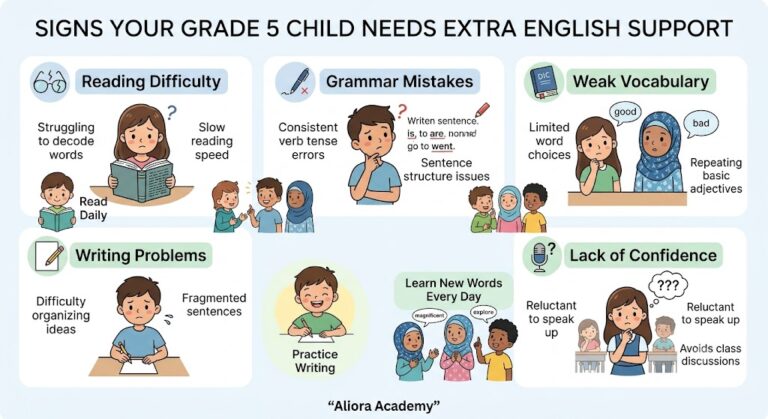
If your child struggles with English grammar, you are not alone. Thousands of parents notice the same thing every school year — their child knows the words, can read a passage, but still writes sentences that feel incomplete or confused. It is a real and common challenge, and understanding why it happens is the first step toward fixing it.
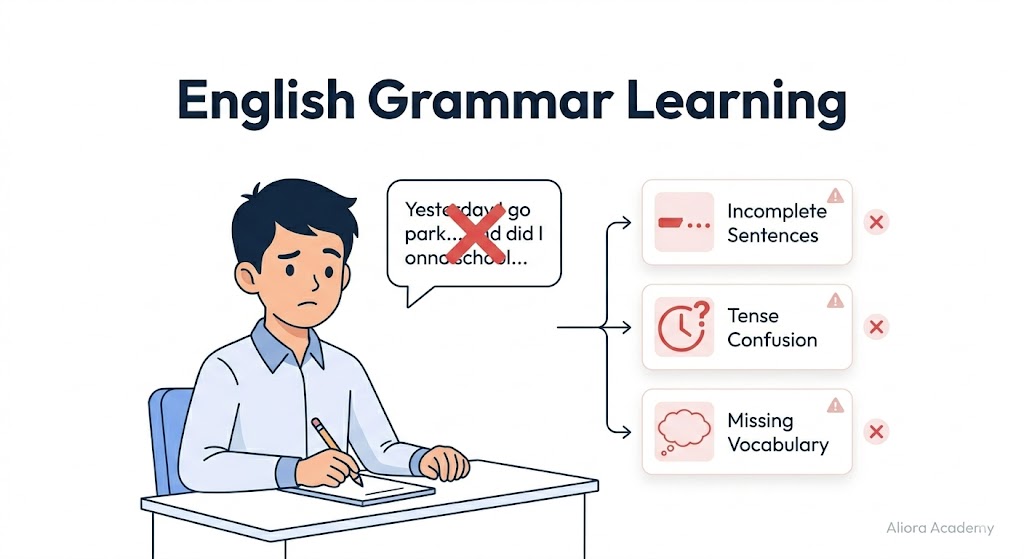
Imagine a Grade 4 student named Aisha. She loves storytelling and talks about her ideas with energy at home. But every time she sits down to write a paragraph for school, her sentences come out tangled. She writes, “Yesterday I go to the park and we plays football and then we eated lunch.” Her teacher marks it. Aisha feels embarrassed. Her confidence drops. What went wrong?
The answer usually is not a lack of intelligence. Most children who struggle with English grammar are dealing with specific gaps in language exposure, practice, or instruction. These gaps are very fixable — but only when parents and teachers identify them clearly.
This article explains the most common reasons why children find English grammar difficult, what parents can do at home, and how structured learning through a good English program can make a measurable difference.

Why Do Children Struggle With English Grammar in the First Place?
Grammar is not a single skill — it is a system of many interconnected rules. A child learning grammar must understand tense, subject-verb agreement, punctuation, parts of speech, and sentence structure — all at once. For young learners, this can feel overwhelming.
Here are the most common root causes:
1. Limited Reading Exposure
Children who read regularly absorb grammar patterns naturally — not by memorising rules, but by seeing how language works in real sentences. A child who rarely reads misses out on this passive learning. They never “see” correct grammar enough times for it to feel natural.
Research in language acquisition consistently shows that children who read for at least 20 minutes a day develop stronger grammar instincts than those who do not. This is not
about testing them on rules — it is about surrounding them with correct language.
2. Confusion Between Spoken and Written English
Children often speak English informally at home or with friends. Spoken English is relaxed — contractions, sentence fragments, and casual word choices are perfectly normal in conversation. Written English is more structured and rule-bound. Many children do not realise these are different registers, so they write the way they speak — and that leads to grammatical errors.
3. Gaps in Foundational Grammar Concepts
If a child skips or misses a key concept in Grade 3 — such as proper nouns, simple past tense, or basic sentence structure — that gap does not disappear. It grows. By Grade 5, they may be attempting essay writing while still shaky on sentence fundamentals. Grammar skills are cumulative, which is why early gaps cause bigger problems later.
4. Lack of Consistent Grammar Practice
English grammar improves through repeated, meaningful practice — not through reading definitions once or doing a single worksheet. Many children do not get enough targeted grammar exercises outside of school, so the concepts do not stick. Consistency is everything.
5. Low Confidence Creating a Negative Cycle
When a child makes grammar mistakes repeatedly and gets corrected, they can begin to avoid writing altogether. They write shorter sentences to reduce the risk of errors. Less writing means less practice, which means weaker grammar skills — a cycle that keeps going unless someone actively breaks it.
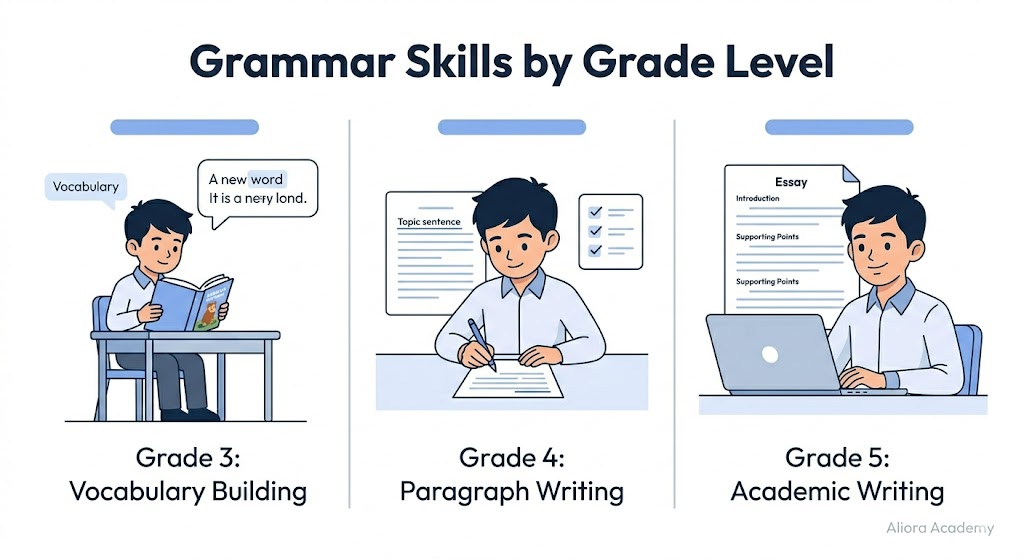
What Grammar Concepts Do Children Find Most Difficult by Grade?
Not all grammar challenges are the same across age groups. Each grade level has its own set of common trouble spots.
Grade 3: Building the Foundation
At Grade 3, children are working on basic grammar essentials. The most common struggles include:
- Subject-verb agreement — e.g., confusing “he run” and “he runs”
- Simple past tense — mixing up “I go” and “I went”
- Capital letters and full stops — not understanding where sentences begin and end
- Nouns and pronouns — using them inconsistently in writing
Grade 4: Applying Grammar in Writing
By Grade 4, children are expected to write full paragraphs. Grammar errors at this stage often show up as:
- Run-on sentences — joining too many ideas without proper punctuation
- Incorrect use of adjectives and adverbs — confusing describing words
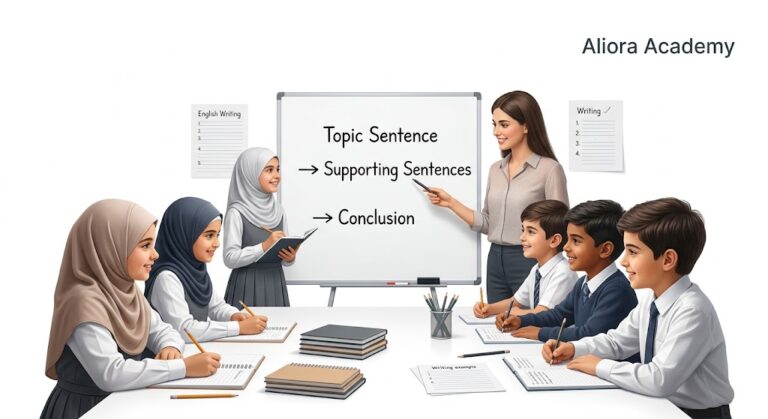
- Weak paragraph structure — missing topic sentences or concluding ideas
- Tense inconsistency — switching between past and present mid-paragraph
A Grade 4 student named Omar was writing story assignments with tense confusion throughout. His teacher noticed he was unsure whether to write in past or present tense. Once Omar practised short daily paragraph exercises focusing on one tense at a time, his writing became more controlled. English classes for Grade 4 that build paragraph writing alongside grammar practice are ideal at this level.
Grade 5: Advanced Grammar for Academic Writing
Grade 5 students are moving toward academic English — essays, reports, and structured responses. At this level, common grammar difficulties include:
- Complex sentence structures — using subordinate clauses correctly
- Passive voice — understanding when and how to use it
- Academic vocabulary in context — using subject-specific words correctly in sentences
- Consistent tone — maintaining formal language throughout an essay
A Grade 5 student named Sara was preparing for a school report on environmental issues. She had good ideas but her sentences were fragmented and her vocabulary was too casual for academic writing. With targeted practice on sentence expansion and academic word choices through English classes for Grade 5, her writing improved noticeably over just a few weeks.
How Does Vocabulary Development Support Grammar Learning?
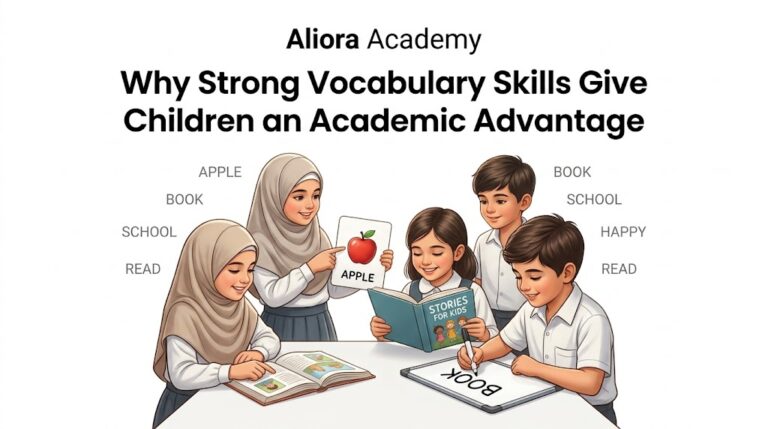
Many parents separate vocabulary and grammar into two different problems. In reality, vocabulary and grammar develop together. A child with a limited vocabulary will write shorter, simpler sentences — not because they lack grammar knowledge, but because they do not have enough words to construct complex ones.
Think about it this way: if a child knows only basic adjectives, their descriptions will always be weak. If they know a wider range of verbs, they will naturally write more varied and accurate sentences. Vocabulary expansion directly enables better grammar use.
Key ways to build vocabulary alongside grammar skills:
- Reading a variety of texts — fiction, non-fiction, poetry, and news stories expose children to different word choices
- Word journals — having your child write down three new words per day with their meanings and use them in sentences
- Contextual learning — learning words in full sentences rather than isolated lists
- Semantic mapping — creating visual word maps showing how related words connect (e.g., walk, stride, march, stroll)
For Grade 3 students especially, building vocabulary through daily reading is one of the highest-impact habits. You can find specific strategies for this in our article on improving English vocabulary for Grade 3.
Why Does Reading Help Children Overcome Grammar Struggles?
When children read regularly, they encounter correct grammar structures repeatedly and naturally. This process — often called implicit language acquisition — is one of the most effective ways the brain internalises grammar rules, especially for young learners.
The important thing to understand is that reading for grammar does not require formal analysis. A child does not need to identify every subordinate clause. Simply reading good sentences repeatedly trains the brain to recognise what sounds right — and to notice when something does not.
Here is what happens when children read consistently:
- They encounter correct punctuation use in real context — full stops, commas, question marks — and begin to use them correctly in their own writing.
- They see how sentences are built — short and punchy, or long and detailed — and start to mimic those structures.
- They absorb vocabulary naturally, which as we noted above directly supports grammar.
- They develop reading comprehension skills, which support better understanding of grammar explanations when these are taught formally at school.
For a Grade 3 student, starting with well-written illustrated books is ideal. By Grade 5, encouraging chapter books, age-appropriate non-fiction, and even quality online articles builds both reading comprehension and grammar awareness simultaneously.
How Can Parents Support English Grammar Learning at Home?
Parents play a bigger role in grammar development than most realise. You do not need to be an English teacher to make a meaningful difference. Here are practical, realistic strategies you can start today.
Create a Daily Reading Habit
Even 15–20 minutes of reading per day has a significant impact on language development. Choose books or articles that are one level slightly above your child’s current comfort zone — this gentle challenge builds vocabulary and exposes them to more complex grammar structures. Make it routine, not a chore.
Respond to Writing Without Overcorrecting
When your child writes something — a story, a message, a diary entry — resist the urge to correct every mistake in red pen. That approach often kills motivation. Instead, focus on one or two specific things per writing session. Celebrate what they got right before mentioning what could improve.
Use Grammar in Everyday Conversation
You can model correct grammar naturally in conversation. If your child says “We goed to the shop,” do not correct them harshly — instead, echo back naturally: “Oh, you went to the shop! What did you get?” This corrective recasting is a technique used by language teachers and it works gently and effectively.
Set Up a Short Weekly Writing Practice
Encourage your child to write two or three sentences about their day every evening, or a short paragraph about any topic they enjoy — football, a favourite game, a book they are reading. The subject does not matter. What matters is the consistent practice of putting thoughts into written sentences.
What Are the Best Grammar Practice Strategies for Children?
Not all grammar practice methods are equally effective. Some approaches build lasting understanding — others just help children pass a worksheet without actually learning.
Contextual Practice Over Drills
Isolated grammar drills — fill-in-the-blank exercises with no context — have their place as reinforcement, but they should not be the only approach. The most effective grammar learning happens when children practice in context: reading connected paragraphs, completing short writing tasks, editing sample sentences, and discussing language choices.
Error Analysis
Taking a piece of your child’s writing and working through specific errors together is highly effective. Instead of re-explaining a rule, ask: “Does this sentence sound right to you? Read it aloud.” This develops their ability to self-correct — which is the real goal.
Games and Interactive Activities
For younger learners especially, grammar games can dramatically increase
engagement. Story-building games, word sorting activities, and grammar-focused quizzes can make practice feel like play. The key is that children are actively using the language, not just passively receiving information.
Model Writing
Show your child how to build a sentence step by step. Write a simple sentence together, then expand it with details, adjectives, and clauses. Watching an adult construct writing in real time is extremely powerful for children who are visual learners.
How Do Online English Classes Help Students With Grammar?
With the right structure, online English classes can be highly effective for children who need grammar support. The key advantages are personalisation, consistency, and engagement.
A well-designed English learning program does the following:
- Identifies specific grammar gaps — not every child has the same weak spots; good programs diagnose and target individual needs
- Teaches grammar in sequence — building from foundational rules to more complex structures in a logical progression
- Connects grammar to reading and writing — rather than teaching it in isolation, links it to real language use
- Provides regular, trackable practice — so parents and teachers can see what is improving and what needs more attention
- Builds confidence progressively — starting where the child is, not where they are “supposed” to be
- Children who engage consistently with a structured English program typically show improvement not just in grammar, but in overall communication confidence — a benefit that extends into every academic subject.
Real-Life Examples: How Students Improved Their English Grammar
Example 1: Grade 3 — Building Vocabulary and Sentence Sense
Challenge: A Grade 3 student had a limited vocabulary and frequently wrote incomplete sentences. She often left out verbs entirely, writing things like “The cat very fast.”
Solution: Her parents introduced a daily 15-minute reading habit using well-illustrated storybooks. Her teacher recommended word-a-day activities to build her vocabulary. Each new word was used in a complete sentence before being added to her word journal.
Learning Outcome: After two months, she was consistently writing complete sentences with proper subject-verb structure. Her vocabulary grew, and she began self-correcting her writing by reading it aloud.
Example 2: Grade 4 — Strengthening Paragraph Writing
Challenge: A Grade 4 student wrote well at the sentence level but struggled to organise ideas into a coherent paragraph. His paragraphs jumped between topics and lacked a clear structure.
Solution: His teacher introduced the T.E.E.L. structure — Topic sentence, Evidence, Explanation, Link. He practised writing one well-structured paragraph per week on a topic of his own choice, focusing on grammar consistency throughout.
Learning Outcome: His paragraph writing became significantly more organised over a school term. His grammar errors reduced because he was thinking more carefully about each sentence’s role in the paragraph.
Example 3: Grade 5 — Preparing for Academic Writing
Challenge: A Grade 5 student needed to write an essay for a school project but struggled with academic vocabulary and complex sentence construction. Her sentences were grammatically basic for her grade level.
Solution: She enrolled in targeted online English tutoring focused on sentence expansion and academic word choices. Her tutor used model texts from her school subjects as examples, helping her see how grammar works in real academic writing.
Learning Outcome: Her essay improved dramatically within four weeks. She began using subordinate clauses and varied sentence lengths — key features of Grade 5 academic writing — with noticeably more confidence.
Frequently Asked Questions
How can my child improve English grammar skills at home?
The most effective home strategies are daily reading, regular short writing tasks, and gentle corrective conversations. Avoid focusing purely on rules and drills. Instead, help your child read widely and write consistently — even short diary entries or story-starters make a real difference. Using contextual grammar practice rather than isolated worksheets produces much stronger long-term results.
What is the best age to start focused English grammar learning?
Grammar development begins as soon as a child starts learning to read and write — typically from age 5 or 6. However, the most impactful window for structured grammar learning is between Grades 3 and 5 (ages 8–11), when children are developing their writing skills and need to master the rules that will carry them through secondary school. Starting early avoids the compounding effect of gaps going unaddressed for years.
Conclusion
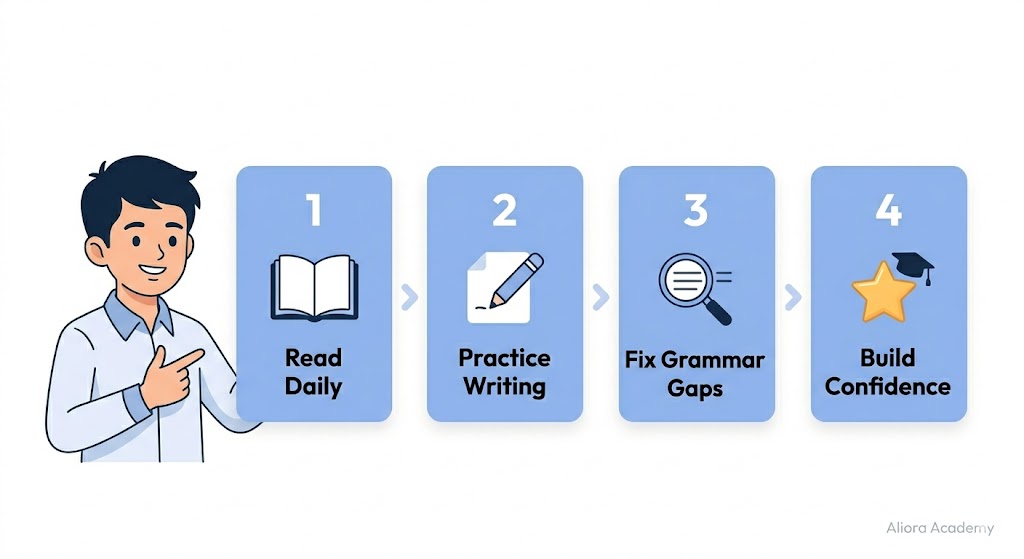
When your child struggles with English grammar, it is not a sign of failure — it is a signal that they need more targeted support in specific areas. Grammar does not develop on its own: it grows through consistent reading, meaningful writing practice, steady vocabulary development, and guided instruction.
The most important thing parents can do is stay curious about the specific gaps their child has, rather than assuming it is a general problem. A child who confuses tenses needs different help than a child whose sentences lack structure.
Build the habits early, keep reading central, celebrate small wins in writing, and give your child the consistent practice environment they need. Grammar confidence, once built, supports every area of academic English — from classroom participation to formal essays.