How to Improve English Vocabulary for Grade 3 Students at Home

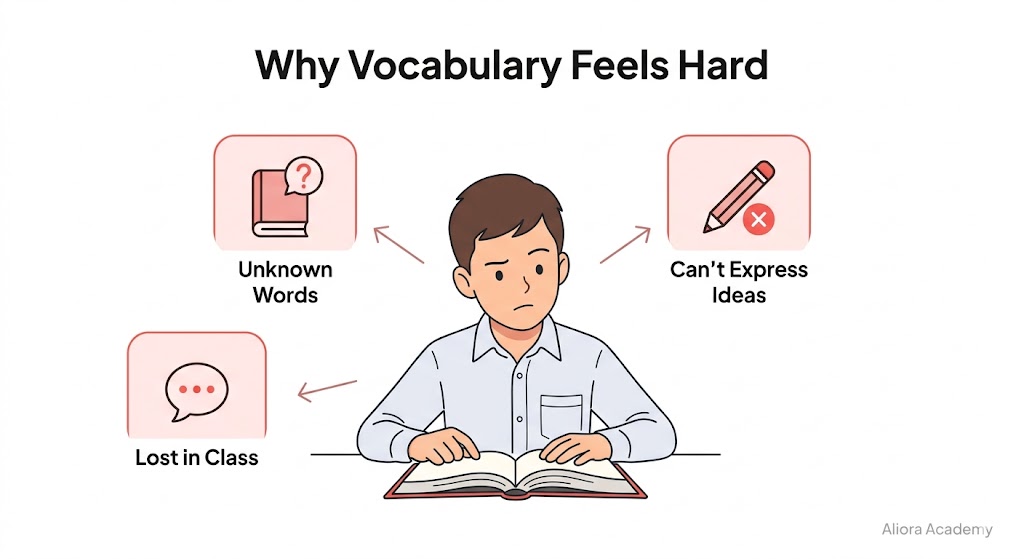
If your Grade 3 child struggles to find the right words when reading, writing, or speaking in English, you are not alone. Many parents notice that their child can decode words on a page but cannot really understand or use them with confidence. This is one of the most common vocabulary challenges children face around ages 8 and 9 — a stage when academic expectations begin to rise quickly.
Consider a typical scenario: Aisha is in Grade 3. Her teacher sends home a book report assignment, but Aisha stares at the blank page for twenty minutes. She can read the story, but the words she needs to express her ideas just are not there. Her parents feel helpless. They know she is bright, but something is missing.
What is missing, in most cases, is a strong foundation in vocabulary development. When children do not have the words they need, reading comprehension suffers, writing becomes painful, and confidence in English class drops sharply. The good news is that this is entirely fixable — with the right strategies, consistent practice, and a little parental support at home.
This article explains exactly how to improve English vocabulary for Grade 3 students in practical, meaningful ways. You will find strategies backed by real educational experience, age-appropriate examples, and guidance on how to build lasting language habits that support your child well beyond third grade.
How Can Reading Help Grade 3 Students Learn New Words Faster?
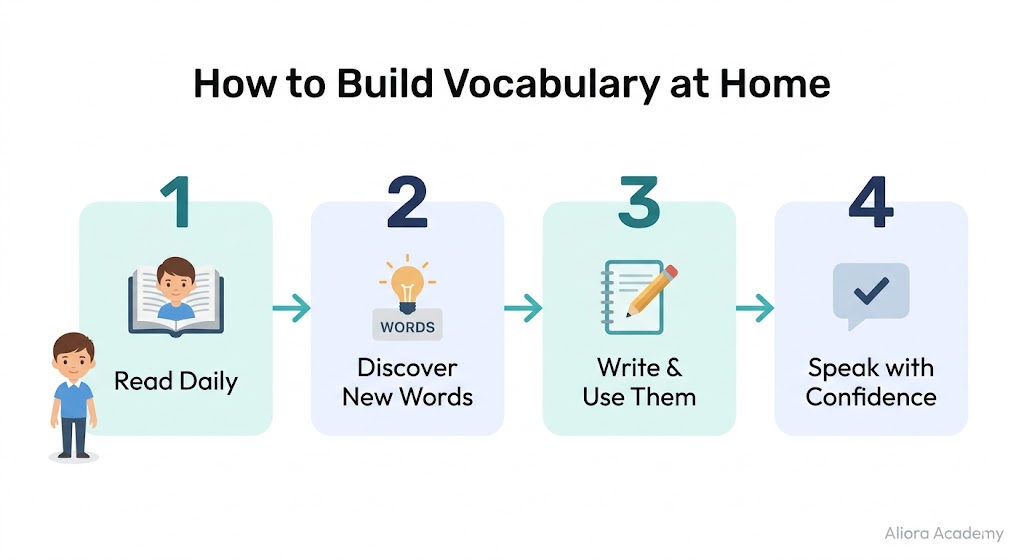
Reading is the most natural and efficient vocabulary learning tool that exists for children at this age. When a child reads regularly, they encounter new words repeatedly and in varied contexts — which is exactly how the brain learns and retains language most effectively.
Consider what happens when a child reads a story and comes across the word trembling. The sentence might say: "She stood at the edge of the stage, her hands trembling with nerves." Even without looking it up, most Grade 3 students can infer that trembling means shaking — because the context, the image, and the emotion in the sentence all support that meaning. This is called contextual inference, and it is one of the most important vocabulary skills a child can develop.
The key is choosing the right books. Books at a child's independent reading level are too easy — they will not encounter enough new vocabulary. Books far above their level are too frustrating. The ideal range is instructional level, where a child can read most of the text independently but encounters enough new vocabulary to keep learning.
For Grade 3 students specifically, some excellent book categories include:
- Early chapter books (like Magic Tree House, Nate the Great, or Ivy and Bean)
- Nonfiction readers on animals, space, history, or science
- Poetry collections — rhyme and rhythm make new words memorable
- Graphic novels — visual context supports new vocabulary powerfully
One practical strategy is vocabulary flagging: give your child sticky notes or small paper flags. When they encounter a word they do not know while reading, they flag it. After reading, spend five minutes going over each flagged word together. This makes vocabulary learning feel like discovery rather than instruction.
Reading also has a compounding effect. Children who read widely and regularly encounter vocabulary across many subjects and registers of English — formal, informal, descriptive, academic — which gives them a flexible, adaptable command of language that goes far beyond what any textbook can provide.
How Can Reading Help Grade 3 Students Learn New Words Faster?
Reading is the most natural and efficient vocabulary learning tool that exists for children at this age. When a child reads regularly, they encounter new words repeatedly and in varied contexts — which is exactly how the brain learns and retains language most effectively.
Consider what happens when a child reads a story and comes across the word trembling. The sentence might say: "She stood at the edge of the stage, her hands trembling with nerves." Even without looking it up, most Grade 3 students can infer that trembling means shaking — because the context, the image, and the emotion in the sentence all support that meaning. This is called contextual inference, and it is one of the most important vocabulary skills a child can develop.
The key is choosing the right books. Books at a child's independent reading level are too easy — they will not encounter enough new vocabulary. Books far above their level are too frustrating. The ideal range is instructional level, where a child can read most of the text independently but encounters enough new vocabulary to keep learning.
Excellent Grade 3 Book Categories
Early chapter books (like Magic Tree House, Nate the Great, or Ivy and Bean)
Nonfiction readers on animals, space, history, or science
Poetry collections — rhyme and rhythm make new words memorable
Graphic novels — visual context supports new vocabulary powerfully
One practical strategy is vocabulary flagging: give your child sticky notes or small paper flags. When they encounter a word they do not know while reading, they flag it. After reading, spend five minutes going over each flagged word together. This makes vocabulary learning feel like discovery rather than instruction.
Reading also has a compounding effect. Children who read widely and regularly encounter vocabulary across many subjects and registers of English — formal, informal, descriptive, academic — which gives them a flexible, adaptable command of language that goes far beyond what any textbook can provide.
What Are the Real Challenges That Hold Grade 3 Students Back in English?
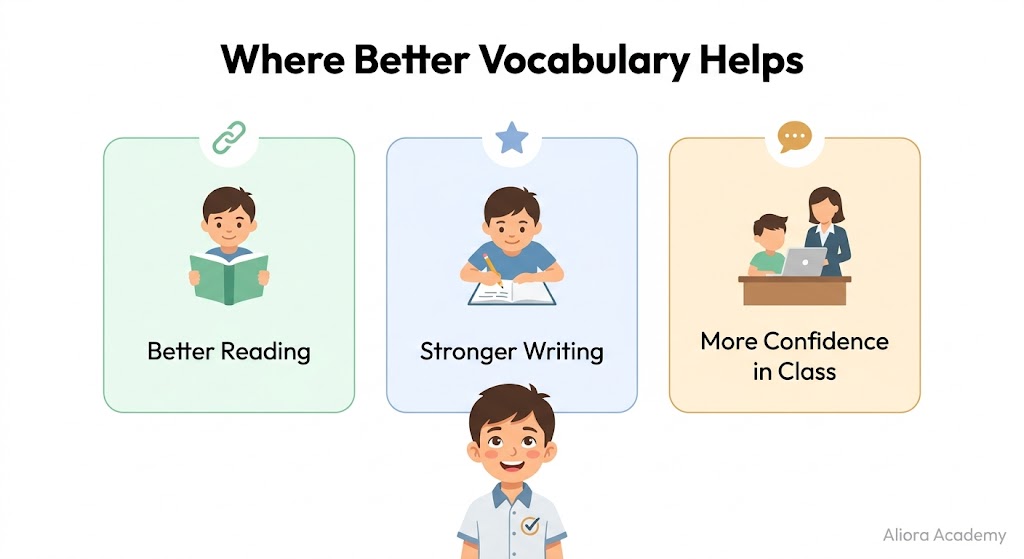
Understanding why a child struggles is as important as knowing what to do about it. Grade 3 English challenges typically fall into a few consistent patterns, and recognizing them early allows parents to address the root cause rather than just the symptoms.
Limited reading experience is the most common underlying issue. Children who do not read regularly simply do not encounter enough new vocabulary to develop naturally. This creates a self-reinforcing cycle: less vocabulary makes reading harder, so the child avoids reading, which further limits vocabulary growth.
Passive learning habits are another major obstacle. Some students can sit through English lessons, copy vocabulary lists, and complete exercises without ever genuinely engaging with the language. They may score reasonably on memory-based tests but struggle to use vocabulary flexibly in reading and writing. Active engagement — discussing, writing, playing with language — is what converts exposure into real learning.
Lack of confidence also plays a meaningful role. A child who feels embarrassed about making mistakes in English will speak less, write less, and take fewer risks with new vocabulary. Creating a safe, encouraging home environment where mistakes are treated as learning moments — not failures — is genuinely important.
Here are three real examples that show these challenges in action, along with what worked:
Example 1 — Rania, Grade 3:
Challenge: Rania could sound out words but often could not understand what she had just read. Her comprehension scores were weak despite strong phonics skills.
Solution: Her parents began reading aloud together every evening and pausing to discuss unfamiliar words in context. Within two months, Rania's comprehension improved noticeably because her vocabulary base had grown.
Outcome: Rania began choosing books independently and no longer avoided reading time.
Example 2 — Hamza, Grade 4:
Challenge: Hamza could speak well in conversation but his paragraph writing was flat and repetitive. He used simple words like good, bad, and nice repeatedly.
Solution: His tutor focused on synonym expansion — for every simple word Hamza used, he was challenged to find at least two alternatives. He also started a vocabulary notebook and used new words in each writing assignment.
Outcome: By the end of the term, Hamza's writing showed noticeably more variety and precision. His teacher commented on his improved written expression.
Example 3 — Zara, Grade 5:
Challenge: Zara struggled with academic vocabulary in science and social studies. She understood everyday English but felt lost when reading textbooks.
Solution: Her parents enrolled her in structured "English classes for Grade 5 : https://alioraacademy.com/english/grade-5/" that specifically addressed academic vocabulary and reading comprehension across subjects.
Outcome: Zara built a strong academic word bank that helped her across multiple subjects, not just English class.
What Are the Real Challenges That Hold Grade 3 Students Back in English?
Understanding why a child struggles is as important as knowing what to do about it. Grade 3 English challenges typically fall into a few consistent patterns, and recognizing them early allows parents to address the root cause rather than just the symptoms.
Limited reading experience is the most common underlying issue. Children who do not read regularly simply do not encounter enough new vocabulary to develop naturally. This creates a self-reinforcing cycle: less vocabulary makes reading harder, so the child avoids reading, which further limits vocabulary growth.
Passive learning habits are another major obstacle. Some students can sit through English lessons, copy vocabulary lists, and complete exercises without ever genuinely engaging with the language. They may score reasonably on memory-based tests but struggle to use vocabulary flexibly in reading and writing. Active engagement — discussing, writing, playing with language — is what converts exposure into real learning.
Lack of confidence also plays a meaningful role. A child who feels embarrassed about making mistakes in English will speak less, write less, and take fewer risks with new vocabulary. Creating a safe, encouraging home environment where mistakes are treated as learning moments — not failures — is genuinely important.
Here are three real examples that show these challenges in action, along with what worked:
Example 1 — Rania, Grade 3:
Rania could sound out words but often could not understand what she had just read. Her comprehension scores were weak despite strong phonics skills.
Her parents began reading aloud together every evening and pausing to discuss unfamiliar words in context. Within two months, Rania's comprehension improved noticeably because her vocabulary base had grown.
Example 2 — Hamza, Grade 4:
Hamza could speak well in conversation but his paragraph writing was flat and repetitive. He used simple words like good, bad, and nice repeatedly.
His tutor focused on synonym expansion — for every simple word Hamza used, he was challenged to find at least two alternatives. He also started a vocabulary notebook and used new words in each writing assignment.
Example 3 — Zara, Grade 5:
Zara struggled with academic vocabulary in science and social studies. She understood everyday English but felt lost when reading textbooks.
Her parents enrolled her in structured "English classes for Grade 5" that specifically addressed academic vocabulary and reading comprehension across subjects.
How Does Grade 3 Vocabulary Development Connect to Grade 4 and Grade 5 English?
It is worth understanding that vocabulary growth is not just a Grade 3 concern — it is a foundation that shapes everything that follows. The words and reading habits a child builds in Grade 3 directly determine how well they will handle the more demanding content in Grade 4 and beyond.
The Core Foundation
Building 500 new vocabulary words in Grade 3 does not just expand a child's word count — it establishes crucial reading habits, word-learning strategies, and language confidence. This early investment pays compounding dividends by allowing them to learn future words independently and efficiently.
Paragraph Mastery & Complexity
Students face longer, more complex texts and must draft multi-paragraph responses. Grade 3 vocabulary serves as the immediate building block for these new words. A strong foundation makes paragraph writing natural and reading comprehension far less frustrating.
Tier 2 Academic Integration
Vocabulary demands soar as students encounter Tier 2 academic words—such as conclude, interpret, analyse, and significant. Essential across all school subjects for critical thinking and essay writing, these complex terms require gradual accumulation over several years to master completely.
If your child is already in Grade 4 or Grade 5 and vocabulary is still a challenge, it is never too late to begin. Structured English classes for Grade 4 and focused tutoring can help bridge vocabulary gaps effectively, even at a later stage.