Best Online Reading Classes for Grade 4 Students
Best Online Reading Classes for Grade 4 Students
Online Reading Classes for Grade 4 Students are becoming an essential support system for children who struggle with understanding English passages, answering questions, or reading fluently. Many parents notice a common situation at home: a child reads a paragraph but cannot explain what it means, or takes too long to complete simple reading tasks in school.
For example, a Grade 4 student may read a story but fail to answer basic comprehension questions. Another child may understand single words but struggle to connect sentences into meaning. These challenges often lead to low confidence and weak academic performance.
Reading comprehension is not just about reading words. It is about understanding ideas, building vocabulary, improving sentence sense, and developing critical thinking. When these skills are weak, students face difficulty in all subjects.
The good news is that improvement is possible with structured guidance, consistent practice, and properly designed online reading support. Platforms like Aliora Academy provide step-by-step learning that strengthens comprehension, fluency, and academic English skills in a practical way.
Why do children struggle with reading comprehension?
Children often struggle with reading comprehension due to a combination of skill gaps rather than a single issue. In Grade 4, students are expected to move from basic reading to understanding full paragraphs and answering structured questions.
Common causes include:
• Weak vocabulary knowledge
• Poor sentence understanding
• Lack of regular reading practice
• Difficulty in connecting ideas in a passage
• Limited exposure to academic English
For example, a child may understand individual words like “forest” and “animals” but fail to understand the meaning of the full paragraph describing an ecosystem.
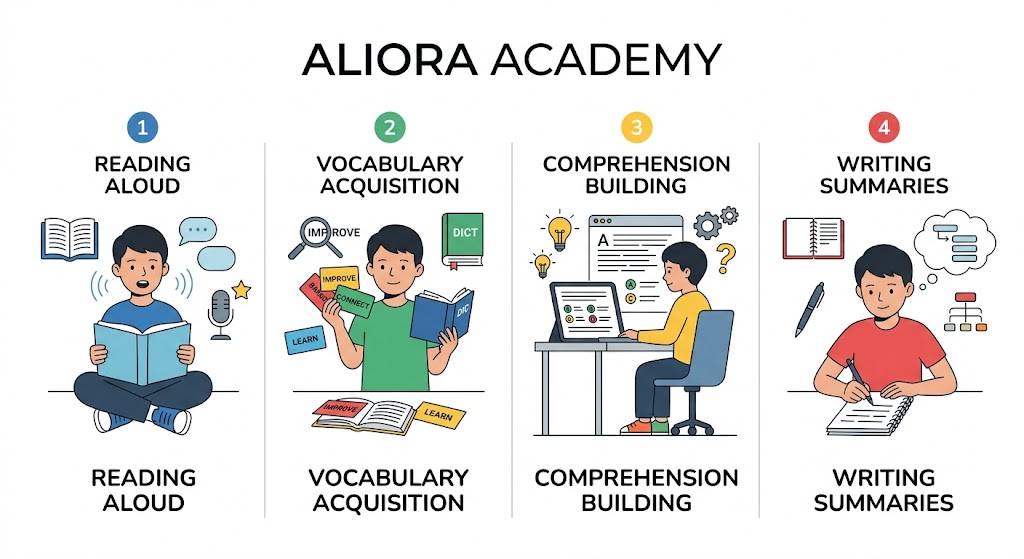
To address this, structured programs like online reading classes for Grade 4 students focus on building comprehension step-by-step through guided reading, questioning techniques, and vocabulary support.
Practical solutions include:
- Daily short reading practice (10–15 minutes)
- Asking “what happened” and “why” questions after reading
- Teaching new words in context, not isolation
- Encouraging re-reading for better understanding
With consistent effort, children begin to understand not just words but complete ideas.
How can students improve reading skills at home?
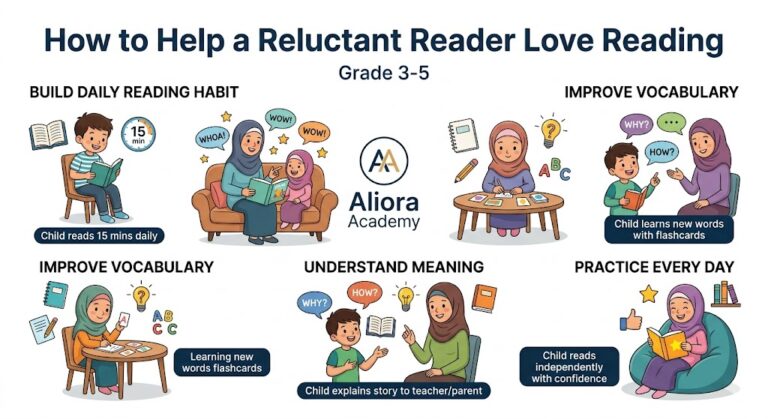
Improving reading skills at home requires consistency, patience, and the right approach. Many students fail not because they are weak, but because they lack structured reading habits.
Parents can support improvement by focusing on:
• Daily reading routines
• Vocabulary development through real-life examples
• Listening and reading together
• Discussing story meaning in simple language
For example, reading a short story together and asking the child to explain it in their own words builds comprehension naturally.
A structured reading improvement program can guide this process with exercises designed for Grade 4 learners, focusing on paragraph understanding and question-answer practice.
Effective home strategies include:
- Reading one short passage daily
- Highlighting difficult words and learning meanings
- Practicing “who, what, where, when, why” questions
- Encouraging storytelling in their own words
These habits improve fluency and make reading less stressful for children.
What role does vocabulary play in reading success?
Vocabulary is the foundation of reading success. Without understanding words, a child cannot understand sentences, and without sentences, comprehension becomes impossible.
In Grade 4, students begin to face academic words that are more complex than basic daily vocabulary. This is where many learners struggle.
For example, words like “predict,” “observe,” or “compare” are commonly used in school texts but may be new to students.
A strong vocabulary helps in:
• Better understanding of reading passages
• Improved sentence interpretation
• Faster reading speed
• Stronger academic writing skills
Programs like reading classes for Grade 3 focus heavily on vocabulary building through context-based learning instead of memorization.
Practical improvement steps:
- Learn 5–10 new words daily in sentences
- Use words in speaking and writing
- Read storybooks with explanations
- Practice word games and context clues
Vocabulary growth directly improves both comprehension and confidence.
How does reading improve academic performance?
Reading is not just an English skill; it is an academic foundation. Students who read well perform better in all subjects, including science, social studies, and even math word problems.
For example, a student who cannot understand a math question will struggle to solve it, even if they know the calculation.
A reading classes for Grade 5 level often includes advanced comprehension training, preparing students for higher academic demands.
Reading improves:
• Critical thinking ability
• Writing structure and grammar
• Understanding of instructions
• Problem-solving in exams
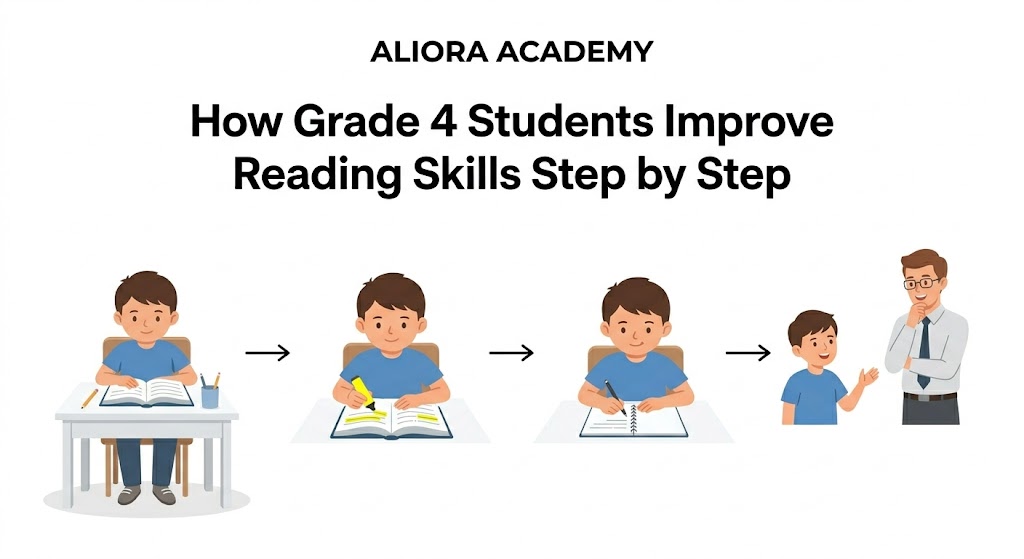
Real-life improvement steps:
- Reading textbooks daily instead of only stories
- Summarizing lessons in simple words
- Practicing comprehension questions
- Discussing lesson meaning with parents
Strong reading ability creates long-term academic success.
How can parents support reading at home?
Parents play a major role in building reading habits. Even without teaching expertise, simple daily involvement can significantly improve a child’s reading ability.
Key support strategies include:
• Creating a quiet reading environment
• Setting a fixed reading time
• Encouraging discussion after reading
• Avoiding pressure or comparison
For example, asking a child “What did you learn from the story?” builds reflection skills.
A structured reading classes for Grade 3 foundation also helps younger learners prepare early before moving to Grade 4 level comprehension.
Step-by-step parent support method:
- Read together for 10 minutes daily
- Ask simple comprehension questions
- Praise effort, not just correct answers
- Encourage storytelling and explanation
This approach builds confidence and long-term interest in reading.
Real-Life Learning Examples
Example 1: Grade 3 student struggling with reading words
A young student could not read simple sentences and often guessed words incorrectly.
• Problem: Weak word recognition and low confidence
• Solution: Daily phonics practice and guided reading sessions
• Outcome: Improved word reading speed and ability to form simple sentences
Example 2: Grade 4 student improving comprehension skills
A student could read fluently but could not answer passage questions correctly.
• Problem: Poor understanding of paragraph meaning
• Solution: Structured comprehension exercises and “why” questioning method
• Outcome: Better understanding and improved test performance
Example 3: Grade 5 student preparing for exams
A student struggled with long passages and inference-based questions.
• Problem: Difficulty in analyzing and interpreting text
• Solution: Advanced reading practice with summary writing
• Outcome: Strong exam readiness and improved critical thinking
Frequently Asked Questions (FAQs)
How can my child improve reading comprehension skills?
Consistent daily reading, vocabulary building, and guided questioning improve comprehension. Short passages with discussion work best for Grade 4 learners.
What is the best age to improve reading ability?
Reading skills can be improved at any age, but Grades 3 to 5 are the most important years for building strong comprehension foundations.
Do online reading classes really help students?
Yes, structured online reading support provides guided practice, interactive exercises, and consistent feedback that improve fluency and understanding.
Conclusion
Strong reading skills are essential for academic success. When children develop vocabulary, comprehension ability, and reading habits early, they perform better in all subjects. Daily practice, structured guidance, and supportive learning environments make a real difference. With proper learning support like online reading classes for Grade 4 students, children can build confidence, improve understanding, and develop lifelong literacy skills.