What Is Reading Comprehension and Why Does It Matter in Elementary School?
Reading comprehension is the ability to understand, interpret, and analyze written text. It is one of the most important skills children develop in elementary school because it affects how well they learn in all subjects, not just English. Strong comprehension skills help children read with meaning, answer questions correctly, and connect ideas from what they read to real-life situations.
Explore our professional online English Classes designed to build primary reading habits, or discover advanced developmental benchmarks inside our specialized Grade 4 English Program. Return to our global Home dashboard to view our entire educational ecosystem.
Understanding What Reading Comprehension Really Means
Reading comprehension is more than just reading words on a page. It means understanding the meaning behind sentences, identifying key ideas, and making sense of the full story or passage. A child with strong comprehension can explain what they read in their own words and answer questions based on understanding rather than memorization.
Explore our structured English Learning Programs built to cultivate deep textual understanding. Stay updated with pedagogical insights and learning strategies on our primary Blog, or browse the dedicated resource catalog within our specialized English Category.
Understanding Text Meaning
Identifying Main Ideas
Answering Questions Correctly
Connecting Ideas
Improving Thinking Skills
Building Confidence
Why Reading Comprehension Is Important in Elementary School
Reading comprehension is the foundation of academic success. Children use it in every subject, including Science, Math word problems, and Social Studies. Without strong comprehension skills, students may struggle even if they can read words correctly. It helps them understand instructions, learn new concepts, and perform better in exams.
Review structural developmental milestones inside our premium Grade 4 English Program, or consult our flagship educational manual, the Parent Guide to English Skills, for actionable home strategies. For interactive, teacher-led skill development sessions, explore our online English Classes.
Cross-Subject Mastery
Directly powers contextual performance in Math word challenges, Science definitions, and historical narratives.
Instruction Analysis
Enables independent interpretation of complex homework prompts and specific multi-step exam questions.
Conceptual Retention
Transforms mechanical text decoding habits into permanent knowledge absorption and analytical skill growth.
Common Problems Students Face in Reading Comprehension
Many children struggle with comprehension because they focus only on reading words instead of understanding meaning. Limited vocabulary and lack of practice also make it harder for students to understand passages clearly.
Often, structural communication barriers occur simultaneously when a Child Struggles With English Grammar. To actively combat core lexical gaps, reference our specialized structural roadmap, the Improve Vocabulary Guide, or track fresh pedagogical strategies directly through our central English Blog.
Difficulty Understanding Meaning
Decoding text mechanically without processing or visualizing the underlying core message.
Weak Vocabulary
Struggling with context parsing due to encountering complex, unfamiliar word definitions.
Trouble Identifying Main Ideas
Getting lost in secondary details while missing the central purpose of the narrative piece.
Forgetting What They Read
Experiencing working memory overloads, leading to immediate information loss after turning pages.
Slow Reading Speed
Spending excess cognitive energy sounding out syllables, disrupting overall semantic flow.
Poor Attention to Detail
Skimming over vital punctuation marks and qualifying terms, leading to incorrect assumptions.
How Students Can Improve Reading Comprehension Skills
Developing elite comprehension capacity requires moving past passive reading habit loops and embracing structured, active evaluation methods. When students apply targeted reading workflows daily, they train their brains to retain spatial context, identify key themes, and recall contextual information with ease.
Discover how professional, live instruction can transform your child's learning habits by visiting our premium English Classes page. To learn about our remote systems and interactive technical frameworks, check out How Online Classes Work, or read our practical guide on Vocabulary Improvement.
Read Daily
Set aside dedicated quiet time every single day to build baseline reading endurance and mental focus.
Learn New Vocabulary
Actively track unfamiliar terms and break down context clues to organically grow a rich personal vocabulary.
Practice Summarizing Text
Encourage your child to recap complex chapters in their own words to strengthen core ideas retention.
Ask Questions After Reading
Review major character motives and narrative turning points to assess real, deep text understanding.
Read Different Types of Books
Explore a wide variety of science texts, historical narratives, and fiction stories to sharpen analytical adaptability.
How Vocabulary Improves Reading Understanding
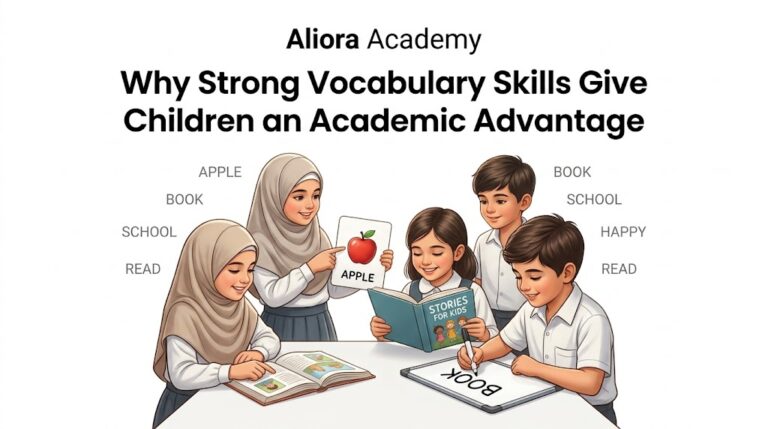
Vocabulary plays a direct role in reading comprehension. When children understand more words, they can easily understand sentences and stories. Strong vocabulary helps them guess meaning from context and improves both reading speed and accuracy.
To strategically boost lexical metrics, check out our specific age-appropriate Vocabulary Improvement guide. Discover complete structural curriculum options inside our primary English Learning hub, or read foundational pedagogical deep-dives across our regular Blog Articles.
Contextual Decoding
Allows young minds to seamlessly deduce the definition of rare words using adjacent sentence clues.
Processing Velocity
Minimizes constant mechanical pauses, boosting overall reading speed and cognitive stamina.
Semantic Precision
Ensures children capture correct story context instead of misinterpreting complex subplots.
How Parents Can Support Reading Comprehension at Home
Parental involvement is the primary driver of rapid literacy acquisition. By transforming passive tracking routines into interactive analytical exercises, parents can help children form deep comprehension habits that enhance focus and clear understanding outside the classroom.
Access immediate, step-by-step guidance within our complete Parent Guide to cultivate advanced communication milestones. Return to our global Home dashboard to view full platform updates, or review active curriculum structures within the primary English Category.
Encourage Daily Reading
Ask Questions About Stories
Discuss Main Ideas
Build Vocabulary Daily
Reduce Screen Time
Create Reading Habits
How Online English Classes Improve Comprehension
Online English classes provide structured reading practice, guided explanations, and interactive exercises that help children improve comprehension step by step. Teachers help students understand passages, identify key ideas, and build confidence in reading.
Review our live delivery systems and step-by-step tools in How Online Classes Work. To check matching age milestones, see our specialized Grade 4 Program, or reserve a real-time skills assessment directly through our main English Classes gateway.
Live Teacher Guidance
Provides instant correction and models complex reading methods in real time.
Interactive Exercises
Keeps young minds focused using modern digital learning puzzles and vocabulary checks.
Measurable Progress Tracking
Monitors reading speed and accurate detail recall through weekly text milestones.
What Is Reading Comprehension and Why It Matters in Elementary School?
An exhaustive, evidence-based exploration of modern literacy mechanics. Learn how elementary children process written syntax, identify cognitive structural gaps, and leverage home intervention strategies to achieve permanent academic success.
What Reading Comprehension Means
At its scientific core, defining what is reading comprehension goes significantly deeper than basic script decoding or fluent pronunciation metrics. True comprehension represents a complex, multi-layered cognitive procedure where a young reader extracts and simultaneously constructs dynamic meaning from written prose. It is the active transition from mechanically recognizing characters to fluidly digesting semantic intent.
When elementary students interact with structural text blocks, their minds perform several tasks at once: working memory holds immediate clause variations, executive function references prior personal experiences, and linguistic frameworks translate sentences into visual mental maps. Developing robust reading comprehension skills requires moving past basic phonetic recognition into deep, active text evaluation.
Why It Is Important in School
The profound importance of reading comprehension becomes evident the moment a child transitions from early phonics lessons into regular, subject-driven elementary school classrooms. In grades three through five, the primary academic style shifts permanently from "learning to read" to "reading to learn." Beyond basic language arts lessons, deep textual tracking serves as the literal operational foundation for all primary subject curricula.
For example, in elementary mathematics, a student with advanced mathematical logic can easily fail complex word problems if they lack the text parsing skills needed to isolate core variables. Similarly, tracking historical patterns in social studies or interpreting structural experiments within foundational science units requires advanced contextual reading habits.
To build these essential milestones early, explore our structured, curriculum-aligned Grade 4 English Program, which is specifically designed to transition intermediate young learners into confident, analytical text researchers.
Common Student Difficulties
Even when children display strong verbal skills, they often encounter sudden roadblocks when parsing lengthy text blocks. A primary barrier is working memory overload, where a child exhausts so much mental energy sounding out individual multi-syllable terms that they lose track of the core narrative thread before reaching the end of the sentence.
Additionally, many intermediate elementary students struggle to separate primary arguments from secondary background details. This leaves them overwhelmed by surface-level text elements while missing the author's true intent. These cognitive processing bottlenecks frequently appear alongside grammatical gaps.
If your child regularly struggles with sentence layout patterns, consult our targeted strategic guide on how to help when a Child Struggles With English Grammar to effectively address these fundamental structural barriers.
Vocabulary and Comprehension Connection
Lacking a rich vocabulary is one of the most common reasons behind poor reading comprehension performance. When a student encounters multiple unfamiliar words within a single paragraph, their natural reading speed drops instantly. This fragmentation breaks the smooth cognitive flow needed to connect ideas across sentences.
A strong vocabulary does more than just help kids look up dictionary definitions; it gives them the mental tools to confidently use context clues. When children know the core meaning of adjacent verbs and descriptive adjectives, they can easily figure out the intent of a completely new term without pausing.
To actively expand your child's daily communication tools, integrate the actionable, age-appropriate tips from our dedicated Vocabulary Improvement Page into their regular homework routine.
"Every new word a student master acts as a functional anchor point, securing their understanding across increasingly complex paragraphs and diverse reading topics."
How to Improve Reading Skills
Transforming weak reading habits into strong, lifelong comprehension abilities requires consistent, active practice instead of simple passive text scrolling. First, children must practice active reading workflows, which includes pausing at major paragraph transitions to ask predictive questions about the text layout.
Second, teaching kids to summarize chapters in their own words helps them distill long stories down to their core main ideas. Regularly introducing new genres—such as historical fiction, natural science articles, or short biographical pieces—challenges their brains to adapt to varied sentence styles and technical vocabulary terms.
To explore more comprehensive educational advice and evidence-based learning strategies, browse our latest curated pedagogical insights inside our central Blog Section.
Role of Parents in Learning
The home environment serves as the fundamental catalyst for developing advanced english reading skills for kids. While formal classrooms introduce core concepts, consistent home practice transforms those ideas into permanent, automatic habits. Parents can easily foster this growth by changing how they talk about books at home.
Instead of simply verifying that a child has completed their required reading time, parents should host casual, engaging post-reading chats. Asking open-ended questions like, "What motivated that character to make that choice?" or "How do you think the story would change if the setting shifted?" encourages kids to look beyond the surface words and practice deep, analytical thinking.
For a complete roadmap on building these daily literacy exercises at home, review our comprehensive, expert-vetted Parent Guide Article.
Benefits of Online English Classes
Modern live instruction offers highly targeted support for children facing stubborn literacy challenges. Professional online literacy platforms bring specialized expertise directly to your home, combining interactive tech tools with structured, step-by-step learning methods.
Experienced instructors use real-time digital text tools to show students exactly how to break down complex passages as they read. Live group discussions help keep kids engaged, while built-in software tools track reading speed and memory recall metrics over time. This data allows teachers to customize lessons to your child's exact needs.
To see how our professional instructors can help your child master essential text analysis skills, explore our live, small-group sessions on the English Classes enrollment portal.
Long-Term Academic Impact
Mastering core elementary reading skills early shapes a child's entire future academic journey. The text comprehension skills built during the elementary years directly predict standardized test performance, essay writing quality, and critical thinking capacity in high school and beyond.
When children build strong text processing habits early, they avoid the frustrating learning plateaus that often hit during middle school as coursework becomes more complex. Instead of struggling to keep up with intense reading assignments, students with strong comprehension skills can focus on mastering advanced concept details, paving a clear path toward long-term college and career success.
Help Your Child Improve Reading Comprehension Today
Strong reading comprehension skills build the foundation for lifelong learning. Aliora Academy helps children improve understanding, vocabulary, grammar, and reading confidence through structured online English programs designed for elementary students.
Ready to start? Book your assessment inside our core English Classes, target milestones with the Grade 4 Program, or discover parent tips in the Parent Guide.