
Common English Grammar Mistakes Grade 4 Students Make
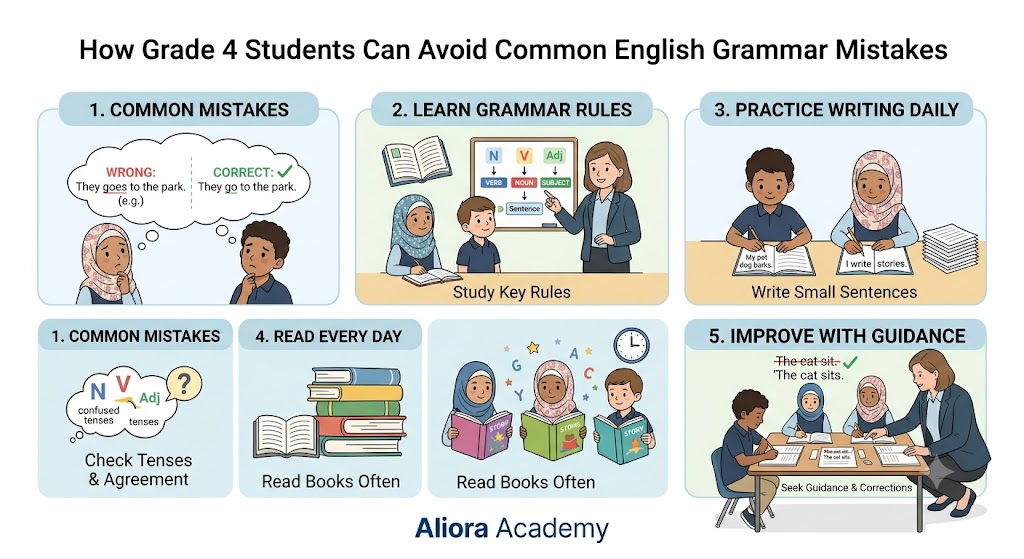
Common English grammar mistakes Grade 4 students make often appear when children start writing longer sentences and short paragraphs. A parent may notice their child knows English words but still struggles to form correct sentences like “He go to school yesterday” instead of “He went to school yesterday.” This is a very common situation in Grade 4 classrooms.
At this stage, students are moving from basic sentence writing to structured paragraph writing, so grammar becomes more important. The problem usually happens due to weak practice, unclear understanding of tenses, or limited reading exposure. Without proper guidance, these mistakes can continue into higher grades and affect writing confidence.
The good news is that these errors are fixable with simple, consistent learning strategies. With the right support, students can improve sentence structure, strengthen grammar usage, and build strong writing skills that support overall academic performance.
Why do Grade 4 students struggle with English grammar in writing?
Many parents wonder why children who can speak English still make grammar mistakes in writing. The reason is simple: speaking and writing use different skills. Writing requires grammar accuracy, sentence structure, and punctuation awareness, which need guided practice.
One major cause is lack of reading practice. When students do not read regularly, they miss natural sentence patterns. Reading helps them understand how correct English “sounds on paper.”
Another reason is over-reliance on memorization instead of understanding. Students may remember rules but fail to apply them in real sentences.
Common challenges include:
- Confusion in tenses (past, present, future)
- Missing articles (a, an, the)
- Incorrect subject-verb agreement
- Weak sentence formation habits
For example, a child may write: “She eat apples every day” instead of “She eats apples every day.” This shows incomplete understanding of grammar rules in real use.
To solve this, structured learning through English classes for Grade 4 helps students practice grammar in context, not just theory.
What are the most common grammar mistakes in Grade 4 English writing?
At this stage, students make predictable grammar errors. These mistakes are normal but must be corrected early to avoid long-term confusion.
Some of the most common errors include:
- Incorrect verb tense usage — Students mix past and present tense in the same sentence.
- Subject-verb disagreement — Example: “He play football” instead of “He plays football.”
- Sentence fragments — Incomplete sentences without a proper subject or verb.
- Wrong punctuation usage — Missing full stops, commas, or capital letters.
- Spelling confusion in daily words — Words like “because,” “friend,” or “school” are often misspelled.
A Grade 4 student once wrote: “My brother go school and he like study.” After guided correction, it became: “My brother goes to school and he likes to study.” The improvement came from understanding structure, not memorizing rules.
Regular grammar practice and writing exercises help reduce these mistakes gradually. For a structured approach to writing development, you can also explore how to teach paragraph writing to Grade 4 students.
How can students improve grammar skills effectively at home?
Improving grammar does not require complicated methods. It needs daily, simple habits that build strong language understanding.
Parents can support children through:
- Reading short stories daily
- Asking children to form 5–10 sentences every day
- Correcting mistakes gently, not harshly
- Encouraging writing small paragraphs about daily life
Another effective method is guided learning through structured programs like online English classes for kids, where teachers explain grammar in simple, practical ways.
Students should also:
- Practice one grammar rule at a time
- Rewrite corrected sentences
- Read their own writing aloud to detect errors
For example, if a child writes: “I goed to market,” parents can guide them to correct it as “I went to the market,” and explain the rule of irregular verbs simply.
Consistency matters more than pressure.
Why does reading improve grammar and writing skills in children?
Reading is one of the strongest tools for grammar improvement. Children who read regularly naturally learn sentence patterns, punctuation use, and vocabulary structure without memorization pressure.
When students read, they:
- See correct grammar in real context
- Learn how sentences are formed naturally
- Improve vocabulary usage
- Understand paragraph flow
For instance, a Grade 3 student who reads daily starts forming better sentences like “The cat is sleeping on the sofa” instead of broken phrases. You can support early reading with vocabulary improvement for Grade 3.
A Grade 4 student improves paragraph writing by reading short stories and noticing how ideas are connected. A Grade 5 student develops advanced writing skills by analyzing story structure, which helps in essays and academic tasks. If your older child continues to struggle, check the signs your Grade 5 student needs extra English support.
Reading strengthens both grammar and writing improvement, making learning more natural and long-lasting.
How can parents support English grammar learning at home?
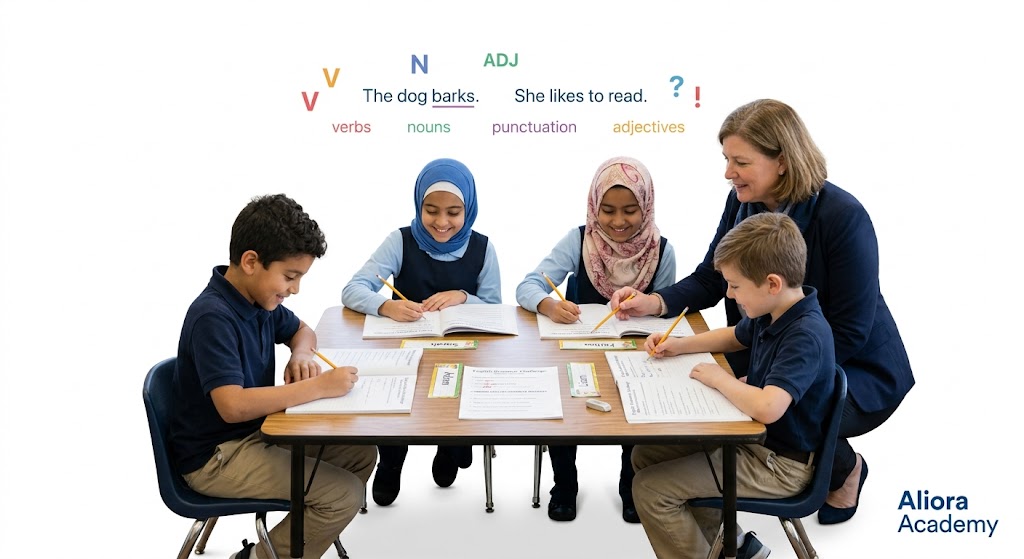
Parents play a major role in improving English skills. Support at home does not need to be formal; small daily actions make a big difference.
Effective strategies include:
- Encouraging daily English conversation at home
- Correcting mistakes gently during speaking
- Providing simple writing tasks like diaries or short notes
- Limiting screen time and increasing reading time
Parents should also avoid focusing only on errors. Instead, they should appreciate progress and effort. This builds English confidence in children.
If a child struggles repeatedly, structured support like Aliora Academy's English learning program can provide professional guidance. For younger children, creative writing activities for Grade 3 can also help build a grammar foundation through fun practice.
The goal is to make English part of daily life, not just a school subject.
Real-Life Learning Examples
Example 1: Grade 3 Vocabulary Improvement
A student struggled to express ideas because of limited vocabulary. The challenge was repeating the same words in writing. The solution was daily reading and learning 5 new words. The outcome was improved sentence variety and better communication.
Example 2: Grade 4 Paragraph Writing Development
A Grade 4 student wrote disconnected sentences without flow. The teacher introduced paragraph structure practice. After two weeks, the student learned how to connect ideas logically and write clear paragraphs.
Example 3: Grade 5 Academic Writing Preparation
A Grade 5 student faced difficulty in essay writing. The issue was weak grammar and poor organization. With guided practice and reading exercises, the student learned structured essay writing and improved academic performance.
Why do children struggle with English grammar?
Children struggle mainly due to lack of practice and unclear understanding of rules. Grammar is not learned through memorization alone. It requires application in writing and speaking.
Common reasons include:
- Limited reading exposure
- Weak sentence practice
- Lack of feedback on writing
- Confusion in grammar rules
The solution is consistent practice, reading habits, and guided correction. Structured learning environments help students understand grammar in real-life usage instead of isolated rules. Explore our English learning resources for more tips and activities.
FAQs
How can my child improve English speaking skills?
Regular conversation practice at home is key. Encourage your child to speak simple English sentences daily and correct mistakes gently. Listening to stories also improves speaking fluency.
What is the best age to improve English vocabulary?
Early primary school years (Grade 3–5) are the best stage. At this age, children learn words quickly through reading and daily practice.
How do online English classes help students learn faster?
They provide structured lessons, real-time feedback, and focused grammar practice. This helps students understand rules and apply them correctly in writing and speaking.
Conclusion
Improving English grammar is a gradual process that requires patience, reading habits, and consistent practice. When students understand sentence structure, vocabulary, and grammar rules together, their writing becomes clearer and more confident.
Parents should focus on daily learning habits rather than perfection. Reading, writing, and guided correction create strong long-term English skills.
With the right support system, students can overcome grammar mistakes, build strong communication skills, and perform better in academic English over time.