How to Choose the Right Homework Help Program for Your Child
best homework help program for children becomes an important search when parents start noticing a daily struggle at home: a child sitting with books for hours but still not finishing assignments, or becoming frustrated over simple tasks. For example, a Grade 4 student may take too long to complete reading comprehension, or a Grade 3 child may avoid math homework completely because it feels confusing. Over time, this creates stress for both parents and students and slowly affects confidence in learning.
This problem matters because homework is not just school work; it is practice for building study skills, independent learning, and discipline. When children struggle daily, it is often due to unclear concepts, lack of routine, weak attention span, or missing academic guidance at the right time. A structured approach can turn this struggle into progress by improving understanding and consistency.
Why does my child struggle to complete homework?
Many parents notice that their child is capable in class but struggles at home. This is common in elementary education and usually linked to learning gaps rather than ability issues. Homework requires independent thinking, and not every child develops this skill at the same pace.
Common reasons include:
- Weak understanding of classroom lessons
- Poor time management skills
- Distractions at home environment
- Lack of clear homework routine
- Difficulty in reading instructions properly
For example, a Grade 3 student may know basic math but struggle when word problems require reading comprehension. Similarly, a Grade 5 student may understand concepts but get overwhelmed with multi-subject homework.
To improve this situation, parents should focus on:
- Breaking homework into smaller tasks
- Creating a fixed study schedule
- Encouraging short, focused study sessions
- Providing guided support instead of direct answers
When children receive consistent academic structure, they gradually build confidence and reduce dependency on help.
What causes homework stress in elementary students?
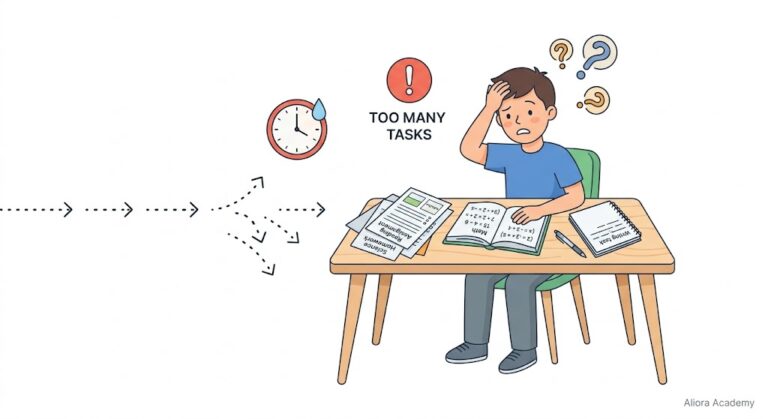
Homework stress often develops when tasks feel bigger than a child’s understanding. This is especially visible in early grades where children are still developing reading, writing, and logical thinking skills.
Key causes include:
- Too many assignments at once
- Lack of academic support at the right level
- Pressure to complete tasks quickly
- Difficulty in subjects like math or English writing
- Weak organization skills
For instance, a Grade 4 student working on a science project may feel lost without step-by-step guidance. This leads to frustration and avoidance.
A structured approach helps reduce stress by:
- Dividing assignments into manageable steps
- Teaching how to plan homework time
- Providing consistent explanation methods
- Encouraging problem-solving instead of memorization
Aliora Academy’s structured approach in programs like online homework help focuses on building calm and confidence in students through guided learning.
How can students become more independent with homework?
Independence in homework is a skill developed over time, not instantly. The goal is to help children learn how to think, not just complete tasks.
Steps to build independence:
- Teach children to read instructions carefully
- Encourage them to attempt questions before asking for help
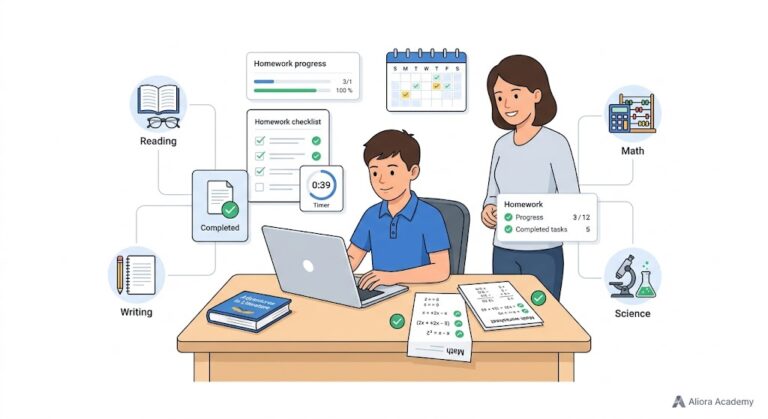
- Help them create a simple homework checklist
- Build study habits through daily practice
- Reward consistency, not speed
A Grade 5 student, for example, should gradually learn to handle essays, math problems, and research tasks without constant supervision.
Programs like a structured homework help program focus on guided independence, where students learn how to solve problems step-by-step instead of relying fully on parents.

Why is homework completion important for academic growth?
Homework completion is directly connected to classroom success. It reinforces what students learn in school and improves long-term memory.
Benefits include:
- Better understanding of subjects like math, English, and science
- Improved academic confidence
- Stronger writing and reading skills
- Development of discipline and responsibility
For example, a Grade 3 student practicing reading daily improves vocabulary faster, while a Grade 5 student working on writing tasks builds essay skills needed for higher grades.
When homework is completed regularly, students naturally perform better in exams because concepts are already familiar.
How can parents reduce homework stress at home?
Parents play a key role in shaping a child’s homework experience. The goal is support, not control.
Effective strategies include:
- Setting a fixed homework time daily
- Keeping a distraction-free study space
- Avoiding pressure or comparison with other students
- Encouraging short breaks during long study sessions
- Reviewing work instead of solving it
For example, instead of solving a math problem for a child, a parent can guide them with steps like “What is the first thing you understand in this question?”
If stress continues, structured programs such as homework help for Grade 3 or Grade 4 support can provide the missing academic structure children need. For older students, academic support for Grade 5 can ease the transition to middle school.
Why do some children take longer to finish homework?
Slow homework completion is often misunderstood as laziness, but in reality, it is usually a learning issue.
Common reasons:
- Weak reading comprehension
- Lack of focus or attention span
- Unclear understanding of tasks
- Poor writing speed or math fluency
For example, a Grade 4 student may take too long in writing assignments because they are still developing sentence formation skills.
Solutions include:
- Timed practice sessions
- Breaking tasks into smaller parts
- Using guided academic support systems
- Improving reading and writing practice daily
Structured learning programs like homework help for Grade 4 help students build speed and clarity over time. You can also find helpful tips in our article about why children take so long to finish homework.
Real-Life Examples of Homework Improvement
Example 1: Grade 3 Student Struggling with Daily Homework
A Grade 3 child was unable to finish math and reading assignments on time. The challenge was lack of understanding of instructions.
Solution: Step-by-step guided support and short practice sessions were introduced.
Outcome: The child began completing homework faster with less frustration and improved reading skills. Parents can explore similar support through online homework help for Grade 3 students.
Example 2: Grade 4 Student Improving Organization Skills
A Grade 4 student often forgot assignments and submitted incomplete work.
Solution: A simple homework checklist and planner were introduced.
Outcome: The student improved organization skills and became more consistent in submission. Families looking for additional guidance can check out Grade 4 homework help resources.
Example 3: Grade 5 Student Managing Multiple Subjects
A Grade 5 student struggled with balancing math, science, and writing tasks.
Solution: Time-blocking method and structured academic support were used.
Outcome: The student learned independent learning and managed homework without stress. Similar success stories are common with homework help for Grade 5 programs.
FAQs
How can I help my child finish homework faster?
Focus on routine, remove distractions, and break tasks into smaller steps. Encourage understanding first, then speed naturally improves.
What should I do if my child refuses to do homework?
Identify the root cause such as confusion or stress. Provide calm support, avoid pressure, and use short guided study sessions.
How does online homework help improve academic performance?
It provides structured explanations, consistent practice, and step-by-step guidance that improves understanding and builds confidence over time.
Conclusion
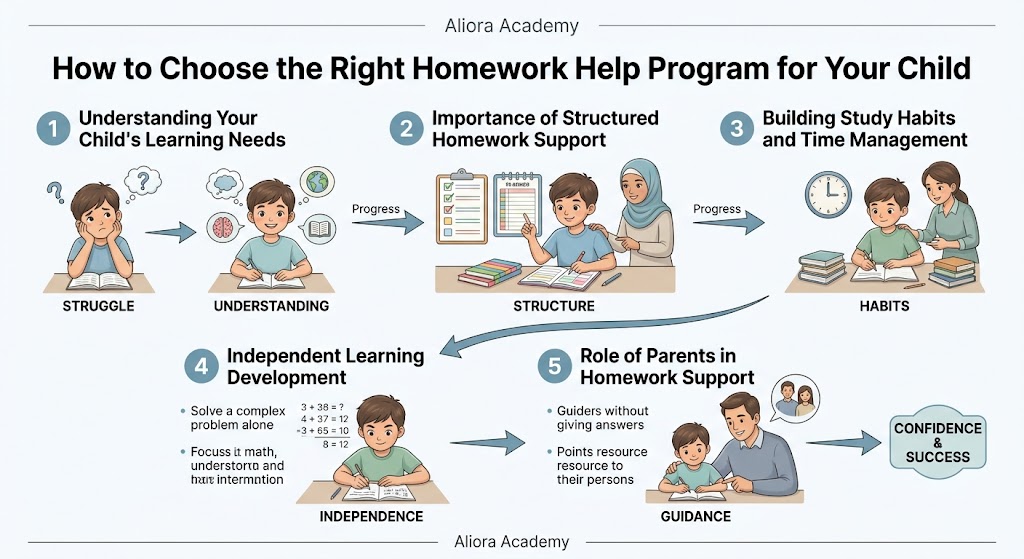
Choosing the right homework support system is about understanding your child’s learning needs, not just finishing assignments. Strong study habits, consistent time management, and proper academic support help children perform better in school and reduce daily stress at home.
When children learn how to manage homework independently, they develop confidence that stays with them in every grade. Structured guidance, especially in Grade 3, Grade 4, and Grade 5, plays a key role in building this foundation for long-term academic success.