Parent Guide to Building Strong English Skills in Children
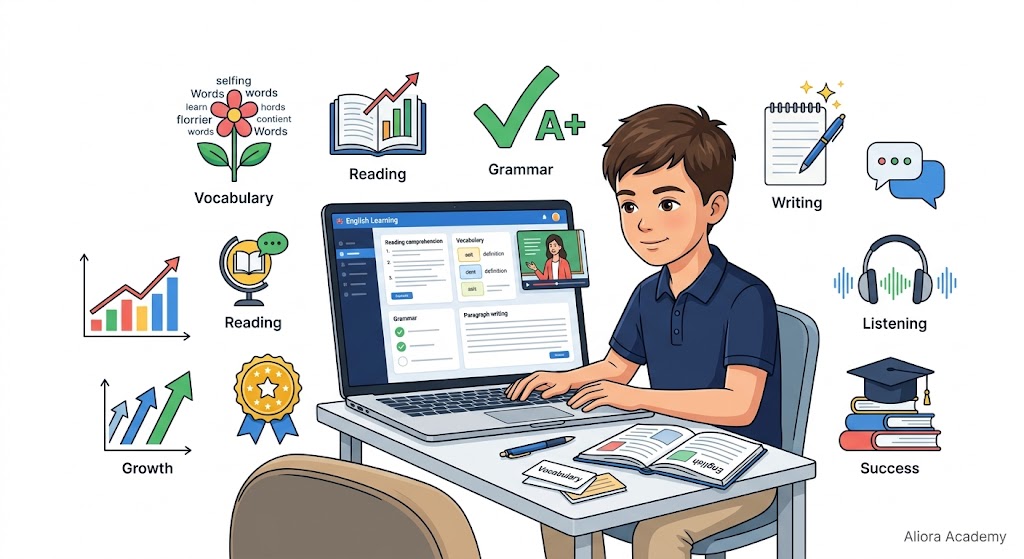
Strong English skills help children succeed in school, communicate confidently, and perform better across all subjects. This parent guide explains how reading, writing, vocabulary, grammar, and speaking skills develop over time and how parents can support language learning through consistent practice and structured guidance.
Start exploring our interactive foundational English Classes designed for young learners, or head back to our Home hub to discover a wide variety of educational insights inside our dedicated English Learning Resources collection.
Complete Parent Guide to Building Strong English Skills in Children
Language acquisition is one of the most transformative milestones in early childhood education. As an international medium for commerce, science, computing, and the humanities, establishing solid linguistic frameworks prepares young learners for lifelong breakthroughs. This Parent Guide to Building Strong English Skills in Children serves as a comprehensive operational matrix for families striving to maximize fluency, syntactic precision, and communicative poise from the comfort of home.
When implementing targeted enrichment strategies, the absolute objective goes beyond achieving passing report cards. The true goal is cultivating intrinsic motivation—fostering an authentic love for narrative construction, contextual text decryption, and articulate conversational debate. By following this systematic overview, you will discover how to convert daily routines into active, stress-free learning laboratories.
Why English Skills Matter for Academic Success
English functions fundamentally as an operational framework through which almost all secondary academic modules are introduced. If a child possesses underlying reading or structural interpretation delays, their performance across independent subjects—such as historical analytics, biological classification, and mathematical word problems—suffers systematically. Universal educational tracking metrics show that advanced language proficiency drives comprehensive testing scores by training the brain in logical deduction and deep conceptual processing.
Furthermore, early language command shapes classroom participation dynamics. Children who struggle to assemble spontaneous spoken answers frequently experience conversational withdrawal, remaining silent to avoid peer correction. Conversely, students with an expansive lexical baseline engage enthusiastically with teachers, express creative viewpoints during open group workshops, and project natural authority when delivering public presentations. Investing in proactive development early builds structural resilience that pays massive academic dividends over time.
Common Reasons Children Struggle With English
To implement an effective remedy, parents must first look behind the surface symptoms of low grades and uncover the specific learning roadblocks your child is facing. Language acquisition requires multiple distinct neural systems working in complete harmony. A child might easily possess an intuitive grasp of narrative imagery but experience immense difficulty when translating those ideas onto paper due to underdeveloped mechanical handwriting skills or punctuation confusion.
Often, these hurdles stem from passive consumption habits. In today's digital landscape, short-form streaming videos and simple gaming communication rely heavily on fragmented phrases and monosyllabic slang. Consequently, children miss out on the rich, complex paragraph structures required for academic testing success. When a Child Struggles With English Grammar, it is rarely due to a lack of core intellectual capacity; rather, they simply haven't had enough deliberate exposure to clear, formally organized sentence templates.
How Vocabulary Impacts Learning
Vocabulary serves as the critical baseline infrastructure for all advanced writing, reading, and human communication. A child’s internal vocabulary size predicts their reading comprehension trajectory with near-perfect accuracy. When a student encounters a paragraph packed with unfamiliar terms, their short-term memory bottlenecks. Instead of focusing on evaluating the deeper narrative arc, their cognitive energy is completely consumed by trying to decode individual words, leading to mental fatigue and frustration.
Expanding your child's vocabulary gives them the descriptive tools they need to break free from flat, highly repetitive phrasing. Instead of leaning on generic descriptors like "good," "bad," or "big," an enriched vocabulary allows a young writer to select precise synonyms like "exceptional," "detrimental," or "gargantuan." To accelerate this growth pathway, check out our step-by-step parent manual, the Vocabulary Improvement Guide, to discover how to seamlessly weave lexical tracking into your weekly family routines.
The Importance of Reading Habits
Reading is the ultimate catalyst for natural language acquisition. Regular exposure to high-quality print media provides children with an organic, visual blueprint of how English functions in real-world scenarios. Through consistent reading, children subconsciously internalize proper punctuation placement, complex multi-clause sentence structures, and elegant paragraph transitions without relying on dry, repetitive rules worksheets.
To cultivate authentic, long-term reading interest, you must provide your child with text-rich environments tailored to their current passions. Whether they are drawn to illustrated mystery series, fantasy trilogies, or deep-dive science journals, regular reading habits naturally sharpen spatial context tracking and abstract reasoning skills. If you are searching for age-appropriate book curation frameworks, browse through the comprehensive resources cataloged inside our curated English Category.
Developing Strong Grammar Skills
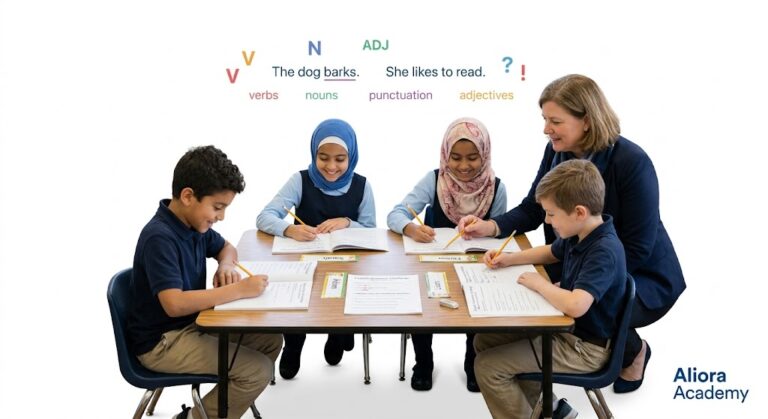
Grammar forms the non-negotiable structural architecture that holds written and spoken thoughts together. Without reliable syntactic rules, communication quickly loses its clarity, leaving room for misunderstanding. Early childhood benchmarks require students to gradually shift from short, isolated fragments toward cohesive compound and complex sentences that maintain perfect subject-verb agreement and consistent tense alignment across multiple paragraphs.
Rather than forcing your child to memorize abstract syntactic charts out of context, grammar development should be interactive and practical. Help your child identify structural errors by turning proofreading into an engaging game, or explore our dedicated Grammar Support Article to learn how targeted line-by-line editing exercises can instantly clear up persistent punctuation confusion.
Improving Writing and Communication Skills
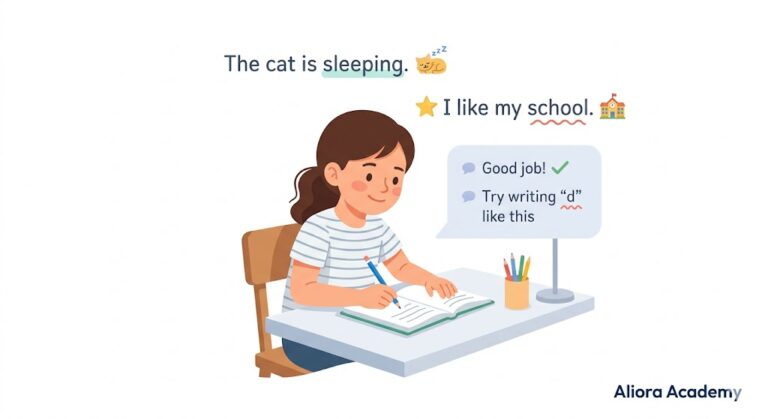
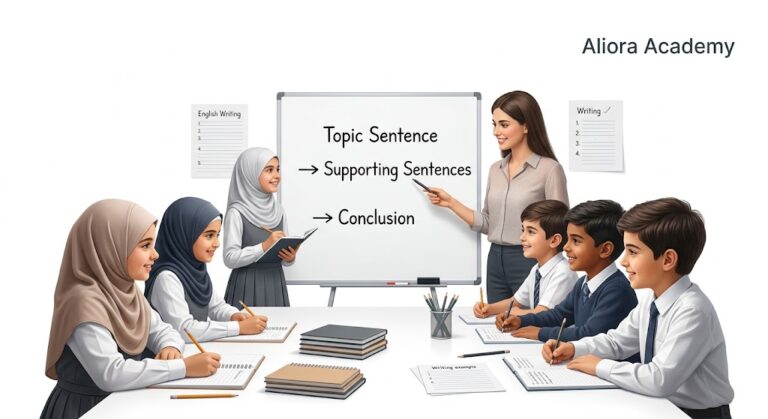
Clear composition is the ultimate display of linguistic mastery. Writing requires a student to independently retrieve words from memory, apply strict grammatical rules, organize paragraphs logically, and keep their target audience's perspective in mind—all at the same time. Because composition demands so much cognitive energy, children often experience writer's block when faced with blank paper, leading them to hand in short, rushed responses simply to finish the task.
Building writing confidence requires breaking down complex assignments into clear, manageable steps. Train your child to begin with simple bulleted outlines, move into drafting descriptive body sentences, and finish with a dedicated polishing pass focused entirely on spelling precision and punctuation rules. Exploring premium instructional resources across our central Blog directory offers parents a steady stream of creative writing prompts designed to spark storytelling inspiration.
How Parents Can Support Learning at Home
The home environment plays a powerful role in reinforcing the lessons taught in a digital or physical classroom. Parents can easily accelerate language learning by introducing subtle, engaging adjustments to daily family routines. Make it a point to talk through weekend plans or recap favorite movie plots using full, descriptive sentences to help your child overcome conversational hesitation and build real-world speaking confidence.
Additionally, establish a quiet, organized study space free from television noises or mobile notifications. This dedicated environment helps children focus deeply on their homework assignments and reflective reading tasks. By showing consistent interest in your child's linguistic growth and celebrating every minor victory along the way, you cultivate a supportive, growth-oriented mindset that transforms language learning into an empowering, lifelong adventure.
Benefits of Online English Classes
While home enrichment sets a wonderful foundation, partnering with professional educators provides the structured guidance needed to systematically master complex language milestones. Virtual learning frameworks break down geographic barriers, giving your family direct access to elite communication instructors right from the comfort of home. These live sessions offer immediate, real-time corrections that keep common spelling and grammar errors from turning into stubborn, long-term habits.
Furthermore, specialized digital classrooms leverage immersive media materials, interactive slides, and clear progress analytics to keep young learners deeply engaged. If you are ready to give your child an elite, future-proof academic foundation, enroll them in our premium live online English Classes. For parents of intermediate students, our highly acclaimed, custom-tailored Grade 4 English Program delivers targeted support designed to master advanced reading comprehension metrics and elevate essay composition skills.
Creating Long-Term English Learning Success
Cultivating outstanding language capability is a marathon, not a sprint. True fluency is built through steady, daily practice rather than occasional, high-pressure study marathons right before exams. By pairing supportive, at-home conversational habits with professional, expert-led digital courses, you give your child a powerful, dual-engine framework for continuous academic growth.
As your child's vocabulary grows, their reading comprehension deepens, and their writing structure sharpens, you will notice a profound transformation in their overall self-esteem. The communication skills they build today will serve as their primary tool for academic excellence, creative self-expression, and professional opportunity for decades to come. Protect their future potential by making a deliberate commitment to comprehensive language development today.