Homeschool English Curriculum Guide for Grades 3 to 5
Grades 3 to 5 are the years English changes shape. Children stop learning to read and start reading to learn — and writing moves from single sentences to full paragraphs. This guide sets out what to teach at each grade, how to structure the week, and how to tell whether it is working.
Why Grades 3 to 5 Need a Different Approach
In Grades 1 and 2, English is mostly about decoding — turning letters into words. From Grade 3 onwards, that flips. Children are expected to read longer passages, explain what they mean, write full paragraphs and talk about their ideas. English becomes the tool they use across every other subject.
Homeschooling parents often notice this shift as a sudden jump in difficulty. The phonics programme that worked perfectly in Grade 2 no longer covers what is needed. This is not a problem with the child — it is a change in what English is for.
This guide breaks the Grades 3 to 5 curriculum into four core strands, shows what each one looks like year by year, and gives you a weekly structure that fits around everything else you are teaching.
- Reading & Comprehension
- Writing & Composition
- Grammar & Vocabulary
- Speaking & Listening
- Year-by-Year Progression
- Weekly Structure

Four Strands Every Grade 3–5 English Week Needs
A complete English curriculum develops all four together. If one is neglected, the others slow down — this is the most common gap in homeschool planning.
Strand 1: Reading & Comprehension
Reading to LearnReading develops on two tracks at once: fluency (reading smoothly and accurately) and comprehension (understanding what was read). By Grade 5, comprehension carries every other subject — so it must be taught directly, not left to chance.
- Daily reading aloud and independent reading
- Retelling, main idea and inference questions
- Non-fiction alongside stories
- Discussion, not just comprehension worksheets
Strand 2: Writing & Composition
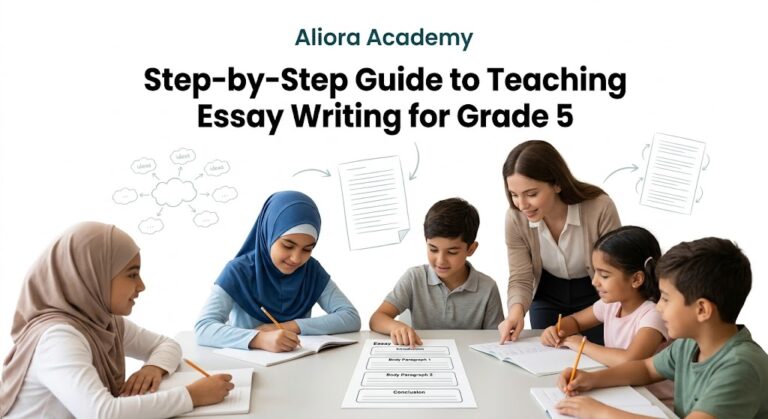
From Sentences to ParagraphsWriting is the strand that grows fastest across these three years. In Grade 3 children write sentences. By Grade 5 they write multi-paragraph pieces. Each stage builds directly on the one before, so skipping a stage rarely works.
- Sentence construction and punctuation
- Paragraph structure with topic sentences
- Short letters, descriptions and stories
- Simple essays and structured pieces by Grade 5
Strand 3: Grammar & Vocabulary
The Building BlocksGrammar gives children the language to talk about their writing — and vocabulary gives them the words to improve it. Taught together, they are the most efficient use of English time in these grades.
- Nouns, verbs, adjectives, adverbs, tenses
- Sentence types and correct punctuation
- Word parts: prefixes, suffixes, roots
- Vocabulary through reading, not word lists alone
Strand 4: Speaking & Listening
The Most Skipped StrandSpeaking and listening are the easiest to forget in homeschool — and the most damaging to skip. Speaking turns passive vocabulary into active vocabulary, and listening comprehension is the rehearsal for reading comprehension.
- Daily conversation in full sentences
- Retelling, explaining and describing
- Following multi-step instructions
- Reading aloud with expression
Four Habits That Make the Week Work
A homeschool English week does not need to be long. It needs to be consistent — and to cover all four strands.
Read Aloud Every Day
Twenty minutes of reading — a mix of your child reading and you reading. This is the single highest-value habit in the week.
Get a Reading PlanWrite Something Every Day
It does not need to be long. Three sentences, a short letter, a paragraph — daily writing builds fluency faster than weekly essays.
Get Writing PromptsTalk About What Was Read
Five minutes of discussion after reading builds comprehension better than any worksheet — and takes almost no planning.
Get Question StemsReview Every Six Weeks
Pause every six weeks to look at the child's writing and reading level. Progress is visible at that distance — not day to day.
Get a Review SheetWhat Changes From Grade 3 to Grade 5
A practical reference showing what each strand looks like at each grade level — and how the expectations grow.
| Strand | Grade 3 | Grade 4 | Grade 5 |
|---|---|---|---|
| Reading Fluency Reading | Reads short passages aloud smoothly in phrases. | Reads longer texts with expression and reasonable pace. | Reads chapter books independently with stamina. |
| Comprehension Reading | Retells a story and finds the main idea. | Answers why and how questions using evidence from the text. | Infers meaning, summarises and compares texts. |
| Sentence Writing Writing | Writes simple and compound sentences with correct punctuation. | Writes varied sentences with adjectives and adverbs. | Controls sentence length and structure for effect. |
| Paragraph Writing Writing | Writes a short paragraph with a topic sentence. | Writes a structured introduction, body and conclusion. | Writes multi-paragraph pieces with clear organisation. |
| Grammar Grammar | Nouns, verbs, adjectives, simple tenses, basic punctuation. | Adverbs, conjunctions, complex sentences, direct speech. | Tense consistency, active and passive voice, clauses. |
| Vocabulary Vocabulary | Synonyms, antonyms, common prefixes and suffixes. | Word families, roots, meaning from context. | Precise word choice and academic vocabulary. |
| Speaking Speaking | Speaks in full sentences and retells stories. | Explains opinions and describes in detail. | Presents, discusses and debates simple ideas. |
| Listening Listening | Follows two and three step spoken instructions. | Follows longer spoken passages and answers questions. | Listens for main idea and detail in longer texts. |
| Weekly Time Planning | Around 45–60 minutes a day. | Around 60–75 minutes a day. | Around 75–90 minutes a day. |
Want Help Building Your Homeschool English Week?
Share your child's grade, what you are already doing, and how much time you have each day. You will get a realistic weekly structure that covers all four strands — without adding hours to your day.
Share a Writing Sample
One paragraph is enough to see which strand needs attention first in your week.
Send a SampleDiscuss Your Daily Time
Tell us how many minutes a day you can give to English, and we will fit the four strands around it.
Discuss TimePick Reading Material
Tell us your child's interests, and we will suggest books that fit their grade level and reading strength.
Get Book IdeasSix Common Homeschool English Mistakes
These are the patterns that quietly hold children back. Naming them is often enough to fix them.
Skipping Speaking and Listening
The easiest strand to forget and the most damaging to skip. Speaking turns passive vocabulary into active vocabulary — without it, reading and writing move more slowly.
Worksheets Instead of Real Reading
Comprehension worksheets feel productive but produce far less than twenty minutes of reading with discussion. Use them as a check, not as the curriculum.
Grammar Without Writing
Grammar taught in isolation is forgotten. Teach it as a tool for improving the child's own writing — then apply it immediately.
Word Lists as Vocabulary
Memorising lists produces words that disappear by Monday. Vocabulary grows through reading volume and active use — not through copying definitions.
Long Sessions Once a Week
A two-hour English session on Saturday produces less than twenty minutes a day across the week. Consistency matters more than total time.
No Regular Review
Without a six-week review, small gaps go unnoticed. By the time they surface, they take longer to fix — a short review catches them early.
How to Build Your Week in Four Steps
A practical sequence for setting up or fixing your homeschool English routine.
Audit Your Current Week
Write down what you already do in each of the four strands. Most families find one strand is almost missing.
Protect Reading Time First
Twenty minutes of reading a day is non-negotiable. Build the rest of the week around it.
Add a Small Daily Writing Habit
Three sentences a day beats a long essay every two weeks. Make it short enough that it always happens.
Schedule the Speaking Strand
Speaking will not happen by accident. Put ten minutes of English conversation into the day deliberately.
Homeschool English Checklist
- Your child reads aloud or independently every day.
- You read aloud to your child regularly, even after they can read alone.
- Reading material includes both fiction and non-fiction.
- Comprehension is checked by discussion, not just worksheets.
- Your child writes something every day, however short.
- Writing is corrected with one or two specific comments, not a red pen.
- Grammar is taught as a tool for improving the child's own writing.
- New vocabulary is used in speech within a week of learning it.
- Speaking practice happens deliberately, not only when it comes up.
- Your child follows multi-step spoken instructions without repetition.
- You pause every six weeks to review progress in all four strands.
- Your child's writing shows clear improvement across the term.
Frequently Asked Questions
Common questions homeschooling parents ask about English in Grades 3 to 5.
How much time should homeschool English take each day?
Roughly 45–60 minutes a day in Grade 3, rising to 75–90 minutes by Grade 5. The exact figure matters far less than consistency — twenty minutes of reading plus a short writing task plus ten minutes of conversation covers all four strands in under an hour. What you should avoid is the pattern many families fall into: nothing on most days, then a two-hour session at the weekend. The daily habit produces far more than the weekly marathon.
Do I need a formal curriculum, or can I build my own?
Both work. A formal curriculum saves planning time and ensures nothing is missed, but it can be dry and does not adapt easily to your child. Building your own gives you flexibility but requires you to keep track of the four strands yourself. Many families use a light formal curriculum for grammar and spelling, and build the reading, writing and speaking strands around real books and conversation. What matters most is that all four strands are covered — however you get there.
What if my child is ahead or behind their grade level in English?
This is normal — especially in homeschool, where the grade label matters much less than the child's actual level. The most useful approach is to ignore the grade label for the strand in question and work at the child's real level. A Grade 4 child who reads at a Grade 5 level should read Grade 5 books; a Grade 5 child who writes at a Grade 3 level should work on Grade 3 writing skills without feeling behind. The four-strand structure makes this easy, because each strand can be pitched independently.
How do I know if my homeschool English is working?
The clearest indicator is progress in the child's own writing across a term. Compare a piece written in September with one from December. You should see longer sentences, more varied vocabulary, clearer paragraph structure and fewer basic errors. Reading progress is usually visible in the books they choose independently — a child who has moved from short chapter books to longer ones is progressing. For a clearer picture, pause every six weeks and check each strand separately.
Should I correct every mistake in my child's writing?
No. Correcting everything at once is overwhelming and discouraging. The more effective approach is to pick one or two specific things to focus on for a given piece — spelling, or sentence structure, or paragraph organisation — and let the rest go for now. Over a term, rotating through these focus areas produces far better writing than marking every error on every piece. Children need to feel that writing is about communicating ideas, not just avoiding mistakes.
Do I need to teach grammar separately, or does it come through reading?
Both, but with a bias toward the second. Grammar rules learned in isolation are quickly forgotten unless they are applied. Children who read widely absorb a great deal of grammar intuitively — they know what "sounds right" because they have read it hundreds of times. Use explicit grammar teaching to give names to what they already know, and to fix specific patterns in their own writing. Do not use it as the main curriculum.
What should I do if my child avoids writing?
Writing avoidance usually comes from one of two places: the task feels too big, or the child is anxious about mistakes. Reduce the size — three sentences instead of a paragraph — and separate the ideas stage from the correcting stage. Let them write freely first, then fix issues together afterwards. Oral rehearsal helps too: ask the child to say the sentence aloud before writing it, because spoken sentences are usually cleaner than written drafts. For more on this pattern, see why your child avoids homework.
How can I get help planning my homeschool English curriculum?
You can reach out directly on WhatsApp at +92 300 123 4567. Share your child's grade, what you are already doing, and how much time you have each day. That is enough to suggest a realistic weekly structure that covers all four strands — and, where helpful, the right kind of supplementary lesson support.
Build a Homeschool English Week That Actually Works
Share your child's grade, what you are already doing, and how much time you have each day. You will get a realistic weekly structure that covers all four strands — and a clear picture of where to focus first.
Homeschool English Curriculum Guide for Grades 3 to 5
Grades 3 to 5 are the years English changes shape. In Grades 1 and 2, the focus is mostly on decoding — turning letters into words. From Grade 3 onwards, that flips. Children are expected to read longer passages, explain what they mean, write full paragraphs and talk about their ideas. English becomes the tool they use across every other subject. Homeschooling parents often notice this shift as a sudden jump in difficulty, but it is not a problem with the child — it is a change in what English is for. This guide breaks the Grades 3 to 5 curriculum into four core strands, shows what each one looks like year by year, and gives you a weekly structure that fits around everything else you are teaching.
Strand 1: reading and comprehension
Reading develops on two tracks at once: fluency (reading smoothly and accurately) and comprehension (understanding what was read). By Grade 5, comprehension carries every other subject, so it must be taught directly rather than left to chance. Twenty minutes of reading a day — a mix of your child reading and you reading — is the single highest-value habit in a homeschool English week. For a fuller treatment of what comprehension involves, see what to expect from a Grade 3 English curriculum, and for troubleshooting specifically, how to support a child who struggles with reading comprehension.
Strand 2: writing and composition
Writing is the strand that grows fastest across these three years. In Grade 3 children write simple sentences. By Grade 5 they write multi-paragraph pieces with clear organisation. Each stage builds directly on the one before, so skipping a stage rarely works. Daily writing — three sentences, a short letter, a paragraph — builds fluency faster than weekly essays, because consistency is what produces change. For the specific paragraph-level skill, see how to help your Grade 4 child write a strong introduction paragraph.
Strand 3: grammar and vocabulary
Grammar gives children the language to talk about their writing, and vocabulary gives them the words to improve it. Taught together, they are the most efficient use of English time in these grades. Grammar should be presented as a tool for improving the child's own writing, not as a set of rules to memorise in isolation — rules learned in isolation are quickly forgotten unless they are applied. For vocabulary specifically, see best vocabulary-building strategies for Grade 5 students.
Strand 4: speaking and listening
Speaking and listening are the easiest to forget in homeschool — and the most damaging to skip. Speaking turns passive vocabulary into active vocabulary, and listening comprehension is the rehearsal for reading comprehension. Ten minutes a day of genuine English conversation is enough to make a visible difference over a term. The key word is genuine — a real conversation, not a drill. For the full picture of why this strand matters so much, see why speaking practice is essential for English learners in elementary grades and how listening skills affect your child's overall English development.
What changes from grade to grade
The four strands stay the same across Grades 3 to 5; what changes is the level of expectation. In reading, children move from retelling a story to inferring meaning and comparing texts. In writing, they move from a single paragraph to multi-paragraph pieces. In grammar, they move from basic parts of speech to tense consistency and complex sentences. In speaking, they move from full sentences to explaining opinions and presenting ideas. Knowing what changes at each stage is what keeps a homeschool curriculum ahead of the child rather than behind them.
Common homeschool English mistakes
Watch for these patterns:
- Skipping speaking and listening — the easiest strand to forget and the most damaging to skip.
- Worksheets instead of real reading — comprehension worksheets feel productive but produce less than reading with discussion.
- Grammar without writing — grammar taught in isolation is forgotten.
- Word lists as vocabulary — memorised lists disappear; vocabulary grows through reading and use.
- Long sessions once a week — a two-hour Saturday session produces less than twenty minutes a day.
- No regular review — small gaps go unnoticed until they become large ones.
How much time is enough
Roughly 45–60 minutes a day in Grade 3, rising to 75–90 minutes by Grade 5. The exact figure matters far less than consistency. Twenty minutes of reading plus a short writing task plus ten minutes of conversation covers all four strands in under an hour. What you should avoid is the pattern many families fall into: nothing on most days, then a two-hour session at the weekend. The daily habit produces far more than the weekly marathon.
How to know it is working
The clearest indicator is progress in the child's own writing across a term. Compare a piece written in September with one from December — you should see longer sentences, more varied vocabulary, clearer paragraph structure and fewer basic errors. Reading progress is usually visible in the books they choose independently. To catch small gaps early, pause every six weeks and check each strand separately, rather than relying on day-to-day impressions.
When to consider structured support
If one strand is consistently limiting progress — reading comprehension, writing, or speaking confidence — targeted support works better than general practice. Structured online lessons can focus on the specific bottleneck rather than covering everything at once. Our guide to what makes an online English program effective sets out what to look for before enrolling, and online English tutoring for kids covers all four strands with live teachers, built around what the individual child actually needs.
Get help planning your homeschool week
If you would rather not work through every check yourself, you can send your child's grade, what you are already doing, and how much time you have each day directly on WhatsApp at +92 300 123 4567. That is enough to suggest a realistic weekly structure — and, where helpful, the right kind of supplementary lesson support.