
Why Your Child Avoids Homework and What You Can Do About It
Why your child avoids homework is a question many parents ask after another evening filled with frustration, delays, and unfinished assignments. A child who happily participates in school may suddenly become resistant when it is time to sit down and complete homework at home.
Imagine a Grade 3 student who spends twenty minutes searching for a pencil instead of starting a reading assignment. Or a Grade 4 student who becomes upset every time a writing task appears in the homework folder. A Grade 5 student may stare at a science project for days because it feels too overwhelming to begin. These situations are common in many households.
Homework avoidance is rarely caused by laziness. In most cases, children struggle because they feel confused, overwhelmed, tired, distracted, or unsure how to manage their work independently. When these challenges continue, homework can become a daily source of stress for both students and parents.
Understanding the reasons behind homework resistance is important because consistent homework completion helps students strengthen classroom learning, build responsibility, improve study habits, and develop confidence in their academic abilities.
The good news is that with the right support, structure, and guidance, children can learn to approach homework with greater confidence and independence.
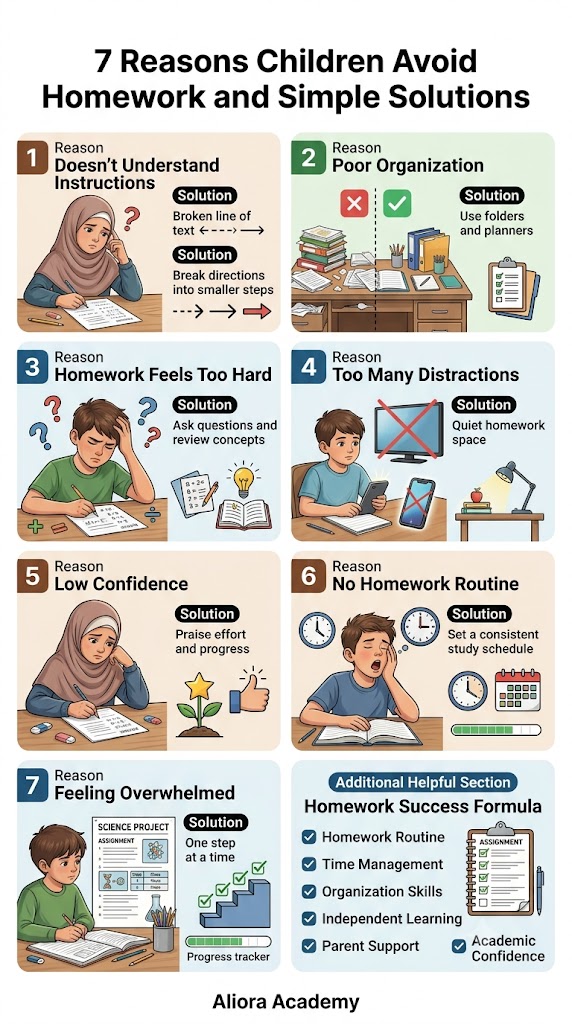
Why Do Some Children Avoid Homework Every Day?
Many children avoid homework because they associate it with frustration. When assignments feel difficult, students may choose to delay the task rather than face the challenge directly.
Some students struggle with understanding directions. They may leave school unsure about what the teacher expects. Without clear understanding, even simple assignments can feel intimidating.
Others experience difficulty with time management. After a full school day, extracurricular activities, and family responsibilities, homework may feel like another burden added to an already busy schedule.
Children also differ in learning styles. A student who learns best through discussion may find independent reading assignments more challenging. Another student may understand concepts in class but struggle to apply them independently at home.
Common causes of homework avoidance include:
- Lack of assignment understanding
- Poor organization skills
- Weak study habits
- Fear of making mistakes
- Limited homework motivation
- Difficulty concentrating
- Academic skill gaps
- Overly long homework sessions
Parents should remember that identifying the root cause is the first step toward finding an effective solution. If you're noticing a pattern of avoidance, our guide on the signs your child needs extra homework support can help you recognize deeper issues.
Why Is Homework Completion Important for Academic Success?
Homework provides opportunities for students to practice skills learned in the classroom. Consistent practice helps strengthen understanding and improve long-term retention.
Assignments also encourage independent learning. Students gradually learn how to solve problems, follow instructions, and manage responsibilities without constant supervision.
Homework helps develop important life skills such as:
- Responsibility
- Time management
- Goal setting
- Self-discipline
- Problem-solving
- Organization
Students who complete homework regularly often feel more prepared during classroom lessons because they have already reviewed and practiced key concepts.
Parents looking for structured academic support often explore an online homework help approach when students need additional guidance outside school hours.
Most importantly, homework completion helps build academic confidence. Children gain confidence when they experience success through consistent effort and improvement.
What Causes Homework Stress in Elementary Students?
Homework stress often occurs when assignments exceed a student's current confidence level. A child may understand a concept during class but struggle when working independently.
Reading comprehension tasks can create anxiety when students encounter unfamiliar vocabulary or complex instructions.
Math homework frequently becomes stressful when students miss an important foundational skill. A small gap in understanding can make future assignments much harder.
Writing assignments may feel overwhelming because they require planning, organization, spelling, grammar, and creativity at the same time.
School projects can create additional pressure because they often involve multiple steps and deadlines.
Parents should watch for signs such as:
- Frequent complaints about homework
- Emotional outbursts during assignments
- Excessive procrastination
- Missing assignments
- Avoidance behaviors
- Negative comments about schoolwork
When these signs appear consistently, additional homework help may be beneficial.

Why Do Some Students Take Longer to Finish Assignments?
Not all students work at the same pace. Some children require additional processing time to understand instructions and organize their thoughts.
A lack of organization can significantly slow homework completion. Students who cannot locate materials or track assignments often spend more time preparing than actually working.
Distractions also contribute to longer homework sessions. Television, mobile devices, noise, and interruptions can reduce productivity.
Real-Life Example: Grade 3 Student
A Grade 3 student regularly spent two hours completing thirty minutes of homework. The challenge was not academic ability. Instead, the student frequently became distracted and struggled to follow a routine.
The solution involved creating a dedicated homework space and breaking assignments into shorter work periods. Within several weeks, homework completion improved and daily stress decreased significantly.
Families seeking targeted homework help for Grade 3 often focus on reading practice, vocabulary development, assignment understanding, and basic math skills.
How Can Parents Support Homework Without Doing It for Their Child?
Parents play an important role in supporting homework, but support should not become completion of the work itself.
Instead of providing answers, parents should guide children toward finding solutions independently.
Helpful strategies include:
- Establish a consistent homework schedule
- Create a quiet study environment
- Encourage short breaks between tasks
- Review instructions together
- Ask guiding questions
- Praise effort and persistence
For example, rather than solving a math problem, a parent might ask, "Which strategy did your teacher show you in class?" This approach strengthens problem-solving skills while maintaining student ownership of the assignment.
Many families benefit from a structured homework help program that provides educational guidance while encouraging independence. You might also find useful tips in our guide on how to help your child complete homework.
How Can Students Become More Independent Learners?
Independent learners understand how to manage their responsibilities and seek solutions when challenges arise. Developing independence starts with building strong study habits. Students should learn how to organize materials, track deadlines, and prioritize tasks.
Teaching children to break larger assignments into smaller steps can make challenging work feel more manageable.
Real-Life Example: Grade 4 Student
A Grade 4 student frequently forgot assignments and lost worksheets. Academic performance suffered despite strong classroom participation. The solution involved using a homework planner and color-coded folders for different subjects. Over time, organization improved dramatically. Homework completion became more consistent, and confidence increased.
Students receiving homework help for Grade 4 often focus on reading comprehension, writing activities, project support, organization skills, and independent problem-solving. Parents should gradually reduce assistance as children become more capable of managing tasks independently. For more on building routines, read about how to structure homework sessions effectively.
How Can Homework Routines Improve Motivation and Productivity?
Children thrive when expectations are predictable. A consistent homework routine reduces uncertainty and helps students transition into learning mode.
Effective routines often include:
- A set homework start time
- A dedicated workspace
- Clear goals for each session
- Scheduled breaks
- End-of-session review
When homework becomes part of a daily routine, students spend less energy resisting and more energy focusing on learning.
Real-Life Example: Grade 5 Student
A Grade 5 student struggled with multiple assignments across different subjects. Science projects, essay writing, and advanced math homework often piled up. The solution involved creating a weekly planning system and prioritizing tasks based on deadlines. The student gradually learned to manage responsibilities independently and became better prepared for middle school expectations.
Students using homework help for Grade 5 frequently receive support with research assignments, essay writing, advanced mathematics, academic planning, and multi-subject workload management.
Consistent routines help transform homework from a source of stress into a manageable daily responsibility.
What Should Parents Do When Homework Challenges Continue?
Sometimes homework difficulties persist despite strong home support. When challenges continue, additional academic support may be necessary.
Parents should consider whether difficulties are linked to skill gaps, learning challenges, organization difficulties, motivation concerns, or increased academic demands. Early intervention often prevents small challenges from becoming larger academic problems. Educational support can help students strengthen foundational skills while improving confidence and independence.
Families seeking additional guidance can explore online homework help programs for elementary students designed to support reading, writing, math, science, and assignment completion. The goal is not simply finishing homework but helping students develop the skills needed for long-term academic success.
Frequently Asked Questions
How can I help my child finish homework faster?
Focus on creating a consistent routine, reducing distractions, breaking assignments into smaller tasks, and teaching time management skills. Encourage focused work periods followed by short breaks.
What should I do if my child refuses to do homework?
Start by identifying the reason behind the resistance. Children often avoid homework because they feel confused, overwhelmed, tired, or discouraged. Addressing the root cause is usually more effective than enforcing stricter consequences.
How does online homework help improve academic performance?
Online homework support provides guidance, clarification, organization strategies, and subject-specific assistance. It helps students build confidence, strengthen study skills, and complete assignments more effectively while encouraging independent learning.
Conclusion
Homework avoidance is often a signal that a child needs additional guidance, structure, or support rather than punishment. Understanding why children resist homework allows parents to address challenges more effectively.
Strong homework completion habits help students build academic confidence, improve study skills, strengthen time management abilities, and develop lifelong learning habits.
Whether a child is working through Grade 3 reading assignments, Grade 4 writing activities, or Grade 5 research projects, consistent support and realistic expectations can make a significant difference.
By focusing on organization, independence, routine development, and positive learning experiences, parents can help children move from homework resistance to greater confidence and classroom success.