Parent Guide to Reducing Homework Stress at Home
Parent Guide to Reducing Homework Stress at Home
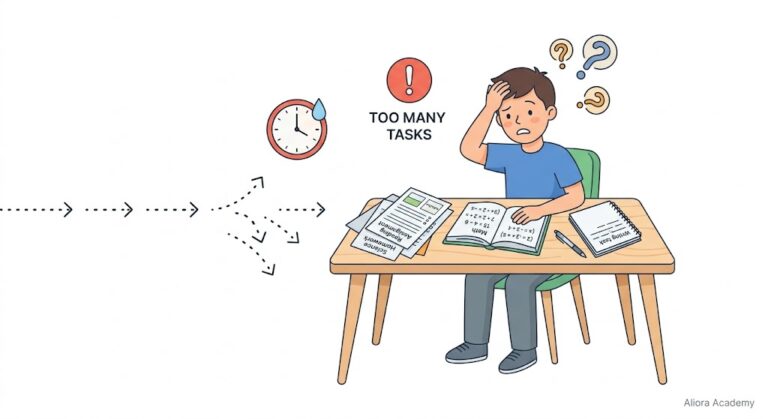
Reducing Homework Stress at Home often starts when parents notice their child sitting at the table for hours, frustrated, distracted, or refusing to begin homework at all. A common real-life situation is a Grade 3 student who starts homework after school but ends up crying over basic math problems, or a Grade 5 student delaying assignments until late evening due to stress and confusion.
This issue matters because homework is not just schoolwork; it builds study skills, discipline, and independent learning habits. When stress takes over, children lose confidence, avoid learning tasks, and slowly fall behind in subjects like English, Math, and Science. Parents also feel pressure, often unsure whether to help or step back.
The main causes are usually simple but overlooked: lack of routine, weak understanding of concepts, poor time management, and emotional pressure. With the right guidance, students can improve their academic confidence and complete assignments with less resistance and more clarity.

Why does my child struggle to complete homework on time?
Many parents notice that their child starts homework but cannot finish it on time. This is not always about laziness; it is often linked to weak learning habits or unclear understanding of classroom lessons.
In Grade 3 and Grade 4, children often struggle with basic reading comprehension or simple math steps. If concepts are not clear in school, homework becomes a stressful guessing game. For Grade 5 students, the workload increases, and multi-subject assignments require better planning skills.
Common reasons include:
- Lack of structured homework routine
- Difficulty understanding instructions
- Poor attention span or distractions at home
- Weak foundation in earlier concepts
- No clear time management system
To solve this, parents should break homework into small parts and encourage short breaks. Using structured academic guidance like an organized homework help program can also improve completion speed and understanding.
What causes homework stress in elementary students?
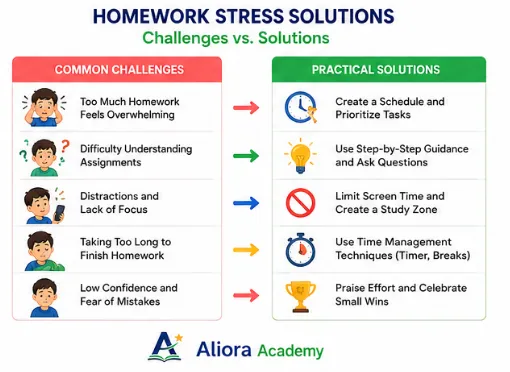
Homework stress usually develops when children feel overwhelmed by the volume or difficulty of assignments. This is especially common in students who do not have strong study skills or confidence in problem-solving.
A Grade 3 student may feel stressed simply because they cannot read instructions properly. A Grade 4 student may struggle with writing tasks or comprehension passages. A Grade 5 student may feel pressure from multiple subjects at once, including essay writing and advanced math.
Key causes include:
- Lack of understanding in class
- Too many assignments at once
- Fear of making mistakes
- Pressure from parents or teachers
- Poor academic organization
Reducing stress requires simplifying the environment. A quiet space, fixed study time, and supportive communication can significantly reduce pressure. Structured academic support, such as guided homework assistance, helps students feel more secure and less anxious.
How can parents support homework without doing it for their child?
Parents often want to help but end up completing the homework themselves. This reduces a child’s independent learning ability and long-term academic growth.
Instead of solving problems directly, parents should guide thinking. Ask questions like “What do you think comes next?” or “Can you explain what the question is asking?” This encourages critical thinking rather than dependency.
Effective strategies include:
- Setting a fixed homework time daily
- Breaking tasks into smaller steps
- Encouraging self-checking before submission
- Providing guidance, not answers
- Creating a distraction-free study space
For Grade 4 and Grade 5 students, independence is essential. Parents should gradually step back and allow children to take responsibility while monitoring progress quietly. Support systems like structured homework help for Grade 4 can also strengthen independence.
Why do some children avoid homework every day?
Homework avoidance is often misunderstood as disobedience, but it is usually linked to emotional or academic difficulty. When a child consistently avoids homework, there is often an underlying issue.
Some students avoid homework because they feel they cannot do it correctly. Others feel bored or overwhelmed by repeated failure. In Grade 3, avoidance may come from difficulty reading instructions. In Grade 5, it may come from stress due to complex assignments.
Common reasons include:
- Fear of failure
- Lack of motivation
- Unclear instructions
- Low academic confidence
- Excessive screen distractions
The solution is to rebuild confidence step by step. Start with easy tasks, appreciate effort, and gradually increase difficulty. A structured homework help approach can also rebuild motivation through guided learning and consistent practice.
How can students become more independent with homework?
Independence in homework is a skill that develops over time, not overnight. Students need guidance to build time management and organizational skills.
Grade 3 students should focus on building basic habits like completing simple tasks daily. Grade 4 students should learn to plan assignments and check their work. Grade 5 students should manage multiple subjects and prepare for middle school expectations.
Steps to build independence:
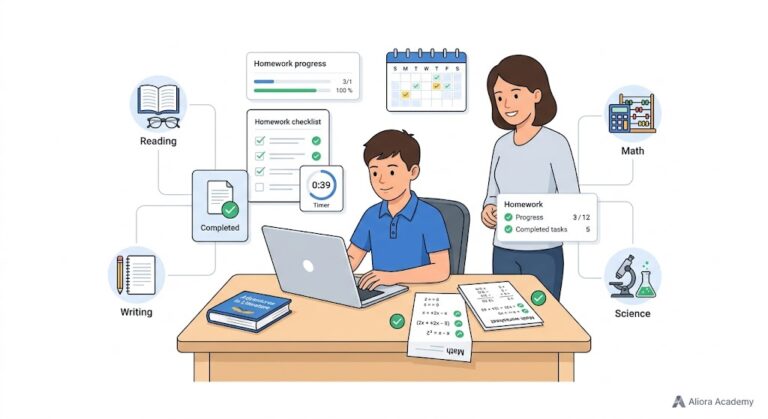
- Create a daily homework schedule
- Use checklists for assignments
- Practice reading instructions carefully
- Encourage self-correction habits
- Reduce over-reliance on parents
When students follow structured systems, their confidence improves, and they complete homework faster with fewer mistakes.
Real-Life Examples of Homework Challenges and Solutions
Example 1: Grade 3 student struggling with homework completion
A child takes 2–3 hours to finish basic math and reading tasks. The challenge is weak understanding of instructions. The solution is breaking tasks into small steps and using guided support. The outcome is improved speed and reduced frustration.
Example 2: Grade 4 student improving organization skills
A student often forgets assignments and loses worksheets. The challenge is poor academic organization. The solution is using a checklist and fixed study routine. The outcome is better responsibility and consistent homework completion.
Example 3: Grade 5 student managing multi-subject homework
A student feels overwhelmed by science, math, and essay writing tasks. The challenge is workload pressure. The solution is prioritizing tasks and creating a weekly plan. The outcome is improved student productivity and reduced stress.
How can parents reduce homework stress at home?
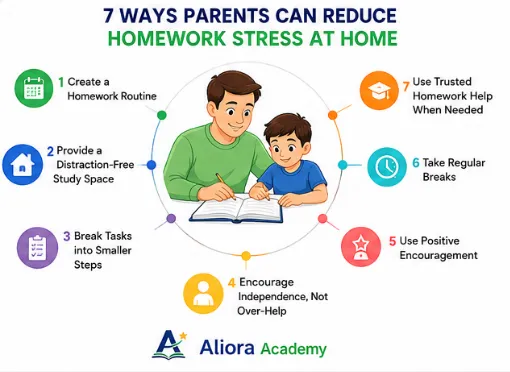
Reducing stress requires both emotional support and structured systems. A calm home environment plays a major role in helping children focus and learn effectively.
Parents should avoid pressure-based communication like “finish it fast” and instead focus on encouragement and clarity. Emotional safety helps children stay open to learning.
Practical strategies include:
- Setting realistic homework time limits
- Encouraging short breaks between tasks
- Avoiding comparison with other students
- Supporting without controlling
- Building consistent homework routines
When parents stay patient and structured, children naturally develop better focus and confidence.
FAQs
How can I help my child finish homework faster?
Help your child by creating a fixed routine, removing distractions, and breaking assignments into smaller parts. Focus on understanding, not speed, to improve long-term results.
What should I do if my child refuses to do homework?
Avoid punishment and instead identify the cause. It may be confusion, stress, or lack of confidence. Start with small, easy tasks and gradually rebuild interest.
How does online homework help improve academic performance?
Guided online homework support provides structured explanations, step-by-step learning, and practice, helping students understand concepts more clearly and build independence.
Conclusion
Managing homework stress is about balance, not pressure. When children develop strong study habits, proper time management, and clear understanding, they naturally become more confident learners.
Parents play a key role in guiding without controlling. With consistent routines and the right academic support, students in Grade 3, Grade 4, and Grade 5 can improve their homework completion, reduce stress, and build lifelong learning confidence.